

For Allan Wesaquate, painting begins with feeling rather than a fixed image. His abstract works use acrylic paint, vivid color, and fluid movement to give emotion a visible form. Layers seem to turn and shift across the surface, creating an atmosphere that can feel restless one moment and reflective the next. The paintings draw on personal experience, yet they leave room for viewers to find their own meanings within them.
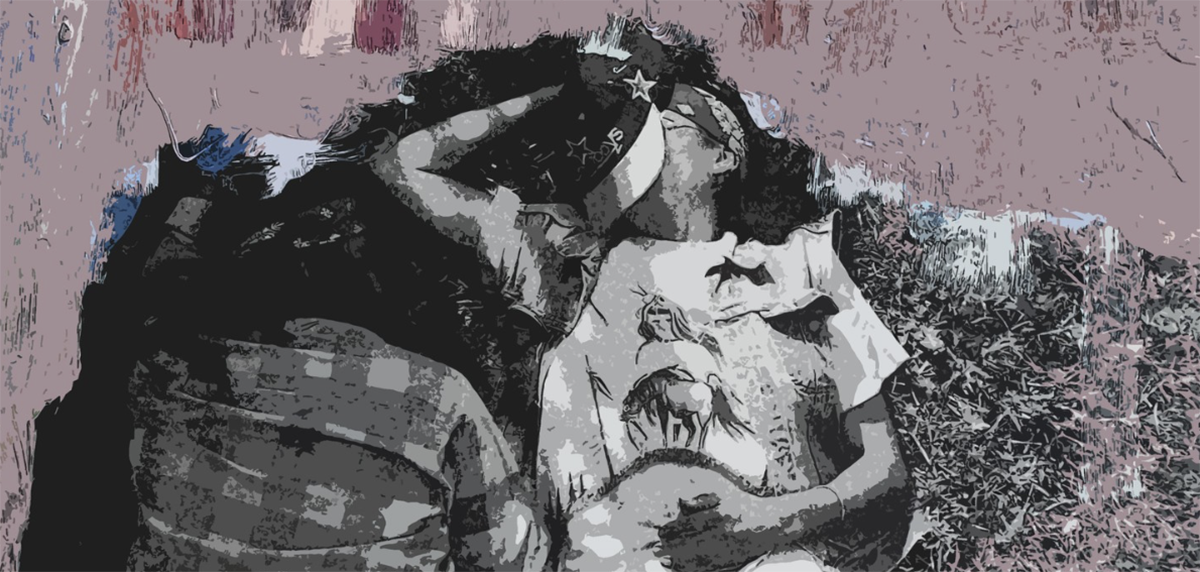
That openness also shapes a mixed media work Wesaquate made after seeing a couple in a Minneapolis park. The encounter took place while he was working on a commission concerning homeless American Indian veterans. What he saw stayed with him. On New Year’s Eve 2001, he returned to the image, applied acrylic paint, and transformed it into a mixed media piece. He says the work has never been exhibited.
A Minneapolis Encounter
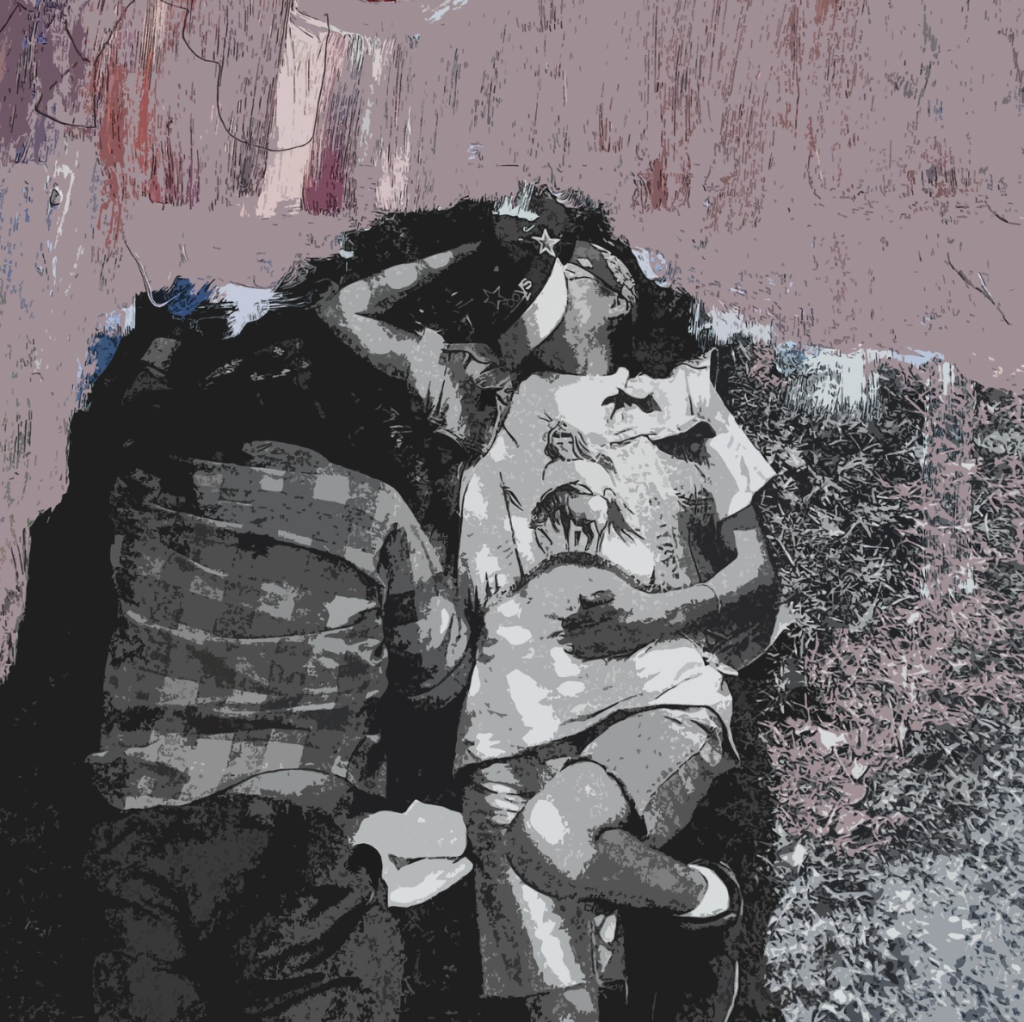
Wesaquate was commissioned by the American Indian Housing Corporation to create an exhibition about homeless American Indian veterans. During that assignment, he saw a couple in a Minneapolis park. He has shared only a few details about them, and their circumstances should not be assumed. What is clear is that the encounter remained with him and became the starting point for another work.
The assignment called for attention to people whose experiences can be overlooked. Seeing the couple brought that attention into a particular moment and place. They were two people in a park, encountered during the course of his work. By making an artwork from the experience, Wesaquate gave himself a way to return to what he had seen without reducing the couple to a general statement about homelessness.
His decision to revisit the piece on New Year’s Eve 2001 adds another layer to its history. The date marks a pause between years, a time when people often look back and consider what lies ahead. Wesaquate has not said whether that timing carried a specific meaning for him. Still, it gives us a clear sense of the work’s making: the encounter happened first, then remained in his thoughts until he took it up again with paint.
Applying acrylic changed the piece into mixed media. That change matters because it suggests the original image was only one stage of the work. Paint gave Wesaquate another way to respond to the memory. Color, marks, and layers could register feelings that a straightforward record of the encounter might leave unspoken. The resulting work holds both an observed moment and the artist’s later response to it.
There is a need for care when writing about people pictured in connection with homelessness. Wesaquate has not provided the couple’s names or told their story, so the artwork cannot stand as a complete account of their lives. It can, however, ask viewers to look closely and think about the person behind an image. The circumstances that brought Wesaquate to the park were tied to his exhibition assignment; the couple became part of a separate memory he chose to keep.
That distinction makes the work personal. It began with a commission, but Wesaquate’s account of this piece centers on something he noticed while carrying it out. The couple was not simply a subject assigned to him. They were people he encountered, remembered, and eventually brought into his art. His use of mixed media leaves room for the passage of time between those steps. The image he made on New Year’s Eve carries the experience of looking back as well as the memory of looking at them.
The fact that the piece has never been exhibited is also part of its story. Wesaquate made it more than two decades ago, yet viewers have had little opportunity to encounter it. An exhibition would place his response to the couple before others, inviting them to consider what the work preserves and what it cannot tell us. Until then, his account of its creation offers a glimpse of an artwork shaped by observation, memory, and a decision to return to an encounter that mattered to him.
Across Wesaquate’s practice, feeling finds its way into paint through movement and color. This work began with a scene rather than an abstract composition, but it shares that concern with translating experience into visual form. Its history reminds us that an artwork can grow from a brief meeting and remain unfinished in the public sense: made, kept, and still waiting to be seen.
