

Sebastian Di Mauro is an accomplished Australian artist whose multidisciplinary practice investigates the connections between material, cultural identity, historical narratives, and the environments that shape human experience. Born in Innisfail, Queensland, and working between Brisbane and the United States, he has developed an internationally recognised career spanning more than three decades. His artistic language moves fluidly between sculpture, painting, textiles, installation, and artist books, transforming familiar materials into compelling reflections on place and collective memory.
With more than 45 solo exhibitions and participation in over 100 group exhibitions, Di Mauro has established a substantial presence in contemporary art. His works are represented in prominent Australian public collections and have appeared in international exhibitions, including a presentation associated with the 59th Venice Biennale. Combining material experimentation with historical inquiry, Di Mauro continues to challenge conventional perceptions of landscape, revealing the complex relationships between beauty, labour, power, and cultural inheritance.
Abridged Landscape (2026): Uncovering the Hidden Histories of Place
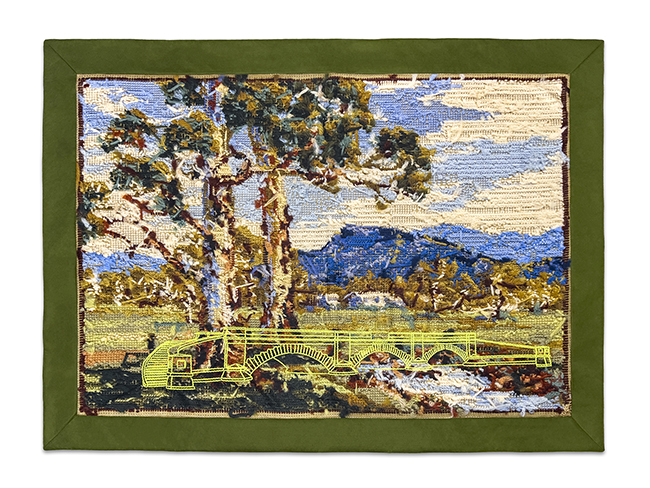
Title: Abridged Landscape
Year: 2026
Medium: Digital print on Twill Waratah fabric, hand-stitched blended yarn, brown felt border
Dimensions: 69.7 × 93 inches
In Abridged Landscape (2026), Sebastian Di Mauro presents a visually intricate meditation on the relationship between landscape, historical memory, and the often-overlooked human labour embedded within the built environment. Through an unexpected combination of digital printing, textile construction, and hand stitching, the artist transforms a seemingly picturesque landscape into a critical examination of colonial history. The work challenges viewers to reconsider the familiar beauty of pastoral imagery, revealing how landscapes can simultaneously preserve cultural memory and conceal uncomfortable historical truths.
The composition initially invites attention through its richly textured depiction of an idyllic natural setting. Towering trees dominate the foreground, their twisting branches spreading across a landscape of distant mountains, open fields, and expansive skies. The intricate visual details recall traditional decorative tapestries, objects historically associated with domestic refinement, craftsmanship, and the romantic appreciation of nature. Yet the image contains an important disruption: rather than presenting the polished front of a tapestry, Di Mauro reproduces its reverse side, exposing the irregularities and underlying construction of the woven image.
This reversal becomes central to the work’s conceptual meaning. By revealing the underside of a decorative object, Di Mauro introduces a metaphor for the concealed structures supporting familiar representations of beauty. The reverse of the tapestry suggests that every carefully composed image possesses another dimension, one that may be less orderly, less comfortable, and more revealing. What initially appears to be a straightforward landscape becomes an invitation to investigate what lies beneath its surface.
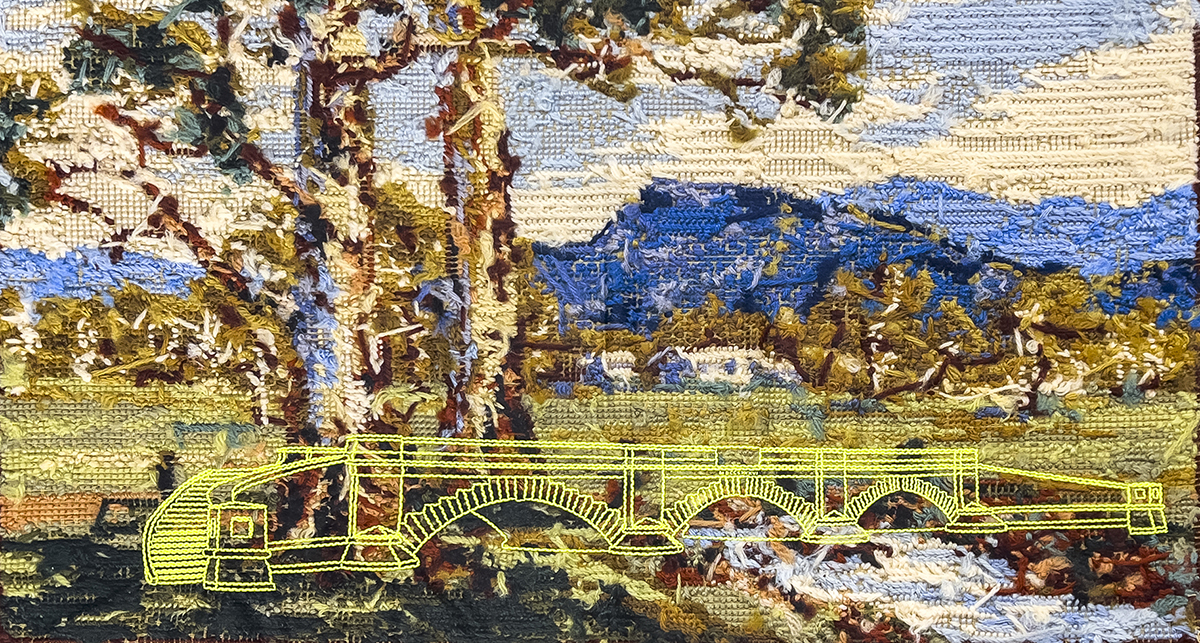
Across the lower portion of the composition, a striking architectural element emerges through vivid stitched lines. The structure represents the historic Ross River Bridge in Tasmania, constructed through the labour of convicts who worked without pay. Its presence interrupts the natural scenery, establishing a deliberate contrast between the idealised landscape and the realities of colonial infrastructure.
The bridge is particularly significant because it represents more than an architectural achievement. It becomes a symbol of the human experiences, unequal power relationships, and systems of exploitation that contributed to the development of colonial Australia. By inserting its form into a decorative landscape, Di Mauro draws attention to the historical conditions that conventional representations of place may overlook.
The stitched bridge possesses a distinctive visual character. Its bright, linear construction stands apart from the richly coloured and densely textured landscape behind it. This contrast prevents the architectural intervention from disappearing into the surrounding scenery. Instead, the bridge asserts itself as an unmistakable historical presence, demanding recognition within an otherwise harmonious image.
The act of stitching also introduces an important conceptual relationship between artistic labour and historical labour. Each thread represents a deliberate physical intervention, recalling the repetitive movements and sustained effort associated with textile production. Within the context of the bridge’s history, this process acquires additional significance. Di Mauro uses the patient, cumulative nature of handwork to evoke the human effort underlying the construction of infrastructure.
Materiality plays an equally important role in the artwork’s interpretation. The digital print on Twill Waratah fabric establishes a relationship between technological reproduction and traditional textile practices, while the hand-stitched blended yarn introduces a tactile dimension that resists the uniformity of the printed image. The brown felt border further reinforces the object’s material presence, presenting the landscape as something constructed, framed, and culturally mediated rather than simply observed.
The combination of digital and handmade processes also reflects the layered nature of historical interpretation. Just as the printed tapestry preserves the appearance of an earlier decorative tradition, the stitched intervention introduces another historical narrative. Neither element completely replaces the other. Instead, they coexist in a complex visual dialogue, suggesting that our understanding of place is shaped by multiple, sometimes conflicting accounts.
Ultimately, Abridged Landscape questions the innocence of picturesque representation. Di Mauro does not reject the visual pleasure offered by the landscape; rather, he complicates that pleasure by introducing the histories that exist alongside it. The work asks viewers to recognise that environments celebrated for their natural beauty may also bear the traces of coercion, displacement, and exploitation.
Through this thoughtful interplay of image, material, and historical reference, Di Mauro transforms a decorative landscape into a site of critical reflection. Abridged Landscape demonstrates how contemporary art can recover overlooked narratives, encouraging a more attentive understanding of the relationship between cultural memory and the places we inhabit.
