

Philip Murphy has worked as a full-time artist since around 2020, following his fine art studies at the College of Marketing and Design in Dublin. Working in oils, charcoal, pastels, and graphite, he moves between landscape and figurative subjects. His interest in mark making leads him to use brushes, palette knives, fingertips, and even balls of sheep’s wool. Some passages approach abstraction, allowing the movement of a hand or the pressure of a material to carry as much meaning as the subject itself. Time runs through his practice: its passing, its effects on the things we see, and the traces it leaves behind. In his figurative work, Philip also explores a feeling that a person exists beyond physical form. Energy and instinct matter to him alongside appearance, giving his images room to express what may be sensed but cannot be easily seen.
Philip’s range of materials suggests an artist who wants each work to develop through the act of making it. Oil paint allows him to move between dense, worked passages and more open gestures. Charcoal and graphite can leave a direct record of pressure and movement, while pastel offers another way to build or interrupt a surface. These differences matter because a mark can convey more than an outline. It can feel tentative, insistent, hurried, or considered.
His willingness to work with unconventional tools expands that vocabulary. A palette knife meets a canvas differently from a brush; a fingertip brings the artist’s touch directly into the image. Sheep’s wool introduces still another kind of contact. Philip’s choices invite attention to how an image was formed as well as what it depicts. As a result, the surface can become a record of decisions made over time.
The relationship between observation and abstraction gives his practice much of its openness. A landscape may begin with a recognizable place, yet its marks can lead the eye toward texture, rhythm, and change. A figure can be present without being confined to a precise description of the body. When Philip lets a mark approach abstraction, he creates space for feelings that a literal image might struggle to hold.
His thoughts about figurative work offer a way into this approach. Philip is interested in the sense that people are more than their physical form—that energy and instinct are part of being alive. Paint or drawing cannot show those qualities as fixed objects. It can, however, suggest them through movement, tension, and the way marks gather or pull apart. A figure, in this context, becomes a place to consider both what is visible and what is felt.
Time connects these concerns. Every artwork takes shape through a sequence of actions, and its surface preserves something of that process. Philip is also drawn to subjects that carry evidence of change. Weather, wear, and endurance can be read in a landscape or an object, just as experience can be felt in a person. His interest is less in stopping a moment than in acknowledging what has happened before it and what may happen next.
That outlook gives ordinary materials and structures room to carry emotional meaning. A fence, for example, has a practical purpose: it marks a boundary and depends on its posts and wires to remain standing. Yet it also changes as it ages. Looking closely at such a structure can lead from its physical condition to questions about reliance, vulnerability, and support.
Philip’s work invites that kind of sustained attention. Rather than asking a medium to produce a single, uniform finish, he allows varied marks to remain active within the image. Rather than treating a subject as an object to be described completely, he considers what it might reveal about living through time. Across his landscapes and figurative works, the tangible and the intangible meet: material touches a surface, while memory, instinct, and feeling shape what the viewer takes from it.
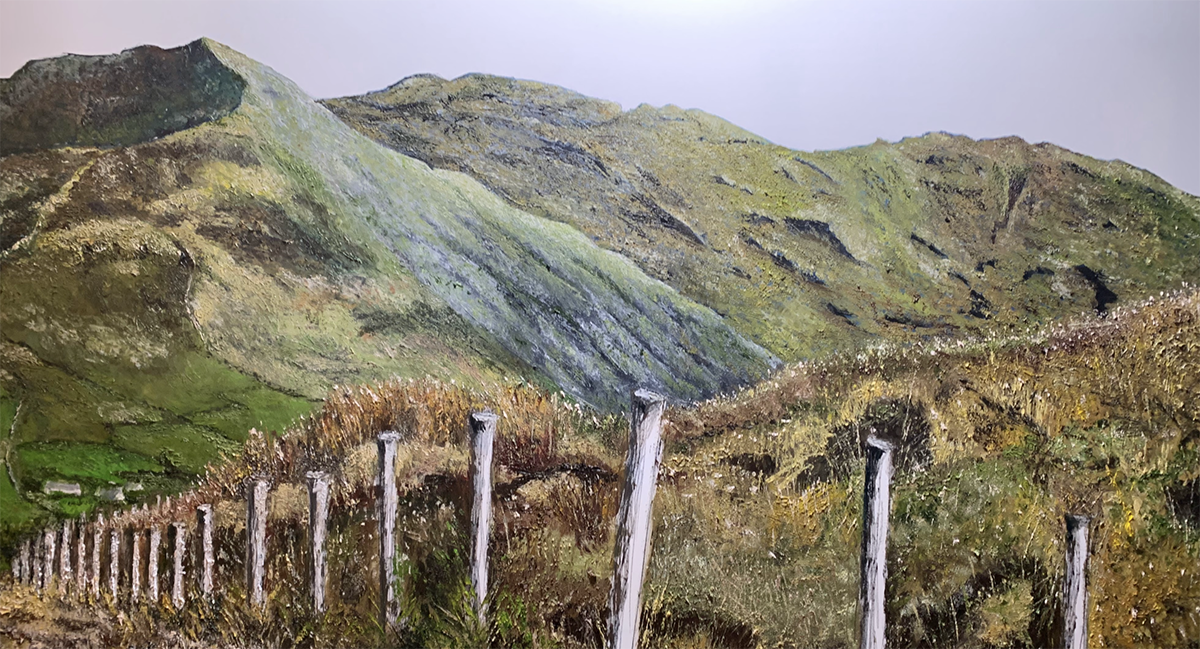
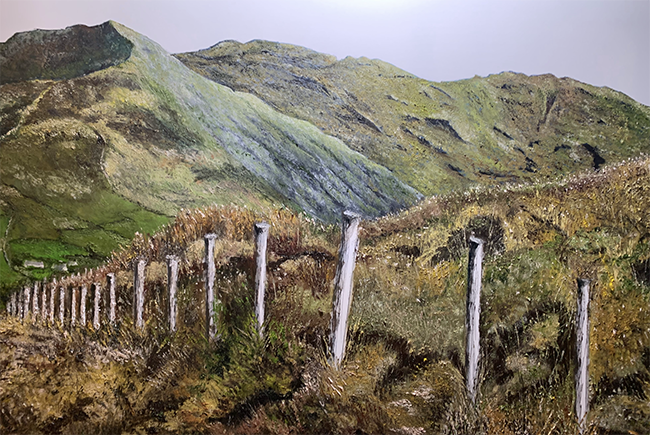
Fencing: What Holds Us Together
Oil on canvas, 80 × 120 cm
In Fencing, Philip uses the lifespan of boundary fencing to reflect on human insecurity and the need for connection. A fence is built to divide space, but it cannot remain upright through the strength of one part alone. Posts and wires depend on one another. Weather acts on them, time wears at them, and still the structure holds together. For Philip, that persistence offers a way to think about how people rely on family and friends throughout their lives.
The subject carries a useful tension. A boundary can offer reassurance: it tells us where one space ends and another begins. It can also suggest a wish to protect ourselves from uncertainty. Philip’s description brings both ideas into the work. The fence speaks to insecurity because it exists to establish a limit. At the same time, its own survival depends on a network of connections. The structure meant to create separation becomes an image of mutual support.
The wires are central to that reading. They join the fence’s parts and continue to hold them together as the structure ages. Philip compares that role to the support people receive from those close to them. The comparison does not require every relationship to be easy or every connection to stay exactly as it was. Wires can be strained; people can experience pressure and change. What matters is the continuing act of holding on and helping one another through those changes.
Weather and time give the metaphor its depth. A newly made fence may appear firm, its purpose clear. Over a lifespan, it is exposed to conditions it cannot control. That gradual wear recalls the way people encounter difficulties they did not plan for. Insecurity may grow from those experiences, but so can an understanding of whom they can turn to. Philip finds meaning in the fact that the fence remains held together despite what it has endured.
Oil paint is well suited to a subject concerned with duration. It can be moved, layered, and reworked, allowing the making of the image to echo the passage of time that interests Philip. His wider practice places value on marks made by different tools and gestures. In a work such as Fencing, that interest encourages a viewer to consider both the fence as a subject and the physical marks through which it is expressed.
The painting’s 80 × 120 cm canvas gives this everyday structure room to sustain attention. A fence is easy to pass without a second look because its function is so familiar. Philip asks us to pause with it. Once we do, its purpose becomes more complicated. It marks a boundary, yet depends on links. It appears exposed to the elements, yet persists. It may show the effects of time without losing its ability to hold together.
Because Fencing belongs to a series, its theme extends beyond one structure. The lifespan of boundary fencing becomes a recurring way to consider the human need for society. Philip finds an accessible image for an experience that can be difficult to describe: we want security, yet none of us can provide it entirely for ourselves. We need other people, particularly when circumstances test us.
The work leaves room for the viewer’s own memories. One person may think of family members who offered steady support; another may think of friends who helped during a difficult period. Others may recognize the effort required to maintain those ties. By grounding these thoughts in a familiar object, Philip gives the idea a physical form. Fencing reminds us that enduring is rarely a solitary act.
