

Born in Montreal in 1964, Adamo Macri studied commercial art, graphic design, photography, art history, and fine arts at Dawson College. That broad education remains visible in a practice that moves among sculpture, photography, video, painting, and drawing. Sculpture holds a central place in his work, but his interest in form is not confined to objects that can be viewed from every side. An image can also feel sculptural through its attention to volume, surface, and the space a figure occupies. Macri often brings these concerns together, asking how a setting can shape the presence of a person within it. In his Concrete Facade series, architecture becomes inseparable from the figures it surrounds. Stone appears to carry a history of bodies and images, while the human form seems capable of merging back into the structures from which it emerged.
Concrete Facade V (2026)
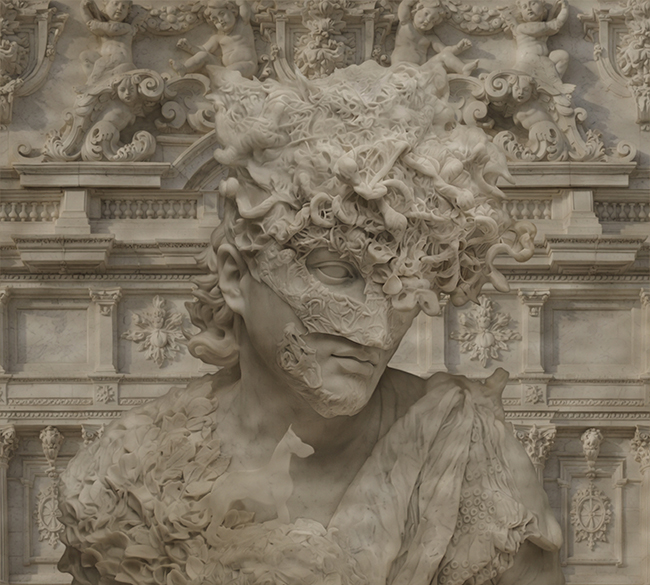
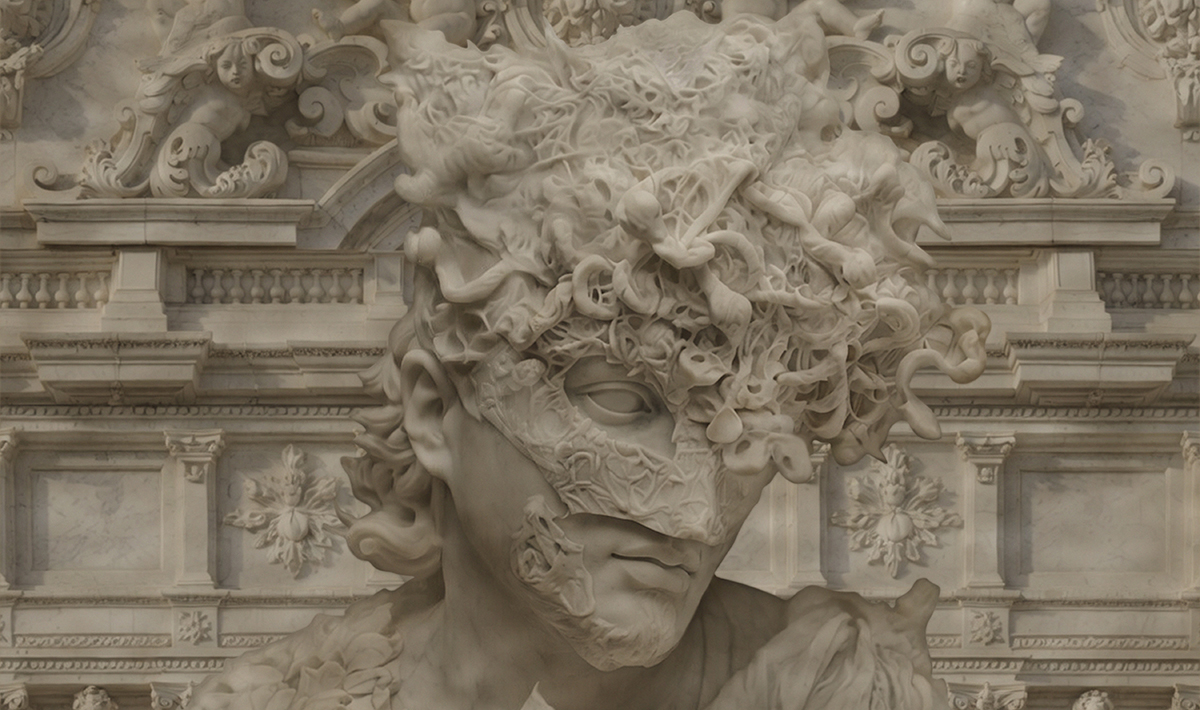
In Concrete Facade V, the fifth work in the series, Adamo Macri brings the figure into an unusually crowded architectural setting. Ornament covers the façade and presses toward the statue at its centre. Carved foliage, flowers, curling forms, drapery, masks, and sculptural fragments compete for space. The eye moves through this abundance before it can settle on the figure. Even then, it is difficult to say where the statue ends and its surroundings begin.
The work draws on the visual language of the Baroque, with its taste for movement and elaborate decoration. Macri uses that language to complicate the relationship between a person and a building. At first, the statue might appear to stand in front of the façade, as a figure displayed against an ornate background. A longer look suggests a closer connection. Its costume and features seem subject to the same decorative forces as the architecture. The figure appears to have grown out of the façade, or to have been assembled from its materials.
This exchange gives the composition a sense of motion despite its stone-like stillness. The carved forms seem ready to spread across the figure, while the figure seems close to becoming part of the wall. Ornament takes on a role beyond embellishment. It shapes the body, interrupts its outline, and partly determines what can be seen of its face. Macri leaves the viewer with a question that runs through the image: does the architecture give the statue its identity, or is it taking that identity away?
The face makes this uncertainty especially vivid. Human features remain visible, yet they are partly hidden beneath forms that suggest a mask or an elaborate growth. The statue can be read as a portrait, but it offers few clues to a distinct individual. It also resembles a relic whose original meaning has become difficult to recover. Macri keeps both possibilities in play. The figure appears present and remote at once, held between a recognizable human expression and the carved world around it.
The monochromatic treatment draws these elements still closer. Architecture, clothing, skin, and ornament share a stone-like appearance, making differences in material less certain. The result can feel like one continuous sculpture rather than a figure placed within a separate setting. This visual unity lends the work grandeur, but it also creates a feeling of confinement. The statue has a commanding position at the centre, yet the surrounding detail leaves it little room to exist on its own.
That contradiction gives the decorative richness an emotional weight. Flowers and foliage might suggest growth; theatrical folds and carved figures might suggest celebration. Here, their sheer density can also feel oppressive. The façade offers the statue a form and a place, while threatening to cover it. Macri allows beauty and unease to occupy the same image without resolving one into the other.
Concrete Facade V can also be understood as a reflection on inherited images. Architecture carries the marks of the people and cultures that make it: choices about beauty, status, belief, and remembrance. The statue stands amid those accumulated forms. Its appearance seems shaped by them, as though a body could be made from the histories surrounding it. At the same time, the figure’s partially concealed face suggests how difficult it may be to remain visible beneath that inheritance.
There is a theatrical quality to this encounter. The façade resembles a stage crowded with decoration, and the statue holds the central position without revealing its role. It might be a guardian, a ceremonial figure, or an apparition caught within a monument. Macri leaves its identity open, inviting viewers to consider their own relationship with the spaces and images that shape how they are seen.
Rather than recreating a historical building, Macri uses architectural language to imagine a structure that feels both familiar and strange. Its ornament seems to possess a life of its own. In Concrete Facade V, the building does more than surround a human figure: it helps make one, then draws it back into stone.
