

Jane Gottlieb approaches photography as the beginning of an imaginative journey. Across a career spanning more than fifty years, she has transformed photographs taken around the world into artworks shaped by painting, color, and digital experimentation. Her work combines photography, painting, and Photoshop, allowing familiar places and objects to take on unexpected visual identities. A few years ago, an exhibition at the UC Santa Barbara Art, Design & Architecture Museum explored her images of France, presenting the progression from hand-painted Cibachrome prints to versions transformed through Photoshop. This relationship between the photographic image and its reinterpretation remains central to her practice. Gottlieb’s artworks have appeared in museums, galleries, public spaces, and international art expos, and are represented in private and corporate collections. Throughout her work, a sustained interest in composition and an expressive use of color invite viewers to experience the world through her personal vision.
For Gottlieb, a photograph offers both a connection to reality and an opportunity to move beyond it. Buildings, landscapes, sculptures, and other subjects retain enough detail to remain recognizable, yet their colors can depart entirely from everyday appearances. The viewer encounters something familiar while entering an atmosphere that belongs to the artist’s imagination. This balance gives her images their distinctive appeal: they preserve the pleasures of looking closely while encouraging a more adventurous way of seeing.
Color carries much of that adventure. Gottlieb uses it to establish mood, organize space, and redirect attention. A surface that might ordinarily recede into the background can become the center of an image through an unexpected hue. Architectural details acquire new rhythms when neighboring areas are separated by contrasting colors. Rather than treating color as a finishing touch, she makes it an active part of the image’s structure, influencing how the eye travels and how the subject is experienced.
Her hand-painted Cibachrome works bring photography into direct conversation with the gestures of painting. The photographic print supplies the underlying information, while the application of color introduces another layer of interpretation. Within this approach, the camera’s description of a place becomes inseparable from the artist’s response to it. The resulting artwork carries two kinds of attention: the initial act of selecting and photographing a subject, and the later act of reconsidering its surfaces, relationships, and atmosphere.
Photoshop extends this process of reconsideration. In her broader practice, digital tools provide additional ways to reshape the relationships between color, form, and space. The transition between physical painting and digital transformation reflects a continuing curiosity about what an image can become. Each method offers different possibilities, but both serve her interest in translating observation into a personal visual language. The subject remains a starting point, open to further discovery through experimentation.
The exhibition devoted to France at UC Santa Barbara offered a useful perspective on this relationship. By showing hand-painted Cibachromes alongside transformations of the same images through Photoshop, it allowed viewers to consider how one photographic source could support different artistic decisions. Such comparisons draw attention to the choices behind an artwork. Changes in color and emphasis can alter the emotional character of a scene, revealing how interpretation develops through the artist’s handling of an image.
Travel has supplied Gottlieb with photographs and visual experiences that continue to inform her work. Yet her images are more than records of destinations. They express the freedom to revisit a place through imagination, giving remembered architecture or scenery a different emotional temperature. A location becomes part of an ongoing creative process rather than a fixed view. Through this approach, the experience of travel continues after the photograph has been taken, unfolding again through painting and digital exploration.
Joy is an essential quality of Gottlieb’s artistic outlook. Her enthusiasm for color and composition encourages viewers to linger, follow visual connections, and enjoy the unexpected. That pleasure does not depend on knowing the original location or understanding every stage of production. It begins with the immediate encounter between the viewer and the image. Over more than five decades, Gottlieb has sustained a practice in which observation opens into possibility, and photography becomes a means of creating a world that feels both recognizable and newly imagined.
Brancusi Head: Color, Scale, and an Unexpected Encounter
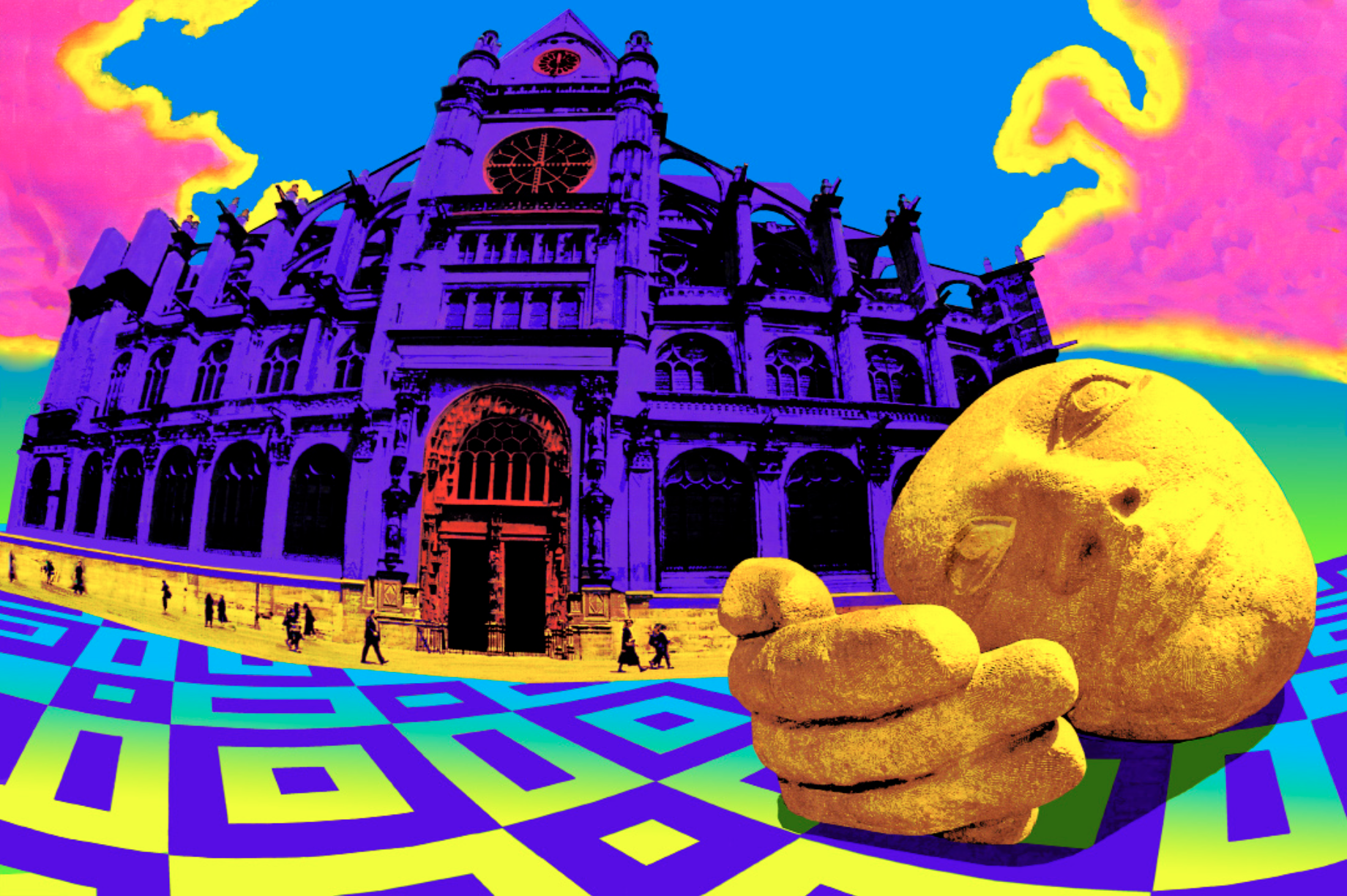
Brancusi Head, dated 1977 and painted in 1989, is identified as an archival hand-painted Cibachrome print. In the supplied image, Jane Gottlieb brings together an elaborate architectural façade, a sculptural head and hand, and a vividly patterned foreground. The scene is recognizable in its individual elements, yet their combination creates an atmosphere of visual fantasy. Photography provides the descriptive framework, while intense color changes the relationships within it, turning a view of public space into an imaginative encounter between architecture, sculpture, and pattern.
The building dominates the background through its size and intricate construction. Arches, columns, circular windows, and dark openings create a dense arrangement of repeated forms. Gottlieb’s purple treatment unifies these details without erasing their differences. Black shadows preserve the depth of the façade, while red accents emphasize the central entrance and circular window above it. These warmer areas establish a vertical connection through the building, giving the eye a route amid the surrounding architectural complexity.
In the foreground, the large golden head introduces a different language of form. Its rounded surface contrasts with the building’s angular structure and layered ornament. The head tilts sideways, its simplified features suggesting a quiet expression. Nearby, the hand appears as a compact grouping of curved volumes. Together, these sculptural elements occupy much of the right side of the image. Their proximity makes them feel immediate, while the building becomes a theatrical setting extending behind them.
Scale contributes to the scene’s unusual character. Small pedestrians along the base of the building offer a measure of ordinary human activity. Against them, the sculptural forms seem immense. This contrast creates a playful uncertainty about the viewer’s position: the scene feels grounded in a photographed location, but its foreground draws us into a more fanciful spatial experience. The people remain part of daily life while the head and hand seem to inhabit another rhythm.
The ground intensifies that uncertainty. Purple geometric shapes spread across areas of turquoise, green, and yellow, forming a pattern that expands toward the lower edge. Its changing angles suggest movement and depth, yet the bright colors also make it read as a decorative surface. The eye moves between interpreting the foreground as a plane beneath the sculpture and enjoying it as an arrangement of shapes. This dual reading keeps the composition visually active.
Above the building, blue sky meets broad pink areas edged with yellow. These irregular borders contrast with the more controlled geometry below. Their curling shapes introduce a sense of motion around the roofline, framing the architecture without following its contours. The sky consequently becomes an expressive component of the artwork. Its saturated colors help connect the upper and lower portions of the composition, preventing the background from functioning simply as empty space.
The dates attached to the work suggest an interval between the original photographic image and its painted transformation. That separation offers a way to understand Gottlieb’s process as a return to an earlier visual experience. A photograph can remain available for reinterpretation long after its initial creation. Here, the application of color gives the recorded scene a renewed identity. The artwork holds together the camera’s attention to visible detail and the painter’s freedom to alter its emotional effect.
Ultimately, the image invites prolonged looking through the tension between stillness and activity. The sculptural face appears calm, while the surrounding colors and patterns keep the eye moving. Architecture supplies order, and the palette introduces surprise. Gottlieb brings these qualities together in a composition where familiar forms become participants in an exuberant visual world, offering pleasure through contrast, imaginative association, and the transformation of photographic space.
