

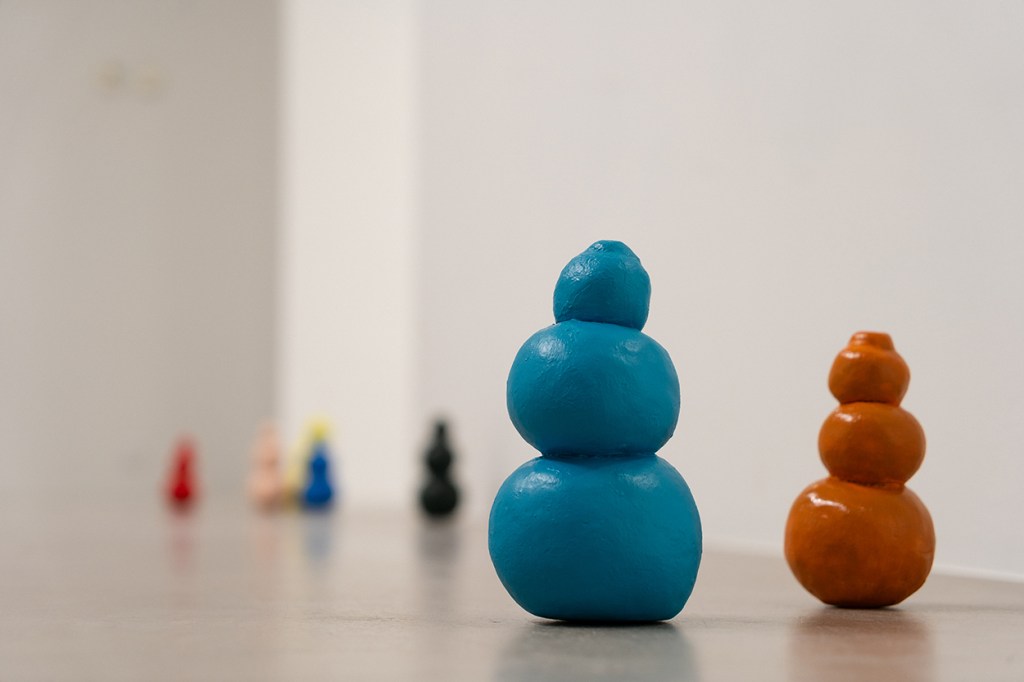
Anyone with empathy for dogs will feel an infectious joy when visiting Emilie Gossiaux’s exhibition at the Trondheim Art Museum in Norway. Before you even get in, you’ll notice the Kongs—those round rubber cones that dogs stick their tongues into, slowing down their gobbling of peanut butter and turning it into a game. As you walk through the museum’s two floors, you never stop noticing the Kongs. There are more than 100 ceramic holes, all handmade by Gossiaux. They’re painted in nearly every color—safety orange, metallic gold, deep purple—and stand out against the ubiquitous Norwegian gray cement floors.
Gossiaux created the exhibition, “Kinship,” as a tribute to her guide dog, London, who recently retired after caring for the artist for more than a decade. Now, Gosioks, who is blind, devotes himself to caring for London. The result is her best exhibition to date. In a recent talk at the Canal Project in New York, the artist described the exhibition by saying she wanted to create a “wet dream” for London, a “palace of pleasure”.

Emily Louise Gosioux: fingers and tongue (2023).
Photo: Torstein Olav Eriksen/Kunsthall Trondheim. Contributed by Emily Louise Gosio.
Kinship celebrates this beautiful interdependence between girl and dog. It also requires you to embrace your inner animal. You follow the Kongs as if sniffing a path that leads first to the elevator and then downstairs, where they rest on a low base painted the same green as the Astor Turf found in dog parks. In the building’s stepped seating, Gosioak placed dog beds next to the plush pillows that would normally be placed there. There are also drawings hung low enough for puppies to peek; some are even drawn from the dog’s perspective. If you are ambulatory and are of average height, this low overhang may be surprising or strange. If you’re more accustomed to navigating a world that wasn’t built for you, you’ll recognize the gesture of adaptation.

Emily Louise Gosioux: Good morning2024.
Photo: Torstein Olav Eriksen/Kunsthall Trondheim. Contributed by Emily Louise Gosio.
The drawings focus on moments of mutual care. One shows a naked Gosioux, her skin similar in color to her yellow Labrador’s fur, crouching down to hug her dog. She brings London down here, and throughout the show asks her audience to do the same. The drawings are done with ballpoint pens and crayons, and the lines are impressively simple: in a photo of London licking Gosioux’s forehead, a curve suggests the artist lying in bed, still beneath the sheets. The piece is tender and sweet, but not at all sentimental or cliche – a tricky balance to strike.

Installation view of “Emilie Louise Gossiaux: Kinship” at the Trondheim Art Museum, 2024.
Photo: Torstein Olav Eriksen/Kunsthall Trondheim. Contributed by Emily Louise Gosio.
It’s a show about joy and joy, but in a provocative way, not an innocent way. Because it reminds us of a fundamental truth about disability: When life circumstances require us to adapt, we can rise to the challenge and create beautiful new things in the process. After all, many of the norms that inconvenience disabled people so much—font size, the height at which paintings are hung—are completely arbitrary and therefore open to reinvention.
Then there are images of London in the afterlife – and eventually retirement. Gosio drew her with his wings, and like a butterfly or an angel, she floated toward the sun. In the small sculpture, London and her people combine to form a super creature with a dog head, a humanoid body and six nipples. Another sculpture shows London licking a disembodied human hand. The opposite: a human tongue licking her paws. These pieces are reminiscent of the votive sculptures of ancient Egypt, where animals were much more revered than today and may have been seen as incantations from the gods.
