

Carolin Rechberg is an artist who resists categorization, working across disciplines with a practice rooted in material inquiry, sensory awareness, and philosophical depth. Born in Starnberg, Germany, she engages a wide spectrum of media—ranging from ceramics and drawing to installation, painting, performance, printmaking, photography, poetry, sculpture, sound, textiles, and voice. Rather than specializing in a single form, she approaches art as an interconnected ecosystem where mediums inform and expand one another. For Rechberg, creation is not merely a means to produce an object; it is an embodied act of exploration. Touch, rhythm, breath, and intuition guide her process. The experience of making carries equal—if not greater—importance than the finished result. Her works function as immersive encounters, inviting viewers into spaces where perception sharpens and inner transformation becomes possible. Art, in her practice, is alive: a site of movement, awareness, and renewal.
A Fountain of Life (2026)
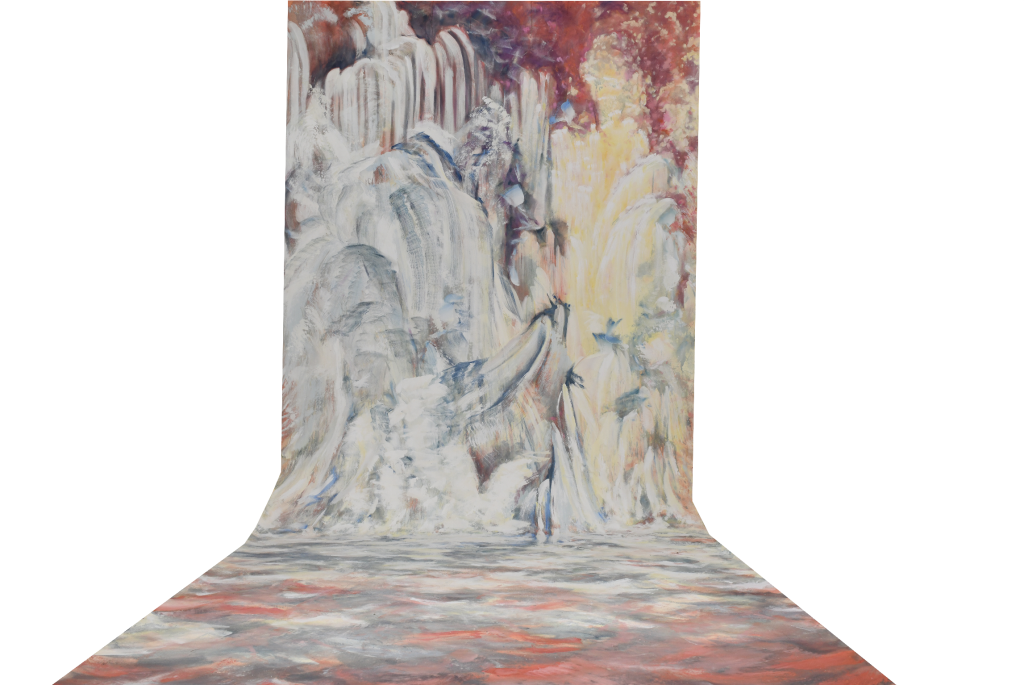
Mixed Media on Canvas
H 265 cm × W 211 cm × D 208 cm
With A Fountain of Life, Rechberg redefines the boundaries of painting, expanding it into a spatial and almost architectural experience. Standing more than two and a half meters tall, the work possesses a commanding physical presence. The canvas does not remain contained within a vertical plane; instead, it flows outward onto the floor, dissolving the line between wall and ground. This gesture transforms the piece from an image to be viewed into an environment to be entered.
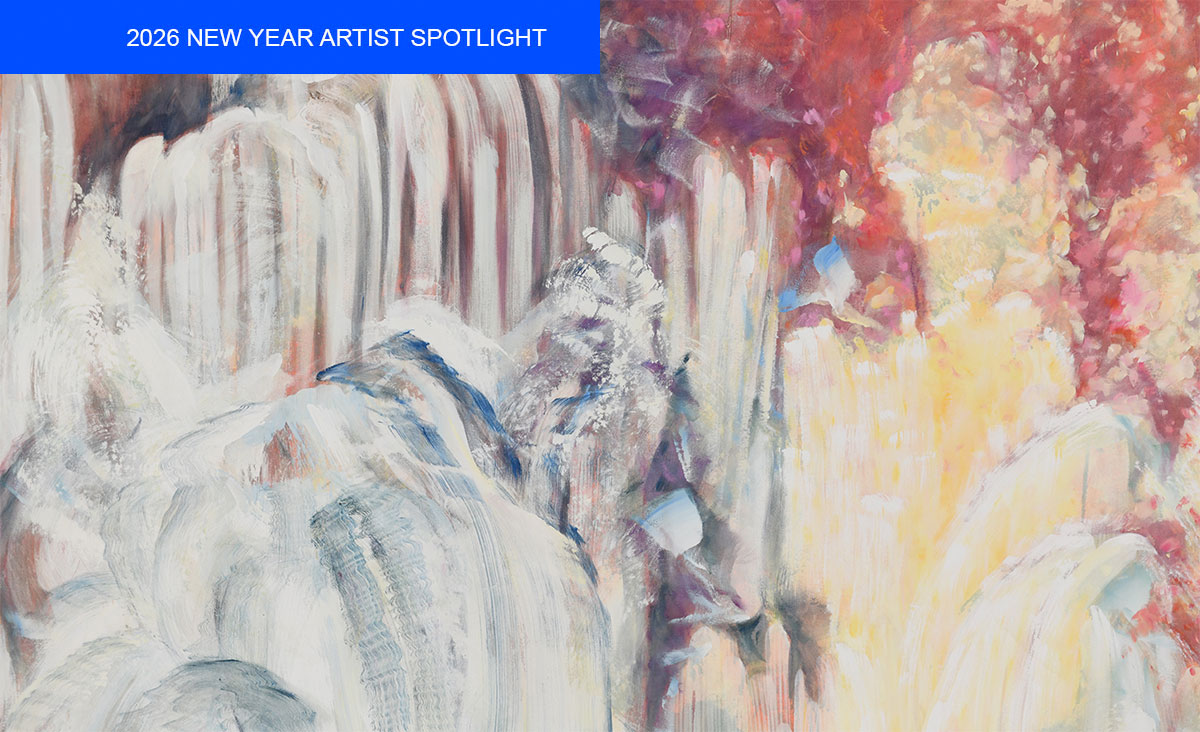
The composition suggests a torrent of radiant energy cascading downward from a blazing canopy of color. At the upper edge, intense reds, oranges, and yellows glow with heat and luminosity, evoking combustion and vitality. As the eye descends, the palette gradually cools into pale whites, muted greys, and gentle blues, creating a visual transition from intensity to stillness. Broad, gestural strokes and layered textures animate the surface, conveying motion, gravity, and continuous release. The paint appears to surge and spill, reinforcing the impression of an unstoppable, life-giving current.
This waterfall-like imagery carries an inherent duality. It implies force and potential destruction, yet equally suggests nourishment and regeneration. Near the base, the rushing color disperses into a reflective expanse reminiscent of water pooling at the earth’s surface. The viewer’s gaze follows the downward movement before circling back toward the luminous source above, enacting a cyclical rhythm of fall and return.
Rechberg’s interdisciplinary sensibility is evident in the way she manipulates space. The painting behaves like a hybrid between sculpture and stage, enveloping the viewer in its scale and momentum. Its extension into the room heightens bodily awareness—one almost senses the mist, the weight of gravity, the shimmer of refracted light. Rather than depicting nature, the work evokes its energy. It becomes an atmosphere charged with motion.
Symbolically, A Fountain of Life can be read as an allegory of renewal. The passage from fiery eruption to reflective calm suggests transformation—movement from chaos toward integration. It proposes a source of vitality that continuously feeds experience. In this sense, the painting embodies Rechberg’s conviction that art is not static but perpetually unfolding. The viewer is drawn into this flow, becoming part of the exchange between color, force, and spatial presence.
The Dying and Ascending Self / Shedding Skins to Rise to Life (2024)
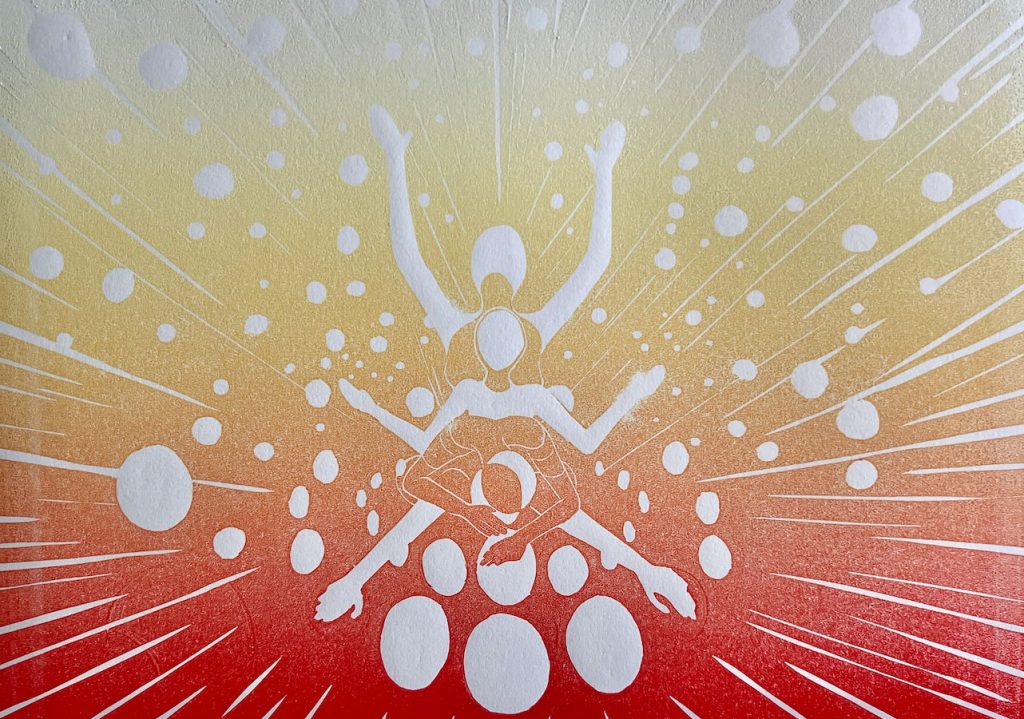
AP Linocut Color Print on Paper
42 × 30 cm
In contrast to the expansive scale of A Fountain of Life, The Dying and Ascending Self / Shedding Skins to Rise to Lifeoffers a concentrated meditation on transformation through the intimate medium of printmaking. Though modest in dimension, the linocut resonates with symbolic intensity.
At the center stands a stylized human figure rendered in stark white against a radiant gradient that shifts from deep crimson at the base to luminous gold above. The body appears layered and multiplied, its arms extending outward and upward in gestures that simultaneously suggest surrender and transcendence. Around it float circular forms—white spheres that may evoke seeds, cells, or celestial bodies—while sharp, radiating lines amplify the sensation of outward expansion.
The striking contrast between the glowing background and the simplified silhouette heightens the work’s visual drama. Without individualized features, the figure becomes archetypal, embodying a universal process of change. The repeated limbs suggest overlapping phases of identity, as though different versions of the self coexist within a single frame. The title’s reference to shedding skins is echoed in the imagery: the body seems to dissolve even as it rises. Descent and ascent occur at once, reflecting the paradox of transformation.
The linocut process reinforces this idea. Carving into the block requires cutting away material—an act of removal that parallels the metaphor of shedding layers. Each printed impression carries subtle variations, reflecting cycles of repetition and renewal. As an artist’s proof, the work underscores experimentation and evolution, aligning with Rechberg’s emphasis on process as discovery.
Together, these two works reveal complementary dimensions of transformation. A Fountain of Life externalizes change through elemental force and immersive scale, while The Dying and Ascending Self turns inward, focusing on the metamorphosis of identity. Across mediums and formats, Rechberg explores existence as an ongoing act of becoming. Her art articulates the delicate balance between dissolution and emergence, encouraging viewers to embrace vulnerability and recognize renewal as an intrinsic rhythm of life.
