

Newly discovered murals and human remains on Pompeii’s surface

Image source: Courtesy of Pompeii Archaeological Park
Archaeologists continue to excavate the ancient Roman city, which was preserved in volcanic ash after the eruption of Mount Vesuvius in 79 AD, and this year they have made a number of noteworthy discoveries, mainly murals and human remains.
The first occurred in March, when a mural depicting siblings Prixus and Helle from Greek mythology was unearthed. The brother and sister are refugees forced to flee by their stepmother. The mural depicts the moments before Helle was overwhelmed by the waves and drowned, her face obscured as she reached for her fleeing brother on a ram with a golden fleece. It was discovered in Leda House, which has been under construction since 2018. Archaeologists also discovered two new Domus nearby.
The following month, a large ballroom was unveiled. The frescoes on the dark painted walls of the room depict mythological figures and themes from the Trojan War. In the evening, guests are entertained in the “Black Room,” where burning lamps bring the paintings to life in the flickering light. The room’s well-preserved white mosaic floor consists of more than a million tiles. The room was just one of a larger house in the residential and commercial block of the 9th arrondissement, where a laundromat and a bakery had been discovered the previous year.
In June, a shrine depicting a female figure was discovered. The 86-square-foot sanctuary has blue-painted walls decorated with female figures representing the four seasons, as well as allegories symbolizing agriculture and shepherding. Particularly rare is the color of the room, which suggests it was an important location for ritual activities and the storage of sacred objects. The room contains 15 removable amphora and a bronze set including two kettles and two oil lamps. The room is located in the city center’s 9th arrondissement, originally a bustling residential area thought to have more than 13,000 rooms in 1,070 housing units.
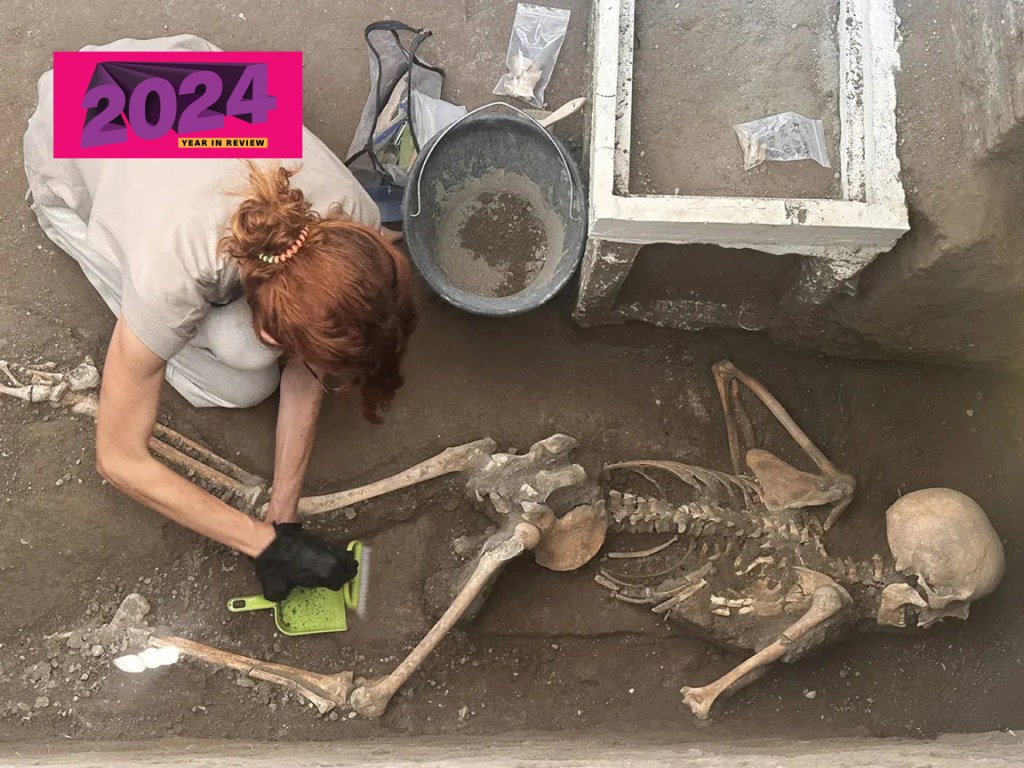
In August, the remains of a man and a woman were discovered in a makeshift bedroom during renovations on the home, along with a small amount of treasure. They were trapped there during the eruption and died from being buried by hot gases and volcanic material. Impressions of objects left in the ash by decomposing organic matter allowed archaeologists to reconstruct the house’s furniture and its exact location at the time of the eruption, including a wooden bed, a stool, a chest and a table with bronze, glass The marble-topped table, and the ceramic objects on it; a large bronze candlestick fell out of the room.
In October, a small house with an erotic mural was discovered. The works include a painting of the Cretan princess Phaedra, who fell in love with her stepson Hippolytus and later accused him of sexual assault when he rejected her advances. Another work shows Venus and Adonis, who are also the subject of a story of unrequited love. The house itself has a unique structure, lacking the traditional atrium common in first-century Roman architecture.
