

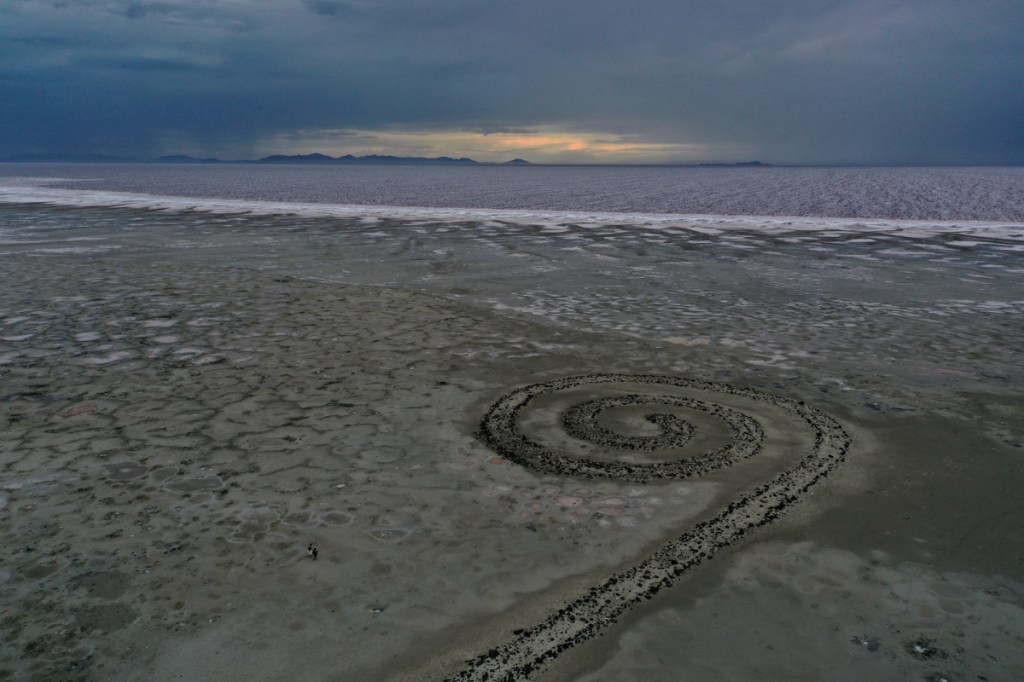
Robert Smithson’s Spiral PierThe famous 54-year-old land art installation on Utah’s Great Salt Lake has been officially listed on the National Register of Historic Places.
The list, overseen by the National Park Service, a division of the U.S. Department of the Interior, recognizes sites of national importance. added Spiral Pier Listing will make long-term preservation of the work easier.
Smithson created this installation in 1970, just three years before his death. At the time, he used the concept of entropy as the basis for his work—the study of the way natural elements and man-made spaces interact and ultimately decay.
Related articles

Smithson used 6,000 tons of black basalt rock and earth excavated from the site to complete the piece, which spans 1,500 feet. He arranged the materials in a 15-foot-wide curve and made it semi-permanent by using crystallized salt to bind the elements. Initially, depending on the time of year and weather, water sometimes consumes parts of the work. Recently, the work has become drier as the water levels have changed.
Jessica Morgan, director of the Dia Art Foundation, said in a statement, Spiral Pier Since 1999, he said: “We are delighted Spiral Pier Receiving this important recognition will help us spread awareness of the iconic artwork and advocate for its long-term preservation. “
Dia works with the Utah Museum of Fine Arts, the Great Salt Lake Institute and the Holt/Smithson Foundation to preserve and oversee the works with support from the Utah Department of Forestry, Fire Protection and State Lands.
Dia curator Jordan Carter said: “This designation further supports our work to preserve this work in line with the Smithsonian’s vision, while recognizing that the surrounding natural environment is an integral part of its meaning. “
The National Directory was established in 1966 and contains more than 95,000 locations nationwide. However, there are also monuments and statues on the list Spiral Pier It is believed to be the first land art work to receive this title.
