

A famous story from Ovid’s first century narrative poem Metamorphosis The story goes like this: After the sun god Apollo killed the snake dragon Python, Cupid, the god of love, shot two arrows at Apollo in revenge. The first caused Apollo to fall madly in love with the fairy Daphne, while the second caused Daphne to insult Apollo, forcing her to turn into a laurel tree to escape his advances. This ancient Roman story of unrequited love and conquest was the basis for the world’s first opera daphne The play was written and composed by Ottavio Rinuccini and Jacopo Peri in 1598, and only the original script remains.
Related articles

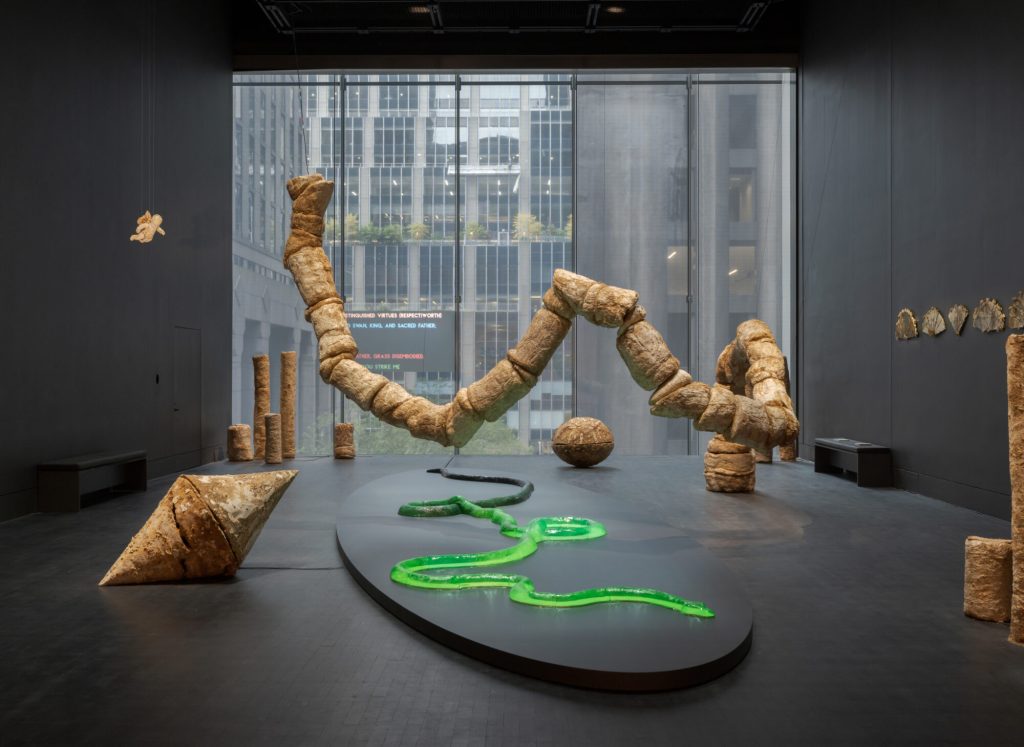
Los Angeles artist Nour Mobarak reimagines sound and sculpture daphneOn view at New York’s Museum of Modern Art (MoMA) through January 12, it expands on the classic myth of Daphne and Apollo to tell a different story around the power of language and personal transformation. The exhibition “Dafne Phono” features 15 singing sculptures made from mycelium (the root-like structure of fungi).
Ovid’s divine figures are reduced to basic geometric shapes like ovals and cones, which together tell the story in some of the world’s most phonetically complex languages, such as Abkhazian from Abkhazia, From the Outback Chatino from Oaxaca and Silbo Gomero from the Canary Islands of La Gomera. The result is a strange and deeply sensory aural clash of whistles, clicks, and consonants, each shaped and deformed by the fungal tissue within which it is encased.
In his early works, Mobarak began to think about the relationship between language and mycelium, Father Fugue (2019), a full-length album and series of columnar sound sculptures, is the culmination of 15 years of recording with her polyglot father, Jean Mobarak. Side A of the album features tender, recursive dialogue and wordplay between Nour and Jean, who speaks French, Arabic, Italian and English but whose degenerative cognitive condition prevents him from sustaining a memory for more than 30 seconds. When listening to the record, however, the content becomes less important than the materiality of their voices, as if the space for communication lies in the musicality and rhythm of the ongoing conversation rather than the conversation itself.
For Mobarak, who was cultivating mycelium at the time, transferring these recordings to speakers covered with rotting mushrooms was an obvious next step: “When I looked at these mycelial clumps, I felt like I was also looking at a Synaesthetic, objectified stuff “in the form of conversations I heard in the studio,” she said in an interview. art news.
With its root-like structure, mycelium proliferates through a constant cycle of decomposition and regeneration, which Mobarak links to the life cycle of human language. “I’m really excited about the potential that mycelium allows me to talk about cause and effect and external systems,” she said.
The presence of uncontrollable external forces – namely time, deterioration and fragmentation – is a thread that Mobarak continues to explore, and his work flows seamlessly between performance, sculpture, moving image, poetry and music.

Installation view of Nour Mobarak’s “Dafne Phono,” 2024, Museum of Modern Art, New York.
Courtesy of the Museum of Modern Art, New York
For example, in the online exhibition “Locus/Lacuna” (2022), Mobarak uses the ancient memory technique of “memory palaces” to trace the location of personal memories. She presents her memories of being exorcised by an evangelical pastor through three different audio tracks, which visitors can mix live as they walk through an enlarged painting of the memory site, a plush red seat. Try to recall this experience gap or lost memory, but in the process of trying to remember, temporality and subjectivity become confused and new thoughts, ideas and images are formed in the mind of the viewer.
Mobarak later poured the painting of the red seat into mycelium so that only traces remained. The image is metabolized by the fungus in a process of self-destruction and, like memory itself, is given a new existence through its decay.
“Offset is very comfortable for me,” Mobarak said of transforming sculpture into sound work and sound work into painting. “I’m ambivalent about it, but other people think it might have something to do with being a diaspora, because you never really belong where you are. You’re always a little bit out of place, but you always fit in.”
Mobarak’s family is from Lebanon; although she was born in Egypt and raised in Italy and the United States. As a teenager, she received seven years of classical vocal training before abandoning operatic formalism in favor of the experimental music and poetry scene she discovered while at the University of Sussex in England. Later in Paris. Mobarak’s frequent exposure to languages she was not fluent in made her realize early on that sounds and feelings communicate differently than semantics.
“Dafne Phono” begins with an investigation into the origins of the speaking voice as an instrument. Rinuccini and Perry’s daphne Performed using a new style called recitative, in which the singer imitates the rhythm of spoken words rather than focusing on the melody. This transformation of a single voice into music, and the body into a material instrument, is related to Mobarak’s long-standing interest in mechanized sounds and expanded vocal techniques that have long been used by Joan La Barbara ), Meredith Monk (Meredith Monk) or Klaus Nomi (Klaus Nomi) and other avant-garde singers. Explore the limits of the human voice.
“But I realized that a lot of the artists I knew were Anglo-Saxon, and the distinctly radical sounds they made were also present in many other spoken languages,” Mobarak said.
Given the limited sonic palette of the Romance languages, Mobarak sought to create an opera that encompassed the widest range of human voices through translation daphne Translate into some of the world’s most phonetically complex languages.
Mobarak has been investigating the emotional power and limitations of the human voice through phonetics, and through earlier performance works such as the Allophone Movement series (2019-21), She combines collaged audio samples from the UCLA Voice Lab archives with live improvisation.
“I think a lot about empathy in terms of how we use sound to communicate verbally,” she explains. “Language is a carrier of meaning, and so are sound waves. Being able to go through the process of separating meaning from language is a way of being able to focus on how sound affects how we interpret what people are saying.”
In the lineage of sound artists and composers such as John Cage, Brion Gysin and Robert Ashley, Mobarak tried his hand at Dafne Phono How to separate sound from the fixed meaning of language to produce new knowledge and cognitive systems.
The process of translation of the script – from the original Italian to English, then from English to Abkhazian, Chatino, Silbogomero, !Xoon (Taa dialect), Latin and finally And then translate back to English – it’s different for every language. Many of these require Mobarak to perform the translation process on site. For example, she went to Namibia, where only about 2,000 people speak Spanish! Xoon; its users have survived centuries of genocide, live in extreme poverty, and often lack access to modern amenities like Wi-Fi and cell phones.
“I’ve never looked for rare languages. I’m wary of fetishizing indigeneity and rarity, or talking about these things too simplistically,” Mobarak said. “But when I did this research, I found that many of the phonetically complex languages are also some of the oldest languages still spoken on Earth.”

Installation view of Nour Mobarak’s “Dafne Phono,” 2024, Museum of Modern Art, New York.
The effect of these languages sounding together at MoMA extends the metaphor of Daphne’s silence to the suppression and eradication of thousands of language systems and their cultures. Mobarak’s aim is to raise awareness of the many ways in which our spoken phonetic palette, as well as our sensory capabilities, are shrinking under the influence of the imperialist forces of monolingualism, assimilation and globalization.
“We hear far fewer phonemes at scale because of hegemonic forces,” she said. “What does it mean to have fewer colors and textures available in the sonic and auditory palette when we try to communicate with each other?”
Twice translated English subtitles daphne Appears in a video in a corner of the MoMA gallery. They are color-coded according to each line of content broadcast by the speaker and projected verbatim on the screen, resulting in a linguistic sculptural experience akin to concrete poetry. Viewers can choose to follow the video or move around the sculptural actors in the room, but in each case the enveloping logic of sound’s call and response activates a variety of affective and cognitive registers and brings about a sense of immediacy and intensity. Feel.
Exhibition curator Sophie Cavoulacos describes Mobarak as “both a formalist and a sensualist” and a person who is “based on process and materials, but also curious. A man of heart and determination.”
“Dafne Phono” is the artist’s largest project to date and, in part, represents her own metamorphosis with Daphne—the outsourcing of a single voice and body into multiple voices that together transform into a cross-species performance . Daphne’s original voice cannot be restored, but Mobarak creates a space for its absence to be heard anew in a polyphonic chorus of human and non-human voices that is both incomplete and full of sound.
“Shifting away from the primacy of the human body as a sensory and intellectual force is a way of questioning the vastness of the body,” Mobarak said. “And how all realities are separate yet deeply connected.”
