

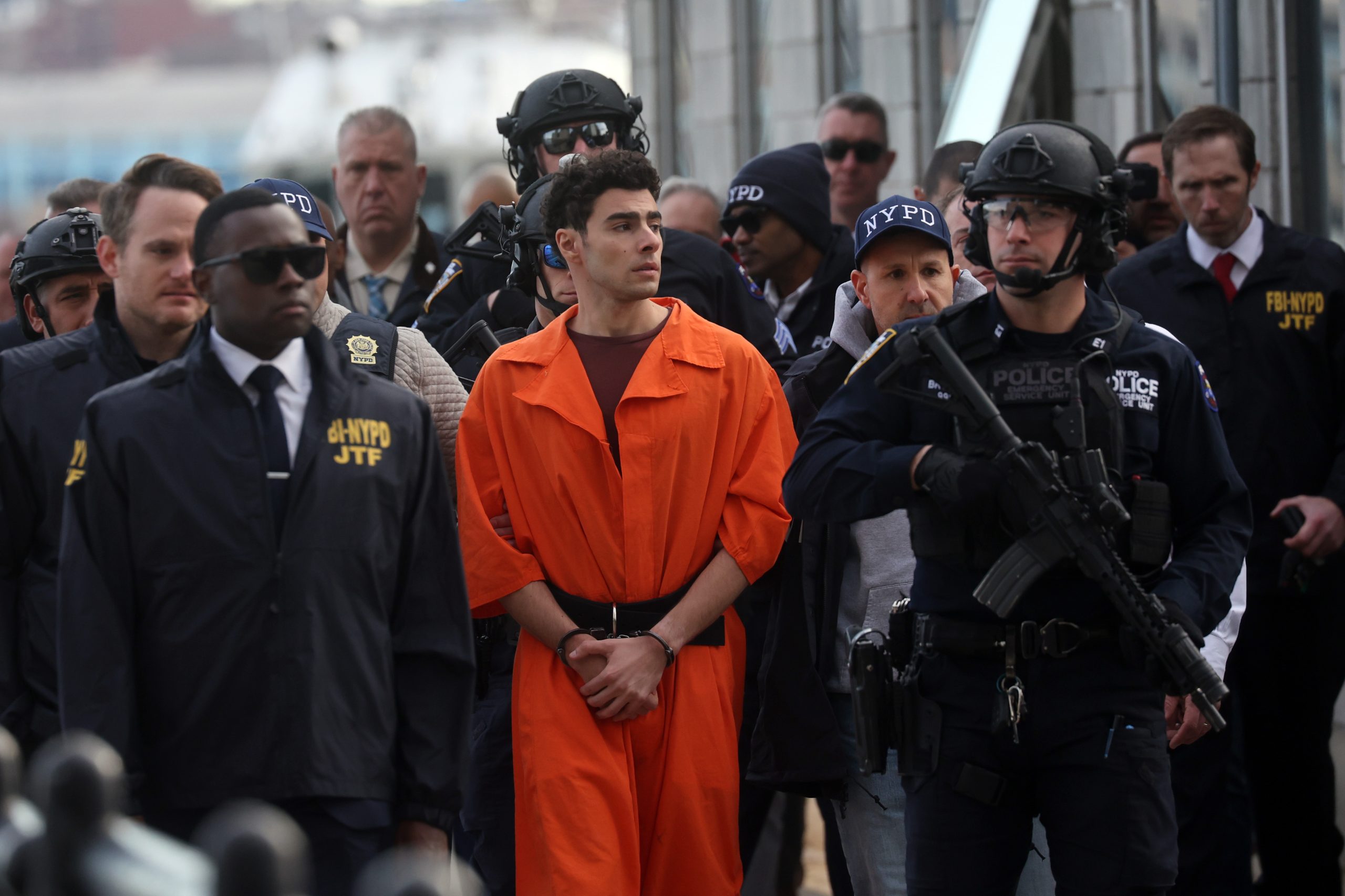
Yesterday, the NYPD released photos of Luigi Mangione’s extradition to New York City. The accused murderer of UnitedHealthcare CEO Brian Thompson wore an orange prison jumpsuit and was surrounded by a group of stern-faced police officers in gray suits brandishing semiautomatic weapons. Behind him, no doubt excited about the photo, was indicted Mayor Eric Adams. The intent behind the photo seemed clear: Any act of violence against the corporate state would be met with overwhelming force, and Mangione — a man with no history of violence and without a single criminal conviction — was So dangerous that he needed a literal army to suppress him.
This image backfired spectacularly. The officers wore Kevlar, but only a thin red T-shirt and oversized jumpsuit protected Mangione from the December cold. The police were armed and the defendant was handcuffed. For many insightful Internet commentators who are better educated in Western art history and visual rhetoric than the NYPD, one comparison is particularly striking. Swap out the orange prison uniforms for orange robes, swap out the guns for spears, and you can clearly see that authorities inadvertently turned Mangione’s photograph of a walking prisoner into a Renaissance painting of Christ’s arrest. Using an acronym that symbolized the authority of the Roman Empire, writer Rebecca Solnit noted on Facebook that the photo depicts “SPQR and the NYPD finally together.” As many have pointed out, the happy-faced, dark-curled Mangione is strikingly handsome, which only underscores the difficulty of publicity trying to portray him as a villain.

In fact, the photos are eerily reminiscent of paintings such as the 1858 “The Arrest of Christ” by the German religious iconographer Heinrich Hofmann. The visual perspective is the same, focusing on an unarmed, weaponless figure surrounded by heavily armed representatives of the state. The arrangements the Legionnaires made for Christ appear to be almost identical to the arrangements made for Mangione by the NYPD officers. The two even wore the same color clothes.
The account of the arrest of Jesus by the authorities in the Garden of Gethsemane has an ancient history, drawn from Gospel accounts dating back to the Middle Ages. Late 15th century medieval altarpiece from the Walters Museum collection in Baltimore depicts a similar dark-skinned, curly-haired prisoner being manhandled by a group of guards. A century later, Spanish painter Juan Correa de Vivar painted “The Arrest of Christ” in 1566 The cruelty of the state towards future martyrs is also described. This depiction of Christ gave birth to a vocabulary of imagery evident in the work of artists from Giotto to Caravaggio, creating an archetype that led to someone posting on X that Mangione “kinda looks like a prettier Jesus.” This comparison will offend many people, especially since Jesus Christ did not kill the healthcare CEO. However, Christ’s own feelings about the rich, demonstrated by his argument that the rich will enter heaven as easily as a camel goes through the eye of a needle, suggest what a true Christian response to predatory health insurance might look like.

You only have to glance at the comments posted below articles and editorials about Mangione’s alleged crimes to see the disconnect between official condemnation and public opinion. From Reddit, to Facebook, to Bluesky, to the comments section of Get up: The shooting is possible to some extent. Even if it’s unreasonable, it’s understandable. Many in the media and government have reacted to this sentiment with anger and condemnation, while the public has largely ignored or ridiculed it. When a columnist is new york magazine Pennsylvania Sen. John Fetterman, once hailed as a champion of the working class, argued that while the shooting was a tragedy, America’s health care inequities made it “inevitable,” while Pennsylvania Sen. John · Fetterman (who was once hailed as a champion of the working class) called this “a terrible approach.” However, nearly 41% of voters in their 20s believe Mangione’s actions were justified.
Meanwhile, Bret Stephens, New York Times, In a laughable editorial, Thompson was “a true working-class hero” and the murdered executive was “an example of how a talented and determined man from humble beginnings can rise to the top of corporate life.” You don’t need to support political assassination to properly interpret Stephens’ argument — that healthcare executives who pioneered the use of artificial intelligence to deny legitimate medical claims are heroes — that it’s a startlingly influential one. This practice undoubtedly increases the death and suffering of those whom UnitedHealthcare ostensibly covers to increase the company’s profit margins, which only confirms that Stephens’s claims are morally inconsistent. This is certainly what the vast majority of internet commentators above pointed out, as heartbreaking stories of rejection were shared under the editorial. After the CEO of UnitedHealthcare parent company published an op-ed, new york times There was so much backlash that comments were turned off.
Yesterday’s photos are just the latest in a saga of media failure to read the pulse of the public. The political and media classes have completely failed to capture the narrative of Thompson’s shooting. Whatever one’s views on the intersection of violence and politics, it is undeniable that we are currently witnessing the rise of a folklore figure who personifies the rage that many Americans feel so acutely that in this most partisan of times, In an era of strife, it transcends partisanship. As a result, when columnists tried to paint Mangione as Ted Kaczynski, he ended up looking as romantic as Che Guevara; When Hannibal Lecter is transported to the courthouse, he looks like Christ. Some artists and meme creators took the accusation literally, newsweek According to reports, a pizzeria in Towson, Maryland, hung a photo of Mangione as the Sacred Heart of Jesus, with the haloed suspect holding up two fingers in blessing.
Whatever one’s stance on all this — whether it’s a dangerous precedent for normalizing murder or an organic expression of popular anger at a system that’s been abused — is secondary to the fact that the American people are brewing some angry, vengeful , not without reason. The authorities cannot begin to understand. Perhaps art history can provide us with some clues.

