

The substance of announcements of major museum acquisitions can be difficult to decipher, buried in jargon-laced press releases thanking private donors. Larger museums acquired hundreds of works in 2024, including the Brooklyn Museum, which added 330 works to its collection, and the Museum of Fine Arts, Boston, which added 626 works across three acquisition groups.
We analyzed museum acquisition lists and compiled 10 noteworthy additions to U.S. institutional collections in 2024, below. Please keep in mind that not all of these works may currently be on display, so check each museum’s website for the latest exhibition status of each work.
National Gallery – Cannupa Hanska Luger Project supporting water protectors
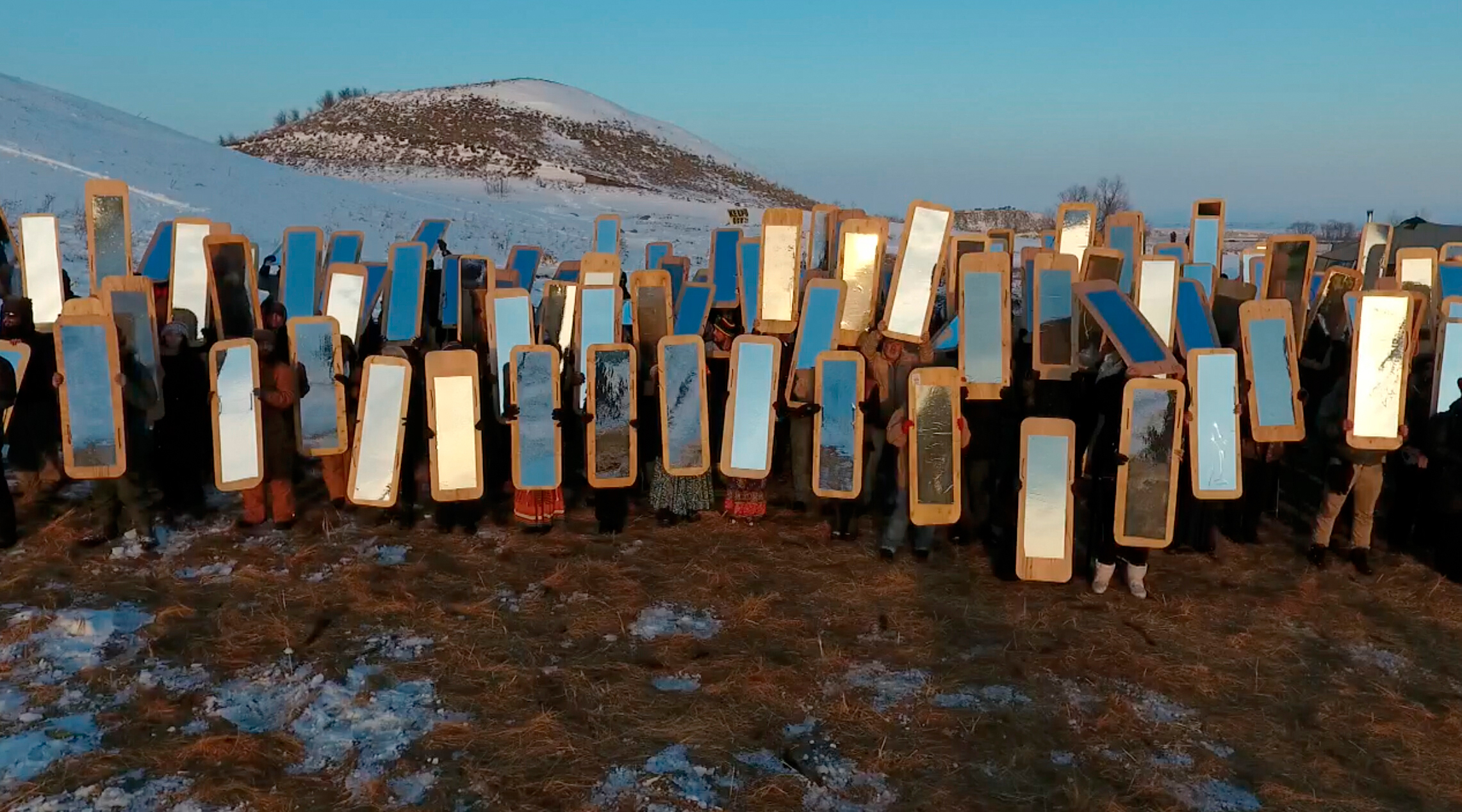
The National Gallery of Art in Washington, D.C., has acquired New Mexico’s Cannupa Hanska Luger’s “Mirror Shield Project” (2016), which includes mirrors of various sizes and approximately two minutes of video. In 2016, inspired by the demands of water protectors opposing the Dakota Access Pipeline, Lugar created a video tutorial for a “mirror shield” made of thin wood and non-glass reflective material that protesters could use in frontline operations It came to reflect photos of police in riot gear rushing towards them. He called on people across the country to help make the shields, and eventually more than 1,000 shields were delivered to Camp Oceti Sakowin near Standing Rock, North Dakota. Some of these were used in the operation in which hundreds of Water Guardians carried shields and walked in the shape of a snake through the Osseti Sakowin camp.
Museum of Fine Arts, Boston – 115 Black Panther Party Photos

In 1965, while still a student at the University of California, Berkeley, photographer Stephen Shames was appointed by Black Panther Party co-founder Bobby Seale as the organization’s official photographer. Over the next eight years, “Shame” chronicled the day-to-day activities of the Black Panther Party, paying particular attention to the organization’s female members, who made up approximately 65 percent of its membership. This year, the Museum of Fine Arts in Boston purchased 115 of Shames’ photographs of Black Panther women, titled “ sisters comrades series, including a 1972 photo of a classroom at the Oakland Community Youth Academy (also known as the Black Panther School) in Oakland, California. Earlier this year, 27 of the Massachusetts-based artist’s photographs were displayed at the Boston institution as part of an exhibition Sister Comrades: The Women of the Black Panther Party.
high museum of art – one A Tribute to the “Godmother of African American Quilting”“

Harriet Powers, a woman born into slavery in Georgia in 1837, is widely considered the mother of the African American story patchwork, bestowed upon her by artist and aerospace engineer Caroline Matz Carolyn Mazloomi was honored for the tradition of painting she established. Her textile tribute Ode to Harriet Bowles: The Mother of African American Quilting (2024) shows Bowles at work in front of the “Picture Quilt” (1895-89), which One of her two surviving quilts, depicting 15 blocks of biblical stories. Mazlumi, a former National Heritage Fellow at the National Endowment for the Arts, had her first gallery show earlier this year at the Claire Oliver Gallery in Harlem, New York, highlighting her signature black-and-white quilted works. In stark contrast to her previous monochromatic textile works, “Ode to Harriet Bowles: The Mother of African American Quilting” is filled with earth tones replicated by Mazlumi, paired with Bowles’ color palette The boards echo. atlanta museum tells allergic The acquisition of Mazlumi’s work is part of an ongoing effort to collect quilts.
Art Institute of Chicago—Four Works by the Great Grandma Moses

Anna Mary Robertson Moses, better known as “Grandma Moses,” didn’t pick up a paintbrush until she was 78. She was a farm wife most of her life and the mother of 10 children, only 5 of whom lived beyond their years. In infancy, Moses began using the medium when arthritis made embroidery too difficult. The self-taught artist captured the landscapes of rural New York State, exhibited her work internationally in the 1990s, and continued painting until her death in 1961 at the age of 101. According to the Art Institute of Chicago, her art was embraced by the American public in the 1940s for rejecting elitism and embracing her authenticity. The Chicago institution received as gifts “Cambridge Valley” (ca. 1942), “The Thanksgiving Turkey” (ca. 1940), “Home” (ca. 1940), and “The Fire at Troy Bridge” (ca. 1941) by Moses . Artist Descendants of the Year.
J. Paul Getty Museum – one Flemish Renaissance Masterpieces

Quentin Messis’s “The Cherry Madonna,” once thought lost forever, is now on display at the Getty Center Museum’s North Building in Los Angeles. Director Timothy Potts said the painting’s whereabouts were unknown after the 17th century, when its first buyer, Cornelis van der Geest, gave it to Sold to an anonymous collector. In 1920, the work appeared again at an auction in Paris, this time with the background landscape covered in green paint. When the work resurfaced after 2015 as part of a Christie’s sale, the painting underwent conservation work to restore it to its original form. The cherries in the painting may suggest the passion of Christ and the fruits of heaven, while the apples represent Christ as the new Adam. Christie’s specialist Maja Markovic said this type of work allergic When the work goes up for auction this summer, it “focuses on the Virgin Mary’s maternal tenderness for all humanity, emphasizing personal piety and devotion to the Virgin Mary, regarded as the intercessor of the Christian faithful, Shortening the distance between the admirer and the admired.” The Getty was the highest bidder for the work, purchasing it for £10.66 million (approximately $13.4 million) in July.
San Francisco Museum of Modern Art – Martin Wong in his hometown

After living in New York City for more than a decade and achieving success in the Lower East Side art scene, Martin Wong returned to his native San Francisco in 1994 when he was diagnosed with AIDS. Huang’s DC-3 (1992), created in the last decade of his life, before returning to China, depicts his San Francisco Chinatown neighborhood, with the image of an airplane crossing the composition, interrupting the viewer’s view. Children’s faces look out from the circular windows. Known for his social realism, explorations of queer desire and urban life, and his iconic cowboy hats, Huang often incorporates multilingual and cross-cultural elements into his work. SFMOMA describes “DC-3” as autobiographical; Huang grew up in San Francisco during the counterculture era, when the city became the center of the national gay rights movement. “DC-3” is the fifth work added to the museum’s collection during the last ten years of Mr. Huang’s life.
Dallas Museum of Art – one A lot of Cecily Brown trypsin

Influenced by the hunting and market scenes of the Flemish painter Frans Snyders, the British painter Cecily Brown created her own scene of massacre in the oil painting The Brilliant Table (2019-20). The work, which features what appear to be the necks of game birds, rabbit and deer carcasses intertwined with abstract brushstrokes on a blood-red table, was gifted to the Dallas Museum of Art from the Rachofsky Collection and the Hartland & Mackie Family/Labora. “The Brilliant Table,” the first Brown painting acquired by a Dallas institution, appears in Cecily Brown: Theme and Variationsviewing now.
National Museum of African American History and Culture – Nat Turner’s rebellion as imagined by Christopher Myers

The Smithsonian’s National Museum of African American History and Culture houses a nearly 32-foot-long tapestry by Brooklyn-based artist and author Christopher Myers that explores the Nazis who led the rebellion against slavery in 1831. The life of Nat Turner. With stitched-together farm tools, red tears, and a clash between white and brown figures, Myers’s quilt is a “portrait of a man caught in a whirlwind of history, a crossroads of ideas, and concepts, like all of us,” The artist is working with allergy. The collection will be on display at the museum until June 8, 2025.
Metropolitan Museum of Art – 300 prints by Mexican artists

In March, the Metropolitan Museum of Art acquired 300 prints by the Mexican artist between 1890 and 2007. Among the treasure trove of North American prints is Mexican-American sculptor Elizabeth Catlett’s Sharecropper (1952), a relief print of an anonymous woman, printed in green, wearing a wide-brimmed hat. Designed to draw attention to the plight of black women. south. Cartwright and other artists in the acquisition group were associated with the Taller de Gráfica Popular (Popular Graphic Art Studio), a progressive art group in Mexico City founded in 1937 that distributed thousands of prints to leftist causes. Selected prints from the series will be exhibited in early 2025.
Brooklyn Museum – Autobiographical Leather Engraving

Winfred Rembert, who died in 2021, endured a horrific seven years in prison and nearly being lynched. When he was released from prison, the artist won acclaim for the leather carving work he learned in prison. His wife encouraged him to make art based on his life experiences, and the Brooklyn Museum this year acquired Looking for Rembert (2012) from trustee Stephanie Ingrassia as a A 200th anniversary gift that depicts a chained gang and reflects on the cruelty of forced labor. The work is the artist’s first in the Brooklyn Museum’s collection.
