

art market
Lavataras
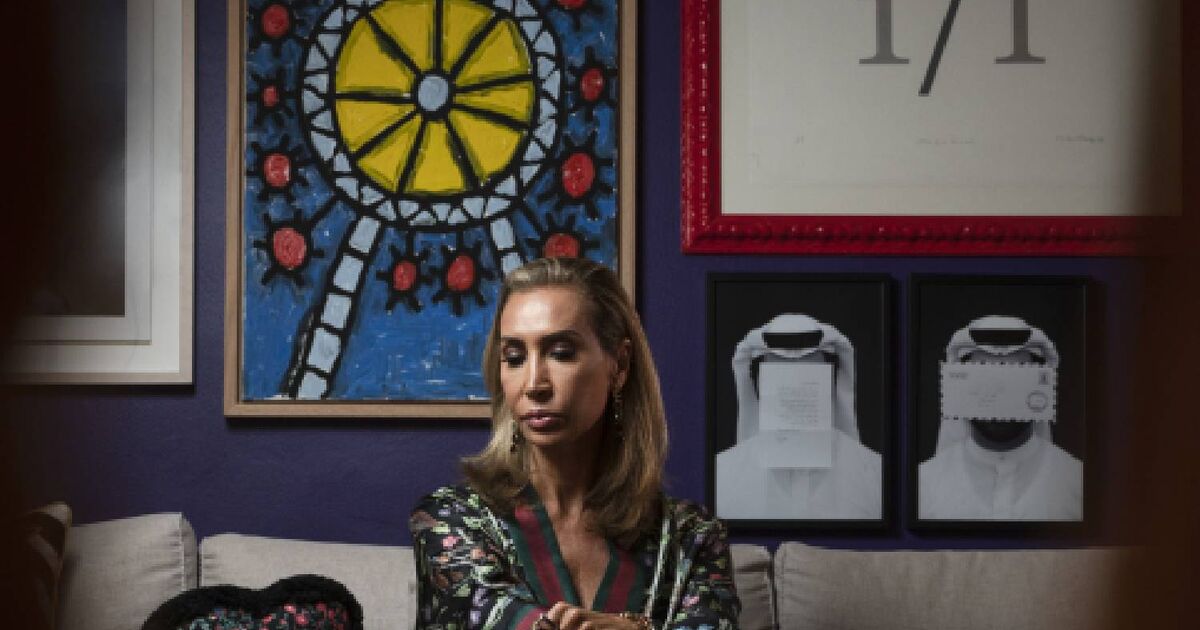
Portrait of Nadine Canso. Contributed by Nadine Canso.
Artsy meets Nadine Kanso on a sunny day in Dubai’s popular Jumeirah waterfront community. Born in Lebanon, Kanso rose to prominence in Dubai with his high-end jewelry company, Bil Arabi (meaning “Arabic”), which celebrates Arabic language, scripture and identity.
Like her own vision of making wearable statement pieces that represent beloved Arabic scripts, Canso’s art collection—whether at home or in her stylish office in the bustling Dubai Design District—is a tribute to A thoughtful reflection of Arab creativity spanning generations.
Canso and her family have lived in a two-story villa for more than two decades, filled with coffee table books, knick-knacks from travels, and, of course, an assortment of art. Her collection spans an eclectic range from contemporary to modern, Arabic to Western, and explores subjects that are both dynamic and majestic. A striking visual in Kanso’s living and dining room is her bold and stylish choice of wall colors—deep purple and green. An extensive collection of art including paintings, photographs and prints hangs on these walls. Kanso, also a photographer, doesn’t follow rules when it comes to hanging art, but instead relies on intuition that not everything has to match.
Works by Françoise Nierly, Mohamed Ahmed Ibrahim, Mohamed El Rawas and Nasir Nasrallah (left to right).
“I think it’s a matter of taste and how I look at things. It’s an organized chaos… If something is beautiful, why not show it off and enjoy it?” she said of her buzz object layout. “Some things you can’t really explain: why you put something on the table like this, or why you decorated your house like this, or why you bought this art. Visually, it needed to make sense to me, and I needed It needs to speak to me.”
Kanso owns about 100 pieces of art, but notably, she doesn’t consider herself an art collector. She has a particular soft spot for Arab artists, whether they come from Lebanon, the United Arab Emirates or Egypt. “I’ve always believed that if we don’t support our artists and take them to greater heights, then who will?” she told Artsy in casual-chic jeans and a Gucci T-shirt. “Everyone else does it. Why not us? The least we can do is support the industry. That’s how you make artists stronger.”
Canso began buying art more than two decades ago, initially with works by regional artists such as Samir Sayegh and Mohammed El Rawas, and with a particular focus on figurative art . Kanso’s living room contains works by French painter Françoise Nielly UntitledEmirati artist Nasir Nasrallah’s Untitledand Lebanese artist Mohammad El Rawas’ unique. There is also an intriguing portrait, Jamal Eldin al-Afghaniby pioneering Egyptian-Armenian artist Chant Avedissian, who produced stencil images of 19th-century Islamic reformist Jamal El Din Afghani. Elsewhere hangs a vivid painting of a Ferris wheel; Untitledcreated by first-generation Emirati artist Mohammed Ahmed Ibrahim, who represents the UAE at the 2022 Venice Biennale. This work was a gift for Canso’s 50th birthday.
Archival print (purple frame) of Nadine Kanso and Egyptian singer Umm Kulthum.
Another master in the group was veteran artist Hussein Madi, known as the “Lebanese Picasso” who died earlier this year. Kanso’s home is decorated with works by artists. woman lying on pillow (1999). “I met him years ago and I have a book he signed for me at the time,” Canso said. “He was a special character, very outspoken.” Two striking images of Arabic calligraphy by Lebanese artist Samir Sayegh, born in 1945, also appear. She noted that Ganso was a fastidious calligrapher.
“Calligraphy is a passion of mine, but I’m very picky about it,” she explains. “It needs to be strong like this. I don’t like when you do classical calligraphy with swirls. I mean, it’s beautiful, but it’s hard to do, so I appreciate it. Sayegh’s work is more thoughtful, with typographic elements, And not just calligraphy.”
As for the dining area, it’s decorated with vintage radios and elegant candlesticks, and the centerpiece of the room is a large portrait Malika (2022) is by Spanish artist Angeles Agrela, known for his depictions of women in brilliant colors and gorgeous hairstyles. “At the time, I didn’t know much about the artist, but I fell in love with his work,” she said.
Angeles Agrera, Malika, 2022. Contributed by Nadine Canso.
Works by Mohamed Ahmed Ibrahim, Huguet Karan, Mohamed El Rawas and May Salem (left to right).
Some of Ganso’s artworks also have a political edge. It includes a poignant black-and-white photograph by Iranian artist Reza Aramesh, one of her first art purchases. have the right Action 65 In 2009, the artist juxtaposes two contradictory images: Egyptian prisoners captured by Israeli forces in 1967, huddled together in an ornate setting. “It’s about all the contrasts in our lives,” she commented. So do Palestinian artists such as Rula Halawani, Samia Halaby, Larissa Sansour and Hazem Harb Canso was raised during a visit to her home. “Palestine has always been an important part of our lives as Arabs,” she said.
A long-time resident of Dubai, Canso has become friends with gallerists and artists over the years. “I usually like to get to know artists, not because I buy their art, but because I like their way of thinking and the story behind their art,” she said. Her favorite galleries in town are Ayyam Gallery, The Third Line, Lawrie Shabibi and Gallery Isabelle.
Portrait of Nadine Canso. Contributed by Nadine Canso.
A visit to Art Dubai, the UAE’s premier annual art fair, is also a must. In fact, Canso lent one of her artworks, a red pillow-like sculpture, to this year’s Art Dubai. expansion (2018), by Emirati artist Shaikha Al Mazrou – included in the live exhibition at the fair organized by Dubai Collection. “I was invited to speak on a panel with larger collectors, and I was the only woman,” she recalls. “I didn’t realize it until I was sitting in the chair. But actually having my work included in the collection is still a proud moment.”
In fact, as Kanso continues to discover new artists and artworks, her collecting goals remain the same as they were twenty years ago. “It’s about being able to access beauty in the environment you’re in every day,” she said. “You are surrounded by pieces that resonate with you, tell you a story that is meaningful to you, and sometimes evoke feelings of happiness, memory and nostalgia.”
