

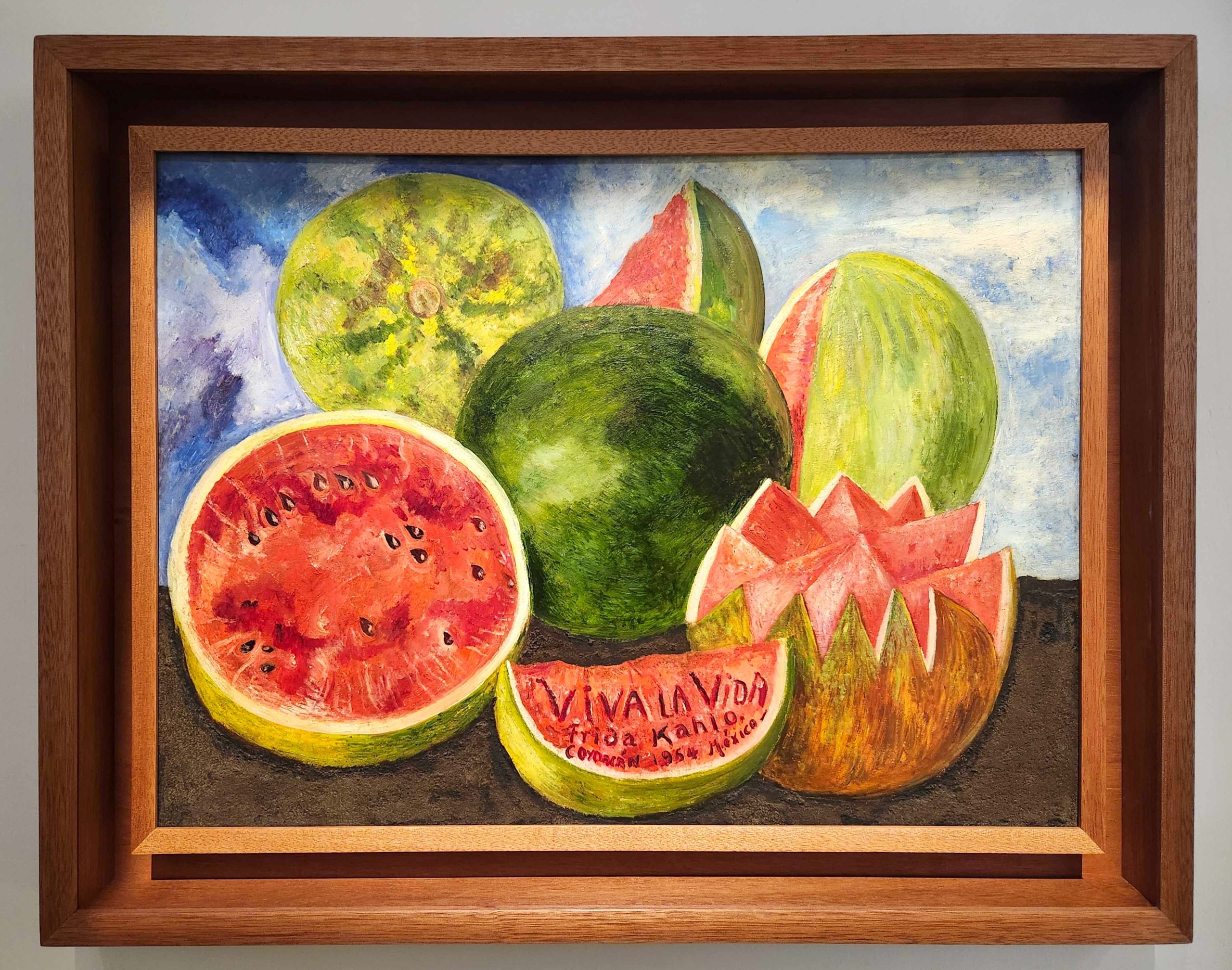
Happy Public Domain Day! Starting today, January 1st, you can legally access, adapt, remix and redistribute (depending on your jurisdiction) works by Henri Matisse, Frida Kahlo and Robert Capa, and some texts by William Faulkner, Virginia Woolf, and Ernest Hemingway, among others.
In the United States, copyright on commissioned works lasts for 95 years, so films and books published in 1929 are up for grabs. The United States also observes a “life plus 70 years” period for copyrighted individual works; therefore, protection for the work of any author or creator who died in 1954 has now expired. One of our favorite resources is public domain review The magazine’s annual Advent countdown calendar highlights significant contributions to literature and the visual and performing arts in a month that will join the public sphere in 2025.

“He who loves flies, runs, rejoices; he is free and nothing can stop him…” Matisse once said. Now, nothing can stop us! The French artist’s life’s work is one of this year’s notable works in the public domain. We’re certainly excited to see his rich paintings and creative cutouts transcend white wall exhibitions and covers body record score (2014), finally.
Next are works by the important Mexican artist Frida Kahlo, who also died in 1954. Kahlo is best known for her confrontational self-portraits, which she painted with serious expressions and her signature unibrow in her established surrealist style, often seen as an offshoot of magical realism.
While Kahlo’s likeness has been commercially exploited and regurgitated on an astronomical scale, distorting even her message and life experience, it seems unlikely that her life’s work will finally find its way into people’s hands via the public domain. Socialism and anti-socialism that best fit her. -Capitalist ideology and radicalism.
While Kahlo’s work has entered the public domain, people should remember that her family and estate had trademarked elements of her identity and likeness through the Frida Kahlo Corporation and then began selling products bearing her face and the word “Viva” Resin iPhone case. la vida” to them.
“Once a work enters the public domain, it is generally free to be used – this is copyright law’s way of recognizing that creators only have a limited time to hold exclusive rights to their work before it is made available to the public,” Laura Ricciardi said (Ricciardi) said in an interview that in addition to providing legal counsel to visual and performing artists, he also teaches arts law in the arts management program at SUNY Purchase. allergic.
“However, elements of the work may be protected by legal mechanisms other than copyright,” Ricciardi clarified. “For example, if Frida Kahlo’s estate trademarks the use of her name on a coffee mug, someone who produces a coffee mug using one of Kahlo’s paintings and her name may be liable for using her name. be liable for trademark infringement even if there is no copyright issue with the painting.”
Ricciardi also acknowledged a right of publicity, which she said was “commercial profit based on a person’s name or likeness.”
“Kahlo is an interesting artist in this context because she often created self-portraits and in many cases the works themselves are intertwined with her likeness and character,” Riccardi explains. “That makes parsing the issue of publicity rights critical, but also a little tricky. Of course, all aspects of intellectual property, whether we’re talking about copyrights, trademarks or publicity rights here, are balanced by First Amendment concerns ”
Publicly commissioned works by Swedish artist Carl Eldh that dot the map of Stockholm join the public domain this year.

Copyright protection has also been lifted for the photography of Robert Capa, a 20th-century photojournalist, combat documentarian and co-founder of Magnum Photos. The Hungarian-born photographer’s candid moments Snapshots of five international wars and critical captures of important moments in political history are now more important than ever, as millions of people have the ability to record and expose the chaos and destruction around them.
Equally timely are Capa’s records of the 1948 Arab-Israeli War and the early founding of the Israeli state from 1948 to 1950. Some scholars believe that Capa contributed to the normative erasure of Palestine because his photographs presented an idealized and triumphant image of Israeli development while omitting any reference to the forced expulsion and dispossession of Palestinians, i.e. Arab The word “disaster”.
In the literature category, American novelist William Faulkner’s Sound and Fury (1929), which still baffles millions of high school students every year, is now available to read for free. Rest assured, while Faulkner’s signature stream-of-consciousness style will blow your mind, this novel is sure to make you feel better about your own family dynamics if you’re having a less-than-stellar holiday. On the other hand, a wartime love story Farewell to weapons Ernest Hemingway (1929) (pictured above, coincidentally) is also close by.

Virginia Woolf dominates the public sphere for a third consecutive day, this time with A Room of One’s Own (1929), in a long essay that emphasizes women’s economic and intellectual independence as literary expression A key prerequisite for freedom or other creative pursuits. Woolf’s revolutionary essay coined the famous saying “If a woman is going to write novels, she must have money and a room of her own”, which once again brought attention to the question, she raised the question of what would happen if women were not limited by their role in society. Troubled, what can they achieve? Caregiver, childcare provider and homemaker.
This is something to keep in mind as we brave the next four years together.
Finally, the autobiography of Mahatma Gandhi The story of my experiment with truth (1929), compiled from a series of his weekly Najivan Diary entries from 1925 to 1929 are now in the public domain – as is the autobiographical novel daughter of earth (1929) The author is Agnes Smedley, an American writer and journalist whose career included support of the Indian independence movement and the Chinese Communist revolution.
As we hurtle towards a future filled with absurdity and atrocities, Public Domain Day is a great time to look at what has come before us and repurpose that knowledge in a contemporary context.
So, with that in mind, we wish you a Happy Public Domain Day and a Happy New Year!
