

Looking back at 2024, it’s clear this year has been filled with artists who have created intersting works. Clint Imboden, a 3D artist based in the San Francisco Bay Area, is one of those voices. His work transforms everyday objects into layered narratives, blending nostalgia with sharp social and political commentary.
Clint’s childhood in St. Louis, shaped by his parents’ love for collecting Americana and kitsch, laid the foundation for his artistic journey. Today, he scours flea markets for forgotten items—rusty tools, vintage toys, and other relics of the past—and brings them to life in his Oakland studio. Through his sculptures and installations, Clint addresses complex issues like addiction, gun violence, and cultural shifts, proving that even the most ordinary objects can tell extraordinary stories.
Addiction in Focus: Poppy Seed
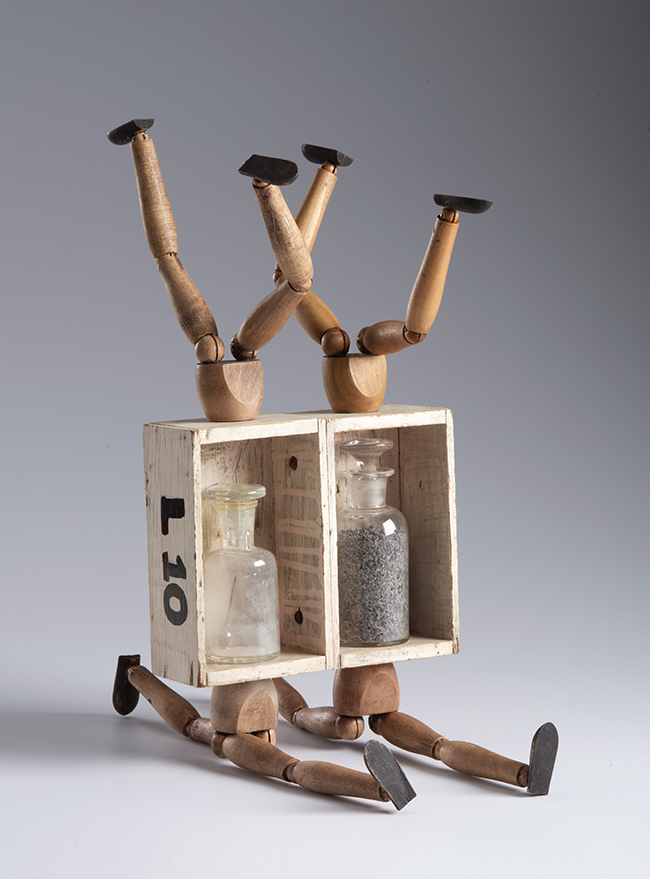
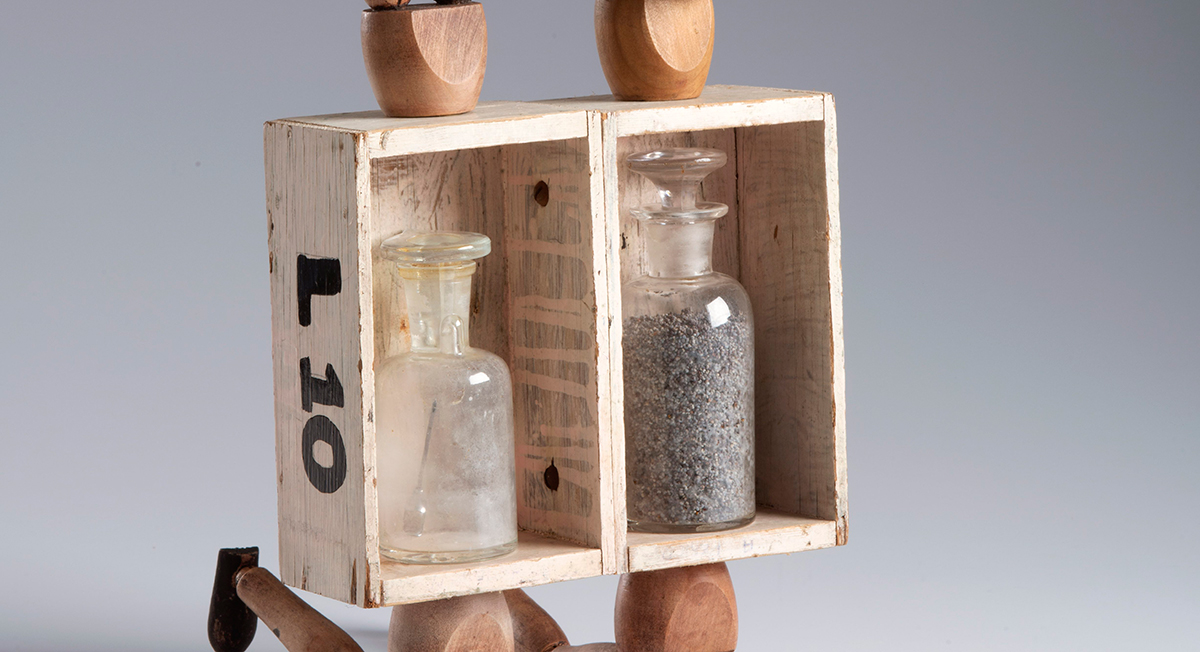
With Poppy Seed (2024), Clint confronts the stark realities of heroin addiction. This assemblage pairs glass medical containers filled with poppy seeds—a nod to the raw origins of opiates—with a single hypodermic needle. Together, they tell a story of fragility and devastation.
Clint’s years working in community mental health lend weight to this piece. During a decade in the field, he supported people navigating drug diversion programs and those with overlapping mental health and substance abuse challenges. These experiences inform his understanding of addiction as a complex, systemic issue.
The glass containers, fragile and transparent, symbolize lives and structures under strain, while the poppy seeds hint at the innocent beginnings of something that can spiral into destruction. The needle serves as a stark reminder of the dual nature of intervention—offering both hope and harm. This work compels viewers to pause and reflect, confronting addiction not as a distant crisis but as a deeply human struggle.
Sanctuary in Question: Welcome to Sunday School
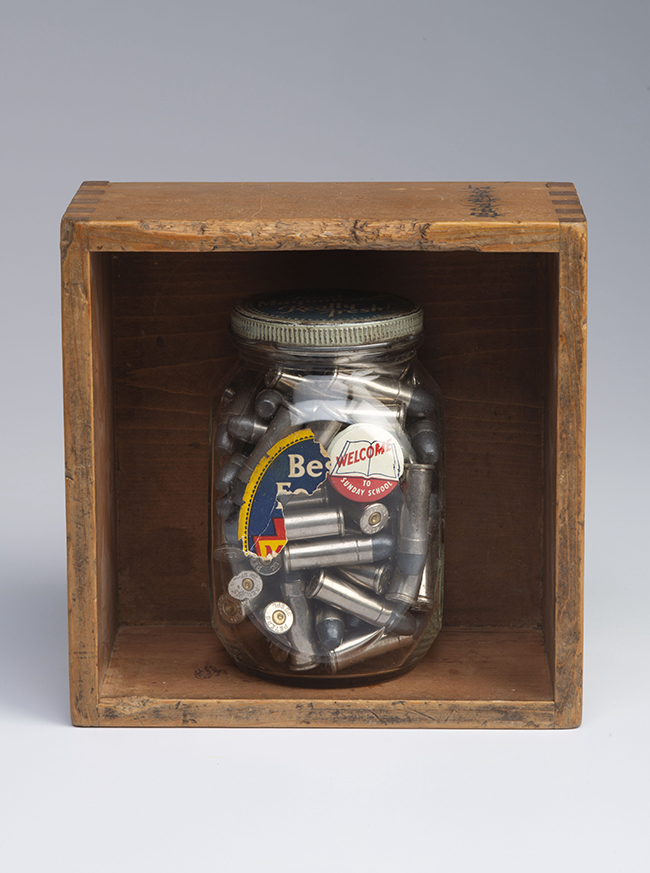
In Welcome to Sunday School (2024), Clint examines the unsettling presence of gun violence in spaces that were once considered sanctuaries. The piece juxtaposes childhood memories of church as a safe haven with the current reality of metal detectors at religious institutions.
For Clint, growing up in a church-going family, these spaces symbolized protection and community. But today, churches are no longer immune to the epidemic of violence. The assemblage critiques this shift, incorporating elements of religious iconography and subtle, haunting details.
The title alone—Welcome to Sunday School—carries a bitter irony. It evokes innocence while pointing to the alarming normalization of violence in spaces meant for reflection and peace. Clint doesn’t shy away from expressing frustration at the lack of action on gun reform, calling out the empty rhetoric of leaders who fail to address the root causes of the problem.
This piece challenges viewers to question societal priorities and consider the cost of inaction, particularly for children growing up in a world where such violence is routine.
Rediscovering the Ordinary
At the heart of Clint’s work is his ability to reimagine discarded materials. Nearly every day, he scours flea markets and estate sales, seeking objects that spark curiosity and narrative potential. A dusty rolling pin or a rusty shovel might seem mundane to most, but Clint sees in them the beginnings of something transformative.
In his studio, he uses repetition to great effect, amassing hundreds of identical items and arranging them in ways that abstract their original purpose. This approach invites viewers to see the familiar in a new light, uncovering stories hidden within these materials.
Objects as Storytellers
For Clint, every object carries meaning—emotional, historical, or cultural. His art amplifies these stories by adding text, a practice he began after the 2016 election. Words etched into tools and other materials become part of their essence, making each piece a permanent testament to social issues.
In works like Poppy Seed and Welcome to Sunday School, Clint uses these objects to distill complex issues into accessible yet deeply moving forms. His pieces don’t shout; instead, they invite quiet reflection. They ask viewers to reconsider what they think they know and to find meaning in the everyday.
As 2024 comes to an end, Clint Imboden is an artist who transforms the ordinary into the extraordinary. His art reminds us that even the most overlooked objects can hold powerful stories, offering a lens through which we can better understand ourselves and the world around us.
