

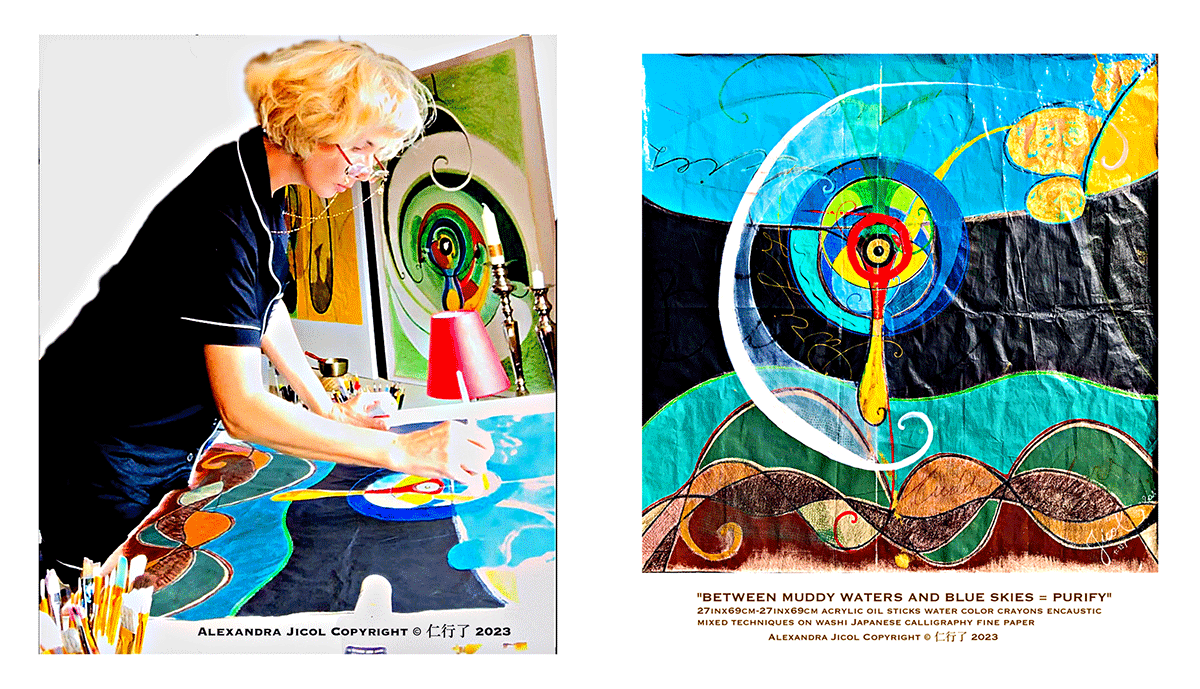
Alexandra Jicol makes art that reaches beyond surface beauty, drawing from a life shaped by contrast and complexity. Born and raised in Bucharest, Romania, during a period of political tension, she grew up between the quiet strength of the Carpathian Mountains and the dense atmosphere of the city. That early duality continues to inform her work, where emotion and observation meet in thoughtful, layered compositions.
For Jicol, art is a kind of excavation. She works to uncover what lies underneath the surface of human experience—emotion, vulnerability, contradiction. Her paintings aren’t just compositions of color and form; they are quiet meditations on the way we live, the weight we carry, and the moments that pass through us. Over the years, she has shaped a style that is tactile, sensual, and emotionally raw. She is drawn to the textures of life, both real and symbolic. Her focus remains steady: the human condition in all its layered complexity.
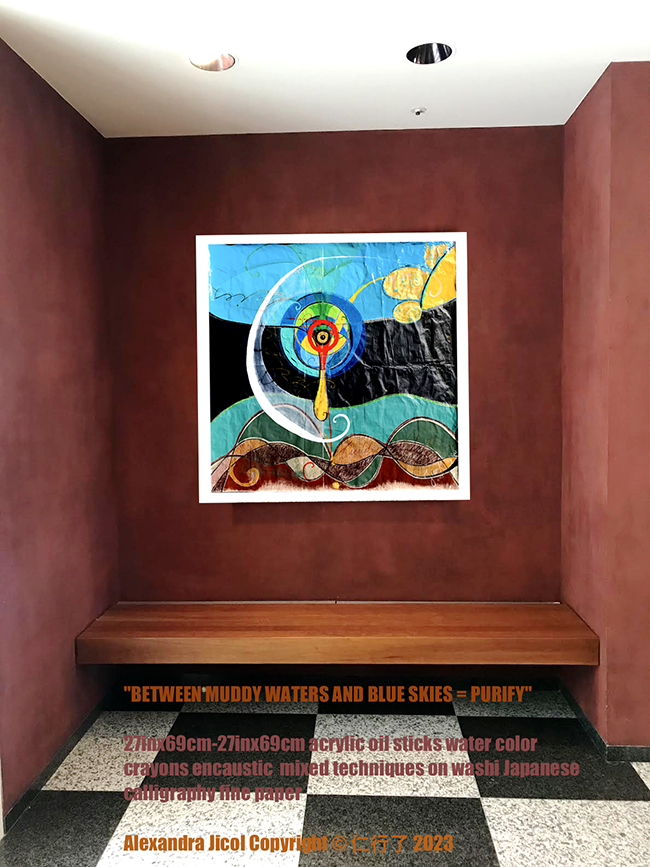
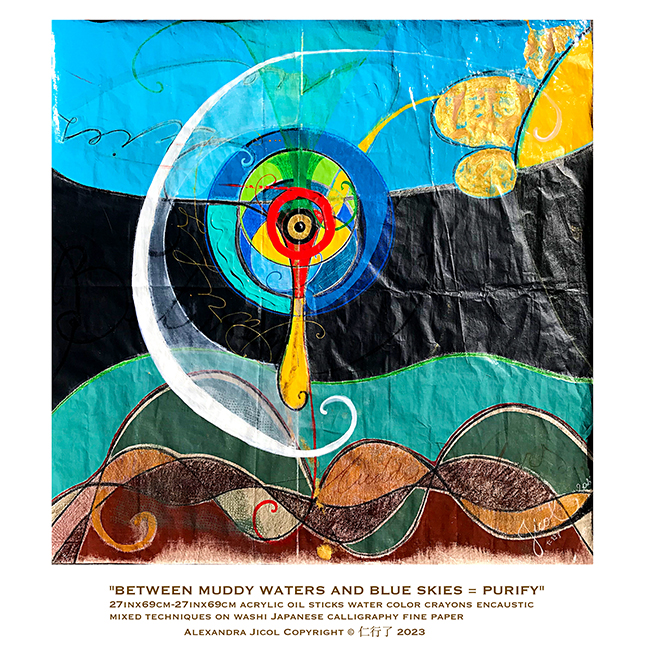
One of Jicol’s recent works, titled Between Muddy Waters and Blue Skies = Purify, reads like a visual diary of the soul’s search for equilibrium. Built on Japanese calligraphy paper mounted on wood, it’s a long, narrow piece—27 by 69 centimeters—but it holds a world inside it.
At the center floats an eye. Not as decoration or motif, but as a stand-in for the viewer, or perhaps the soul itself. The eye doesn’t gaze out; it hovers between two realms. Below it, muddy waters churn—a symbol of confusion, grief, maybe even fear. Above, blue skies stretch open—calm, vast, untouched. That contrast—murk and clarity, depth and breath—is the tension Jicol leans into.
She uses acrylics, oil sticks, water crayons, and encaustic wax to build the surface. These are materials that don’t always want to behave. But that’s part of the point. In her hands, they become emotional tools. The wax, in particular, creates a tactile sense of protection. It seals parts of the painting off, like scars that have healed over but are still visible if you look closely.
Then there’s the white line—a recurring presence in Jicol’s work. Here, it moves like a barrier, a shield. It’s subtle, but once you see it, you can’t unsee it. It suggests boundaries, safety, maybe even grace. It keeps the eye—the soul—from sinking too deep into the mud below. And in the top corner, a golden sun rendered in encaustic seems to radiate just enough warmth to keep hope alive.
What makes the piece so compelling is the way it changes depending on how you look at it. Some parts jump out—sharp colors, bold marks. Others hide in plain sight, only surfacing when light hits at the right angle. That kind of layered seeing mirrors Jicol’s larger artistic philosophy. We don’t always understand our experiences right away. Some things only reveal themselves with time, light, and reflection.
Jicol isn’t painting to give you answers. She’s asking hard questions and leaving space for you to sit with them. What does it mean to move forward when you’re still holding pain? Can clarity and confusion live side by side? Is purification even possible, or just something we reach for?
There’s also a personal dimension to this piece. Jicol’s choice to work on Japanese washi paper isn’t random. It’s deliberate—a nod to tradition, fragility, and resilience. The paper absorbs pigment in ways that feel almost alive. And once mounted on wood, it gains weight and presence. Just like people—soft at the core, but shaped and supported by what they stand on.
Between Muddy Waters and Blue Skies = Purify is not loud. It doesn’t demand attention. It invites it. Slowly. Gently. It lingers, asking the viewer to return to it again and again. That’s the kind of work Jicol is known for—quiet but lasting.
As the year winds down and new ones come into view, her work stands as a reminder: chaos is part of the picture, but so is balance. You can move through both. You can live between muddy waters and blue skies. And sometimes, that in-between space is where clarity finally shows up.
