

Albert Deak creates art that maps experiences beyond the surface of things. Trained in ceramics at a respected University of Art and Design in Eastern Europe in 1989, he began with a strong foundation in form and material. Over time, his work expanded into graphics, painting, and digital media, each step opening new ways to explore and express. Rather than relying on set formulas, Deak builds each piece as a search—an act of visual translation shaped by science, philosophy, and imagination.
Influenced by Pollock’s freedom, Richter’s ambiguity, and Kandinsky’s spiritual use of color and form, Deak has carved out a style that belongs entirely to him. He works in abstraction, but not to hide meaning—rather to express the things we don’t have words for. His art isn’t tidy or conclusive. It’s emotional, strange, sometimes cosmic—and always direct.
Let’s look closer at three of his works.
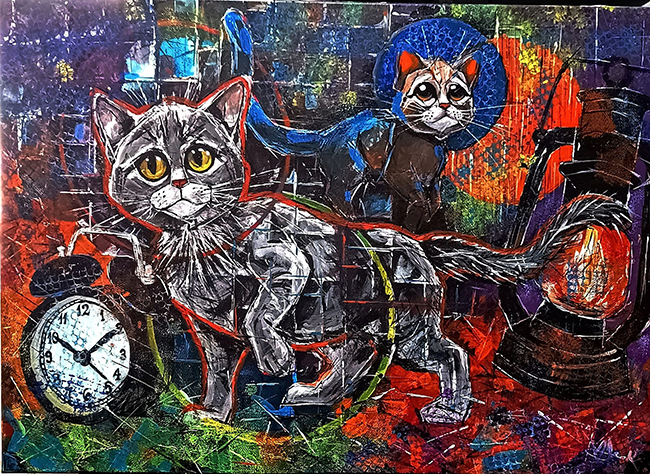
“The Enigma of the Cat and the Clock of Existence”
This piece doesn’t tell a linear story—it invites you to hover in the space between questions. A cat. A clock. A lantern. On their own, the symbols feel familiar, even cozy. But Deak rearranges them in a way that feels off-kilter. He’s working with ideas pulled from quantum theory—specifically, quantum superposition, where particles can exist in multiple states at once until observed. That idea of uncertainty, of reality being shaped by attention, is built into the bones of the painting.
You’re not meant to look and then move on. The viewer becomes part of the question. What is the cat watching? What time does the clock actually keep? The lantern may or may not be lighting anything. This is where Deak excels—he doesn’t push the viewer toward an answer. He pulls them into an unstable moment, asking them to sit with the not-knowing. The style echoes abstract expressionism, but the thought process is more surgical. Every mark is emotional, but it also hints at theory, systems, and paradox.
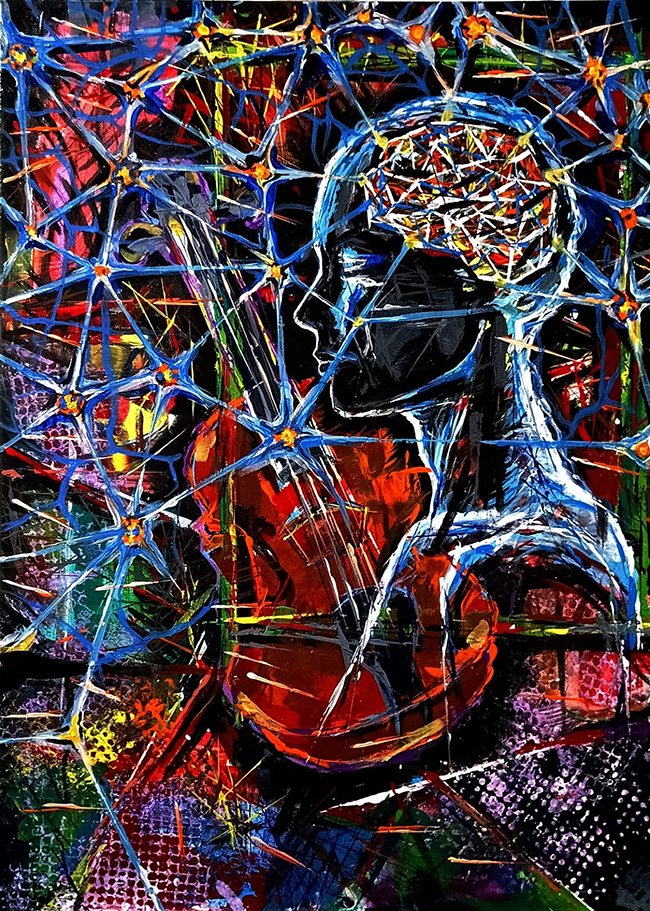
“The Two Universes and Their Inner Music”
Here, color takes the lead. This painting hums. There’s a wildness to the brushwork—loose, rhythmic, layered with light—but within the chaos, you can trace structure. A violin. A luminous human figure. These shapes feel pulled from dreams or memory, not drawn to be precise, but to be felt.
The theme is expansive: two universes and the idea that each has its own internal “music.” That music isn’t just literal—it’s metaphorical. It speaks to resonance between things we don’t fully understand: space, consciousness, sound, and memory. The way the painting moves—colors sliding, lines looping—suggests that harmony isn’t always obvious. It might look like disorder at first. But the more time you spend with the piece, the more it syncs up with something internal.
Deak’s use of contrast in this painting is subtle but key. Warm and cool colors compete, then balance. Straight lines pierce swirls. The violin, often tied to emotion and discipline, becomes a symbol of creativity pushing through entropy. The human figure floats—not as a god or a ghost, but as a being tethered to both universes, hearing both songs.
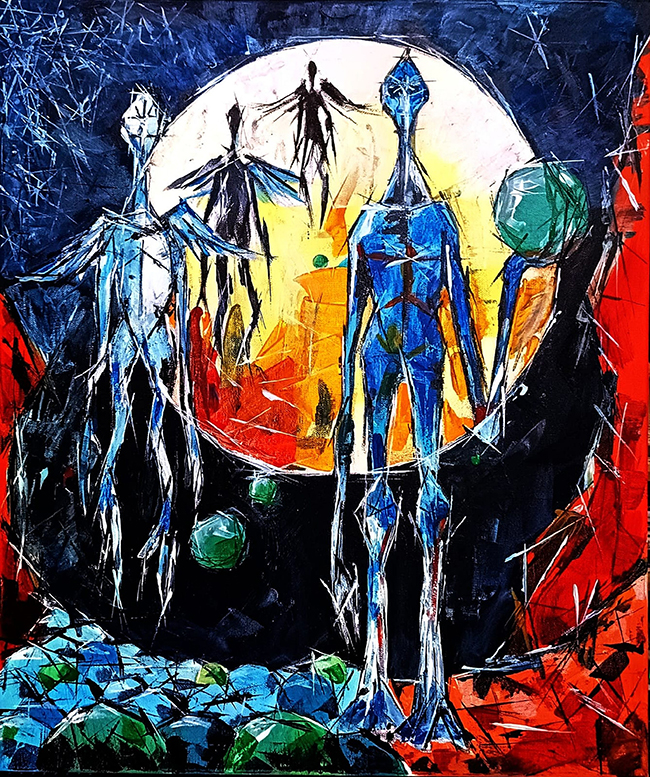
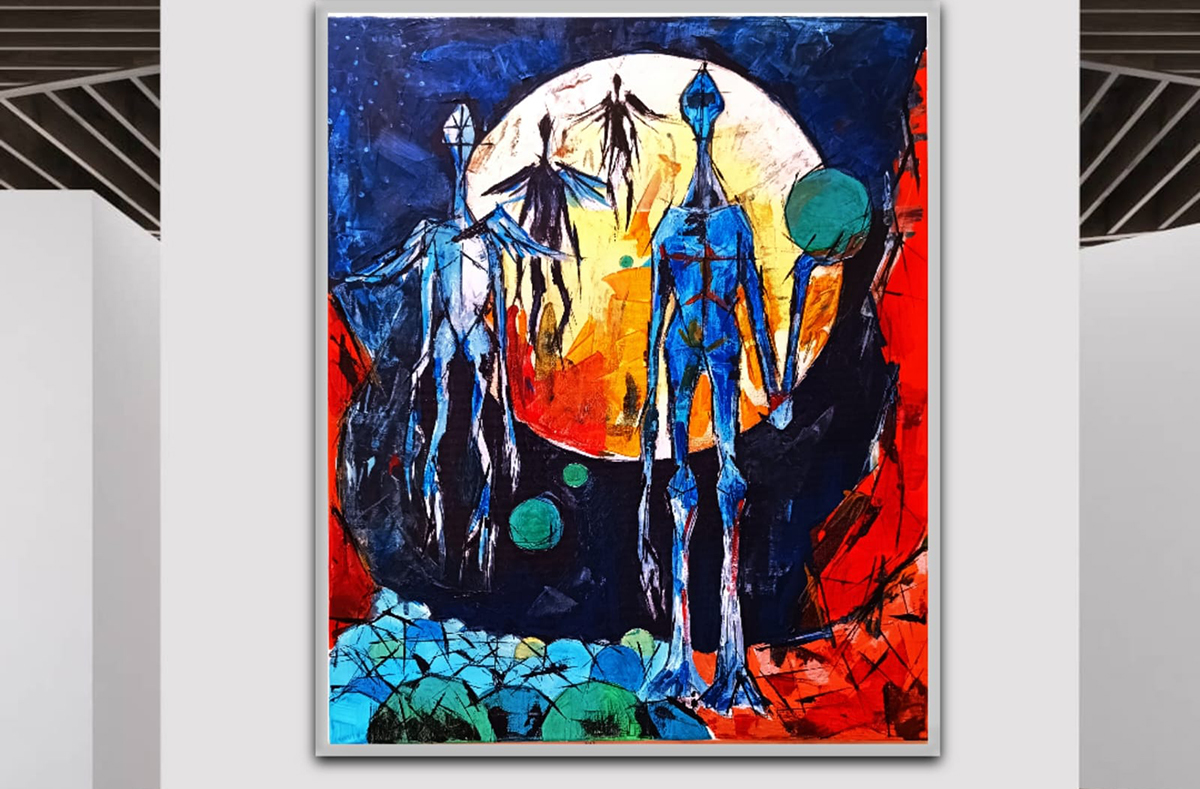
“Travels From Other Worlds”
This piece brings it all together—philosophy, symbolism, energy, and personal vision. The central figure, almost transparent, stands upright, but not still. It seems to be caught mid-movement, mid-thought, holding a small green globe like it just discovered something sacred or fragile. Around it, other figures seem to ascend, almost as if shedding gravity.
Deak’s interest in transformation and stewardship shows clearly here. The figure isn’t dominating its environment—it’s part of it. And it’s aware. That green globe could mean Earth, life, nature, or potential. Holding it isn’t a display of power—it’s a quiet responsibility.
The background vibrates with radiant energy, layers of color that don’t just suggest light—they act like it. This isn’t a painting of space, but of something spiritual or psychological: the idea of being in one world while imagining another.
The ascending figures don’t seem to leave the central form behind—they seem to represent parts of it. Growth, evolution, maybe even memory. There’s no dogma here, no clear religious iconography. But there’s faith—in possibility, in movement, in reaching for something beyond the visible.
Closing Thoughts
Albert Deak isn’t trying to explain the world. He’s trying to express what it feels like to live in it. His work isn’t about beauty in the traditional sense, and it doesn’t rely on shock or scale. What makes it hit is the honesty behind it. These paintings are personal—but not closed off. They reach for something open-ended, pulling from science, history, and the abstract corners of the self.
Each piece is a question, a gesture, an invitation. And what you see in them may shift over time. That’s the point.
