

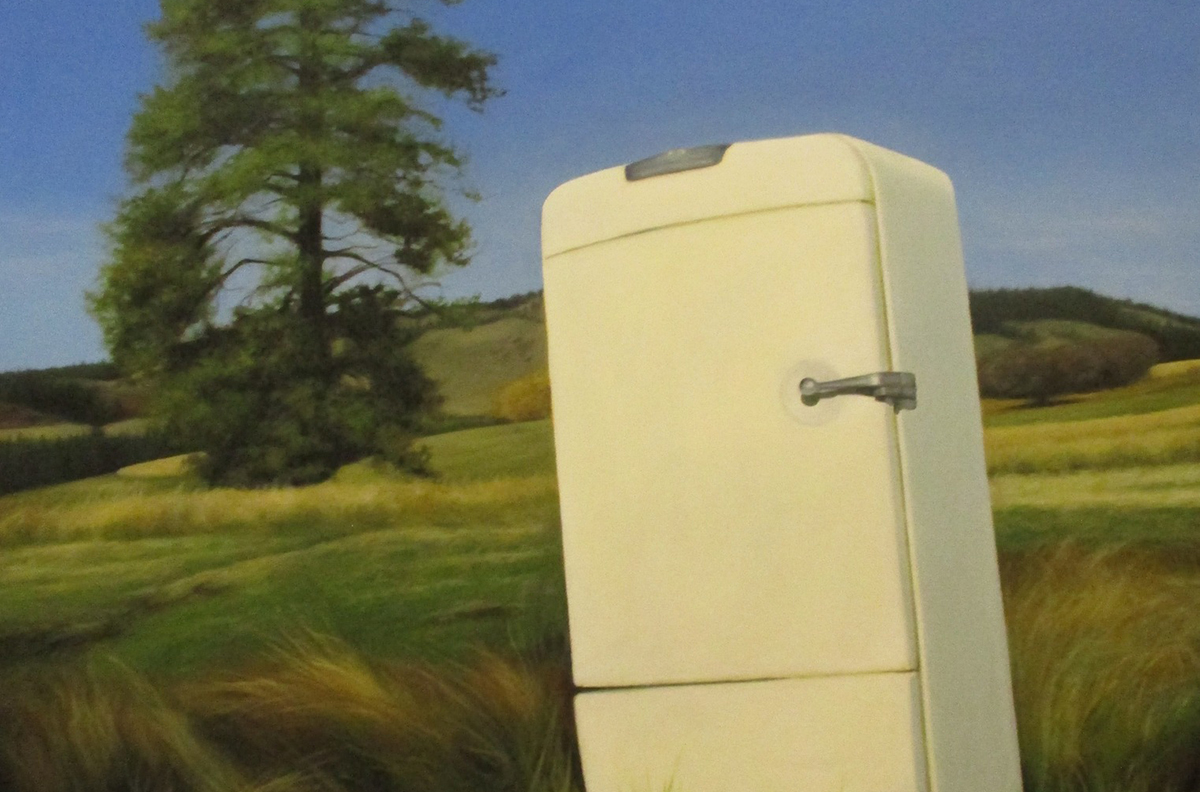
Born in 1959 in Moscow, Idaho, Linda Cancel’s earliest memory is etched with light—watching fireworks burst over the Snake River at just fifteen months old. That brief, dazzling moment set something in motion. From a young age, Linda was attuned to atmosphere, to shadow and glow, to the way light can press into memory. Growing up in the Pacific Northwest, she absorbed its quiet drama: misted mountains, cool rivers, the hush of snowfall. At twelve, she began private oil painting lessons with William F. Pogue, who introduced her to the deep well of narrative art rooted in the Golden Age of Illustration. She learned to paint not only what she saw, but what she felt—interior landscapes stitched to physical ones.
Later, Linda studied Visual Merchandising and Display Design at Spokane Falls Community College, which gave her the structure of visual theory—how color, line, and composition affect perception. That technical skill, combined with her poetic eye and interest in anthropology, geology, and story, led to a deeply personal style. After 25 years on the East Coast, she returned West in 2013, bringing her art full circle, back to the terrain that raised her.
The Artist’s Work
There’s a kind of reverence in Linda Cancel’s paintings. Not for grandeur or spectacle—but for small, still moments that hold a quiet charge.
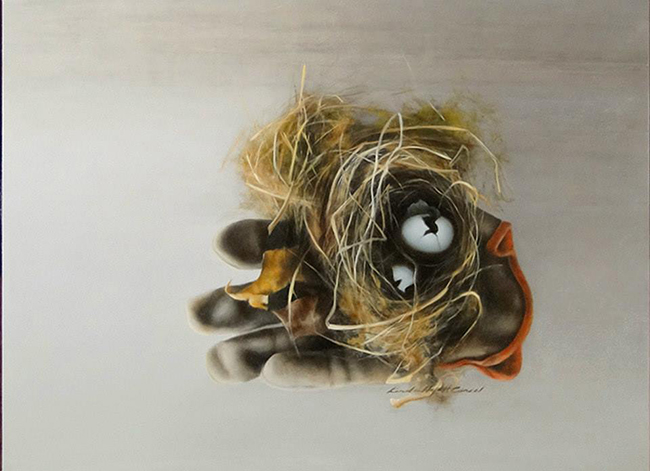
Take A Mother’s Glove, for instance. It’s not a grand canvas, yet it holds volumes. At its center, a nest is cradled in the upturned palm of a glove. Inside, eggs are cracked open, life in mid-emergence. The glove is worn, abandoned maybe, or preserved with care. It could be a literal object or a metaphor—for nurture, for absence, for memory itself. There’s tenderness here, but not sentimentality. The hay is tangled, the shells are broken, and the glove is softly faded. It’s about beginnings, endings, and the hands that hold us through both. You can almost feel the weight of time resting in the fibers.
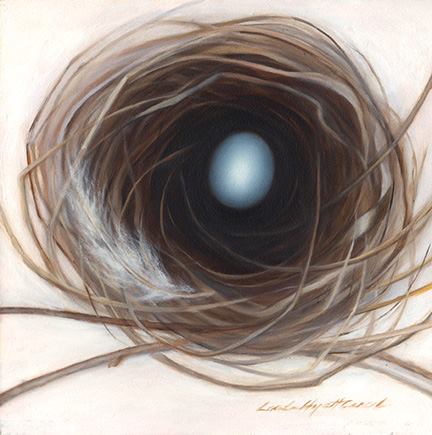
In Light at the End of the Tunnel, Cancel turns her gaze inward. A single egg lies at the dark heart of a swirling nest—no longer in nature, but suspended in a kind of soft white void. There’s a hum to it. The composition pulls you inward. The eye is led through circles of twig and straw, drawn into the soft gleam of the egg, glowing faintly blue. It’s not just about the egg. It’s about the space it occupies—the hush around it, the tension of potential. You’re not sure whether the egg is waiting to hatch or simply holding light. Either way, it feels sacred.
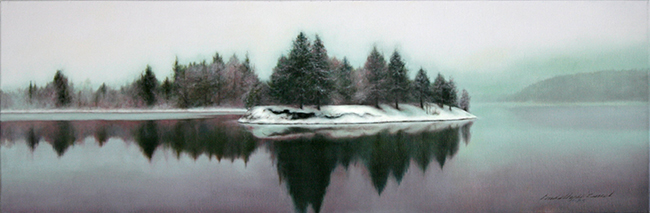
And then there’s Rhapsody in Rose Quartz and Serenity. It’s a shift in mood and scale. Gone are the objects of symbolic still life. Instead, we face a winter island—a real place, softened by fog and reflected in still water. The trees stand in a long row, silent and watching. Their mirrored shapes stretch downward into the lake, as if the land itself is peering into memory. There’s no direct drama, but the quiet is potent. The color palette leans into soft violets, greens, and powdery grays. It feels like waking in a dream you’ve almost forgotten. It’s less a landscape and more a held breath.
What ties all three works together is Cancel’s ability to make space feel personal. Whether she’s painting a glove, a nest, or a stretch of forest, the viewer is pulled into a kind of emotional geography. These are not just representations; they’re invitations to pause and feel. Her use of light is deliberate—never flashy, always tuned to mood. Her compositions often lean toward the centered, the circular, the contemplative. There’s a sense that every element in the painting has been weighed, considered, and placed with care.
Linda Cancel paints like someone who listens closely—to land, to memory, to the murmur beneath the surface of things. Her work doesn’t shout, but it stays with you. It invites you to look again. And each time, there’s something more to see.
