

Cheryl Crane-Hunter is a multifaceted artist whose work not only captivates the eye but also speaks to something deeper. Her background in art education and her enduring connection to nature have shaped a creative practice that’s both expressive and reflective. She doesn’t just paint scenes—she paints moments of stillness, transition, and spirit. Her work feels like a conversation with the invisible threads that hold our world together.
Rooted in a belief that creation is guided by something beyond the self, Cheryl’s approach is meditative and intuitive. The brush becomes a tool for listening. Color, composition, and symbolism come together in quiet but charged ways. She often paints by the sea, draws from moon cycles, and carries a lifelong reverence for light. In each piece, there’s a sense of surrender—a trust in the process and what might rise to the surface. Her art reflects a spiritual commitment to beauty, healing, and transformation.
“As the world in the 5th dimension seems to be crumbling around me… I am answering a calling.”
That’s how Cheryl describes her path right now. Her latest work doesn’t come from strategy—it comes from spiritual guidance. She calls herself a “love and light spiritual painter,” and she means it. These aren’t just paintings; they’re messages, portals, meditations. She chose three works that reflect her connection to composition, chroma, and symbolism—three areas where her inner and outer worlds collide.
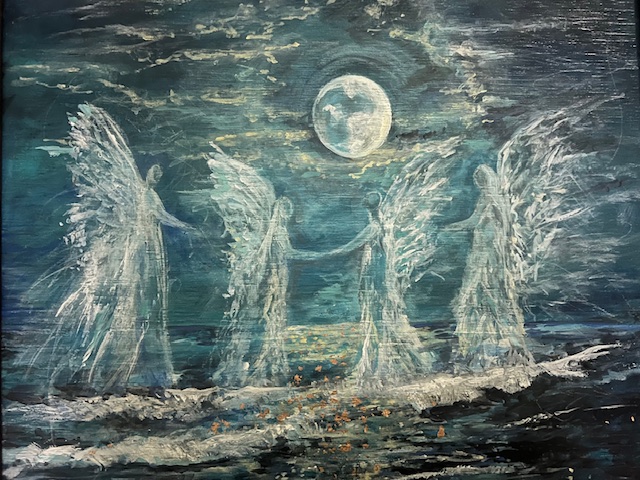
The first is Full Moon on Topsail Island. It’s a monochromatic acrylic painting—quiet, restrained in palette, yet full of layered meaning. To Cheryl, this piece represents the act of calling in helpers from the spiritual world. The moon, especially in its fullness, holds a particular kind of energy. It’s reflective. It’s magnetic. It asks you to trust. In this painting, the moon doesn’t just shine—it whispers. It’s about trusting signs, embracing silence, and opening up to downloads of guidance. The ocean, too, plays its role. She paints the sea not just as scenery, but as presence—a place where magic and clarity meet.
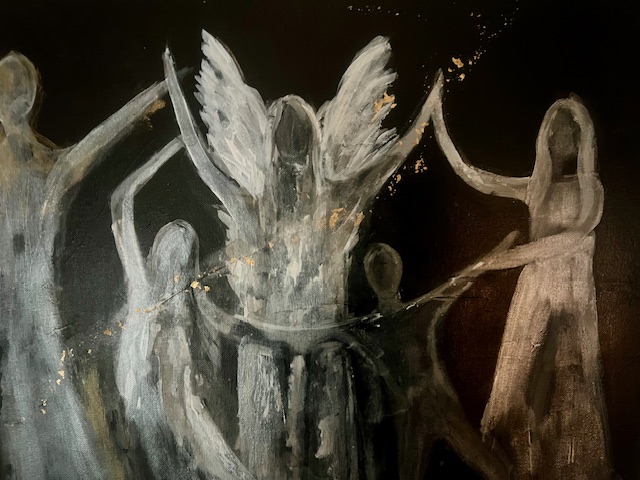
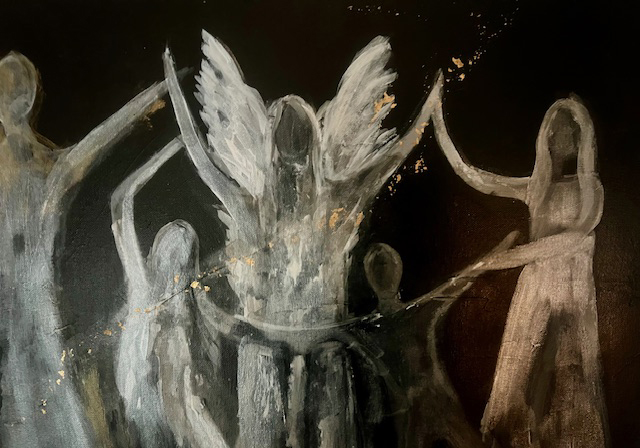
The second piece, The Dance, carries a different kind of rhythm. Here, the palette opens up slightly. The brushwork takes on movement. This painting is about Lemuria—a concept from myth and metaphysics often described as a peaceful, pre-Atlantean civilization. For Cheryl, Lemuria is less a place and more a feeling: heaven on Earth. In The Dance, that feeling comes through as movement between shadow and light. Transparent washes let the forms glow. Shadows give them weight. It’s a dance between what’s visible and what’s hidden, a lifelong exploration of balance through painting. This is where Cheryl’s skill in composition really shines—everything is intentional, yet nothing feels forced.
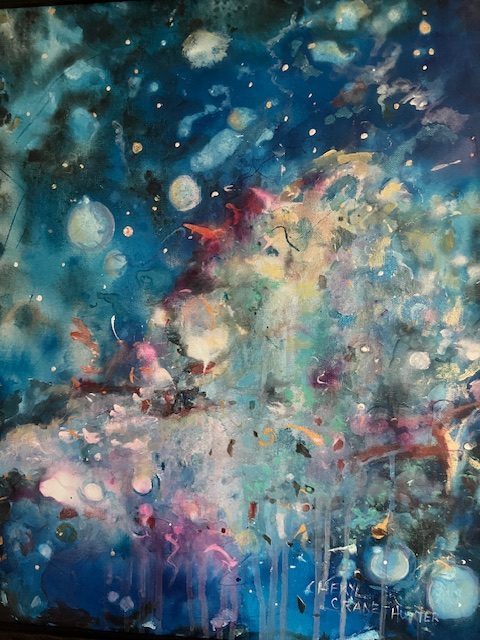
Then there’s Over the Rainbow, maybe the most personal of the three. She painted it as her father was dying of cancer. There’s grief in it, but also peace. Cheryl realized during that time that love is the only thing we arrive with, and the only thing we leave with. The painting is a swirl of blues—dripped, dragged, allowed to move freely. The color doesn’t just sit on the canvas; it travels. It carries the idea of passage. Water becomes sky. Pain becomes love. This work was shown at the Wilmington airport in a show called “Implants,” which touched on the idea of migration and settling—how we arrive in a place with our own history and spirit. For Cheryl, this painting carried both her father’s departure and her own sense of belonging to something wider.
Together, these three pieces are not loud. They don’t demand attention. But they hold space. They carry intention. They ask viewers to slow down and feel their way in. Cheryl’s art isn’t about explaining everything. It’s about opening a window and letting something larger move through.
In a world that often feels like it’s spinning too fast, her work invites you to pause. To remember the moon, the water, the brushstroke. To trust in signs. And to return, again and again, to what is essential: love, light, and the power of simply being here.
