

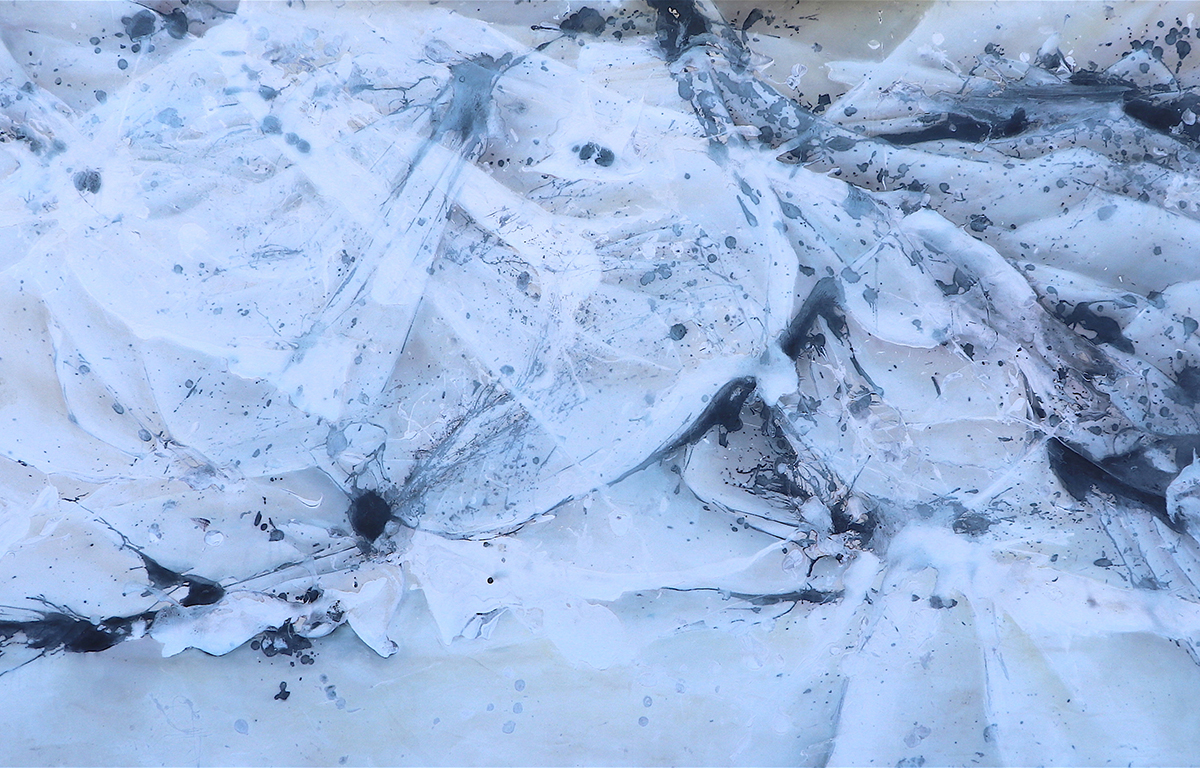
Carolin Rechberg moves through art like a traveler collecting textures, sounds, and sensations. Born in Starnberg, Germany, she doesn’t stay still—not in her practice, not in her ideas. She moves between ceramics, sculpture, painting, performance, poetry, photography, textiles, sound art, and installation as naturally as breathing. But this isn’t about having range for its own sake. It’s about presence. For Rechberg, the process—the movement of hands, the act of listening, the gesture of layering materials—is the work. Her art isn’t just something to look at. It’s something to feel through. She brings her body into conversation with space, letting the material world speak through form and action. Her work doesn’t seek to explain or be explained. It calls for attention, not interpretation. It asks you to show up. To notice. To be in it, not outside of it.
Let’s take a closer look at three pieces that reflect how she works: Song of Myself, Karuna, and Genesis.

Song of Myself
Installation – Mixed Media – Site specific (10 x 10 x 5 meters), 2015
This is not a static installation. Song of Myself was built to become something only when activated—by sound, by voice, by presence. The title echoes Walt Whitman, but Rechberg isn’t quoting; she’s re-sounding. The structure is a visual representation of sound, made to be stepped into, spoken into, sung into. You don’t just see it. You engage with it.
The materials form a sort of spatial score, something between architecture and notation. Think of it as a room that waits for a song to wake it up. It’s about resonance—literal and metaphorical. You become part of it through your own voice, your own breath. It’s a reminder that sound isn’t just vibration in air—it’s also an imprint on space and memory. Rechberg turns the whole room into an instrument and invites you to play it.
Karuna
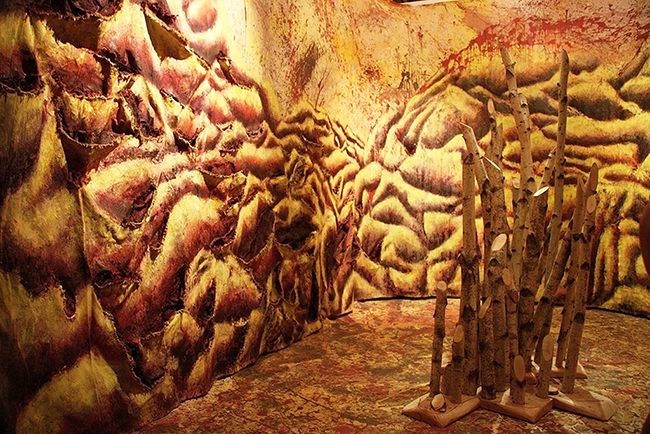
Installation – Canvas, acrylic, house- and oil-paint, cord, burlap, birch trees, pinewood, tracing paper, text – (4 x 3 x 3 meters), 2011
This one takes its title from Aldous Huxley’s The Island, a book where birds remind people to be aware by calling out “attention.” Karuna does something similar—only it doesn’t shout. It surrounds. It draws you in through texture, color, and scale. The materials are raw—cord, burlap, wood. They’re also intentional. Nothing here is decorative. Every element has weight.
The installation is shaped like a quiet forest shrine, soft but dense. Paint and fabric hang in space, suspended between structure and collapse. It smells faintly of pine and pigment. You walk into it, and the world outside falls away. There’s text, but it’s not the center. You don’t have to read to understand. Your body does the reading.
The word karuna is Sanskrit for compassion. And that’s the feeling this space generates—not sentiment, but a deep noticing. It’s a work that’s meant to stir awareness, to pull the observer into a deeper state of perception. Slowly. Gently.
Genesis
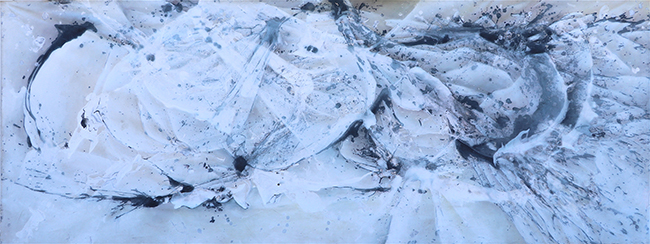
Painting – Mixed media on canvas – (183 x 456 cm), 2016
Here, Rechberg returns to the canvas but doesn’t stay inside its usual rules. Genesis is a large, panoramic surface that pulls you close even as it spreads wide. She uses paint, but also adds unexpected materials, letting the surface become terrain. The title is bold—Genesis—but the painting doesn’t illustrate a biblical scene. Instead, it gestures toward the idea of emergence.
Colors move like tides. Shapes suggest but don’t define. The whole thing feels like it’s in the act of becoming. Rechberg isn’t painting a scene—she’s invoking a process. You get the sense that what’s happening on the surface could also be happening in you.
This work communes with beginnings. Not the kind that mark a fixed starting point, but the kind that are always happening—moments of unfolding, of coming into being. The canvas is a kind of mirror, reflecting not what you are, but what you’re in the middle of becoming.
What ties all this together isn’t a single theme or material. It’s a way of working. Rechberg uses space, sound, fabric, pigment, and structure to hold presence. She doesn’t separate art from the act of living—it’s all one flow. Her installations are invitations. Her paintings are events. Her performances are not meant to entertain, but to remind. Her work, in whatever form it takes, calls you back to the present—to the body, to the senses, to the act of being fully here.
In a world full of noise and image overload, Carolin Rechberg’s art asks for something rare: attention without expectation. It offers no summary, no clean ending. Just a space. A breath. A place to return to yourself.
