

Born in 1967 in Lancashire, UK, Stuart Beck grew up with painting close at hand. His father was his first teacher—introducing him not just to brushes and pigment, but to the idea that art could be part of daily life. That early connection stayed with him. Over time, Beck carved out his own direction, leaning into abstraction while keeping one foot firmly planted in observation. His work doesn’t look like the world, but it’s shaped by it—by nature, by buildings, by culture picked up across time and travel. He paints what lingers in the background: the weathered edge of a wall, the way decay can be beautiful, the uneasy relationship between progress and neglect.
Beck doesn’t paint answers. He paints tension. His canvases suggest conflict and harmony, often at the same time. His work feels like standing still in the middle of something that’s slowly falling apart—but still holding form.
Inside the Work
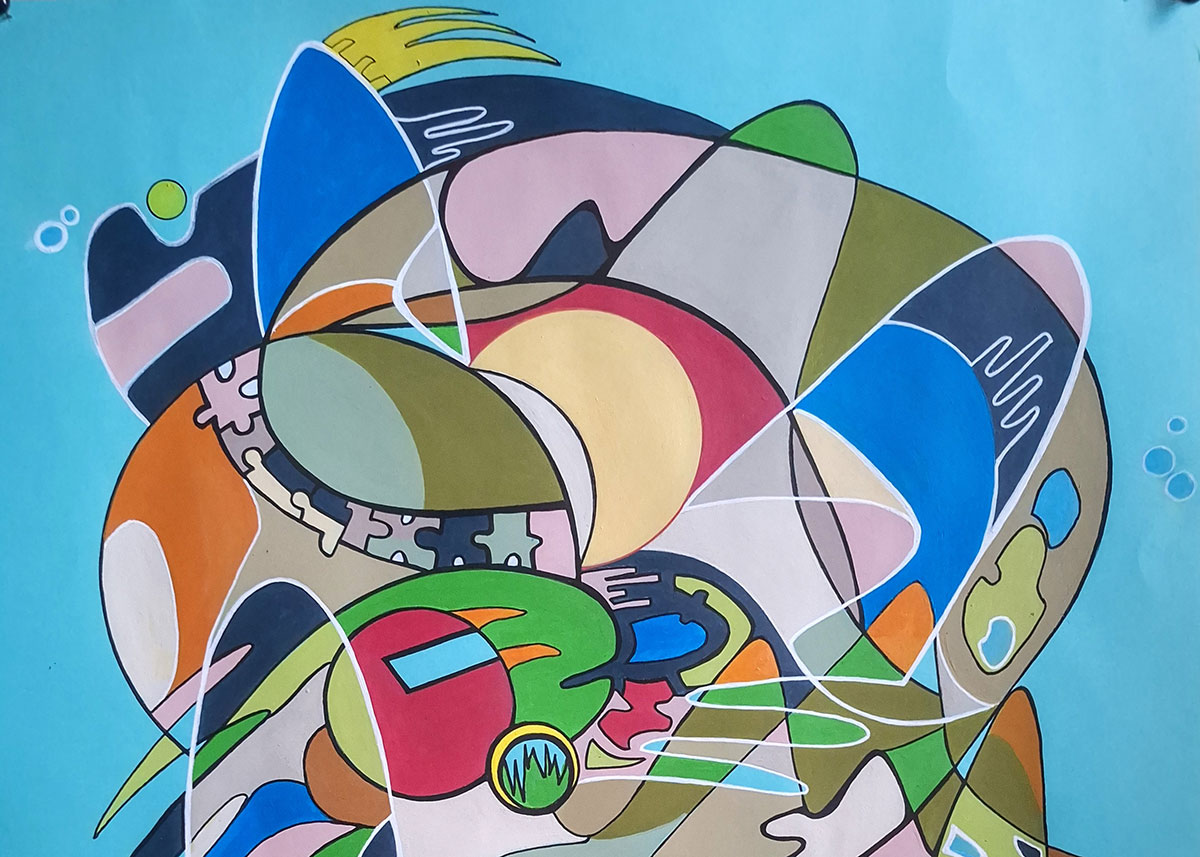
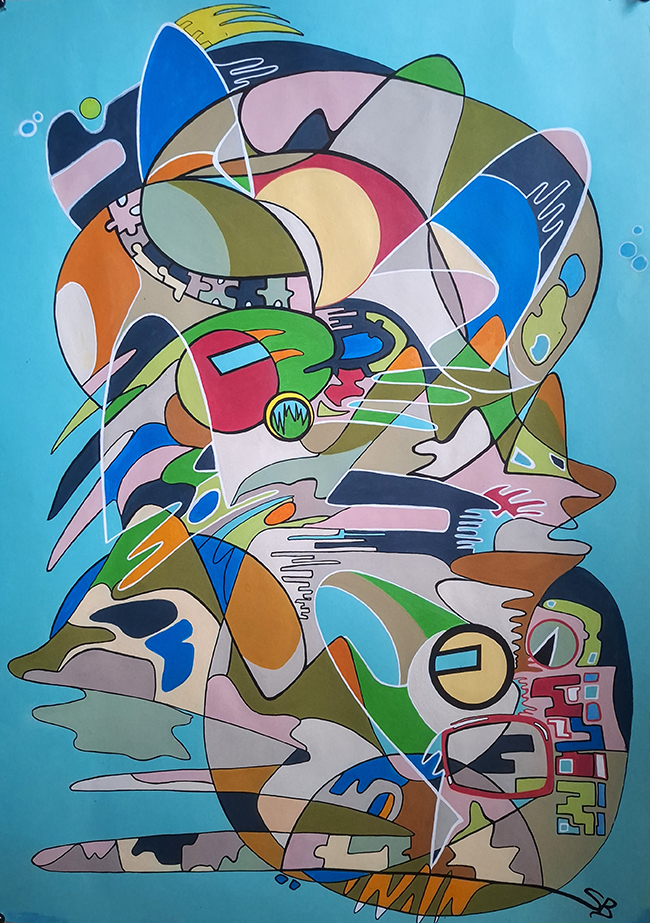
In The Puzzling World, Beck pushes into uncomfortable territory. The acrylic-on-paper piece follows the emotional thread from Human Kind, Destroyer of Worlds, continuing his meditation on the broken ties between people and planet. There’s nothing literal in the painting—no imagery of disaster, no slogans—but you can feel a kind of cracking beneath the surface. Shapes resist coherence. Color doesn’t soothe. The piece stumbles through its own rhythm, like a machine sputtering at the edge of collapse.
The painting seems to ask: What happens when we lose sight of what connects us? When imagined lines—nations, systems, hierarchies—matter more than the fact that we all live on the same earth? Beck describes a “fictional dystopia,” one we’ve chosen to believe in, even as it drags us closer to ruin. The Puzzling World doesn’t try to resolve this—it just reflects it. The painting holds the tension without diluting it, offering a fractured world in fractured form.
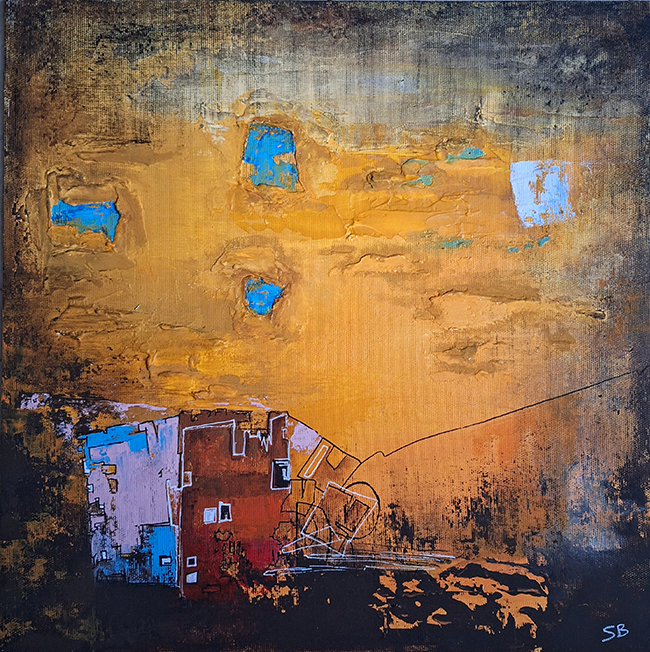
In contrast, Untitled No.25 and Untitled No.26 shift the focus inward. These are not global commentaries, but quiet meditations on time, texture, and transformation. No.25, set against a yellow backdrop on canvas board, and No.26, with its green tones on stretched canvas, build on earlier pieces like No.18 and No.24. There’s a thread running through them: surfaces aged by time, touched by weather, left to settle into their own kind of beauty.
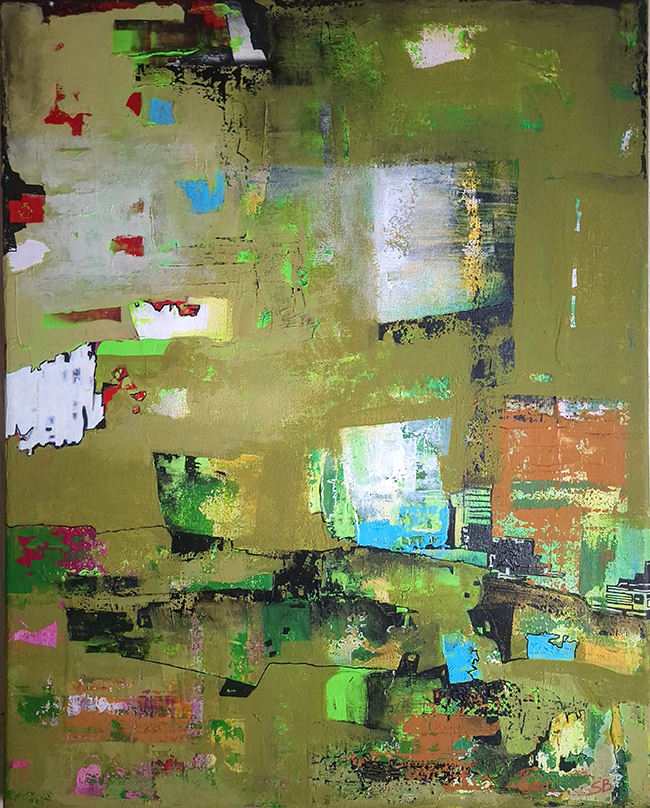
Beck speaks of being drawn to “weathered and aged manmade objects.” But what he captures isn’t just surface damage—it’s a kind of visual softness that happens when something is allowed to live and wear down naturally. These aren’t dramatic ruins. They’re quiet objects, made by people, slowly folding back into the world they came from. The beauty here doesn’t come from design—it comes from erosion, from forgetting, from the way nature reclaims what we leave behind.
Color plays a central role. The yellow in No.25 isn’t bright; it’s worn, almost dusty. The green in No.26 doesn’t pop—it settles. These backgrounds don’t just frame the work—they carry mood. You feel age, memory, maybe even neglect. There’s no clear subject, but the feeling is immediate. These works don’t shout. They hum.
Beck has said he’s drawn to the overlap between the natural and the constructed. That tension sits at the heart of these pieces. It’s where concrete meets moss, where steel rusts into soil. That overlap becomes not just a visual idea, but a way of thinking—what does it mean to build something knowing it won’t last? And can we see beauty in that collapse?
Across his work, Beck returns to this idea: nothing stays pristine, and that’s not a problem. In fact, it’s part of the story. The world we’ve built and the world we come from are constantly in conversation, sometimes in conflict, but always connected. Whether he’s painting global disarray or a crumbling wall, he approaches it the same way—quietly, with patience, and with a deep respect for change.
He doesn’t direct us where to look. He simply paints what he sees and invites us to sit with it. Not to solve it, but to recognize it. His work doesn’t insist on being explained. It asks to be noticed.
In Beck’s paintings, you won’t find clean conclusions. But you might find a kind of stillness—an invitation to look closer at the world you thought you’d stopped seeing.
