

Alan Brown’s art doesn’t make a scene. It invites a pause. His compositions are measured—sometimes witty, often quiet—but there’s always something deeper just under the surface. You don’t look at his pieces and move on. They stick around in your head.
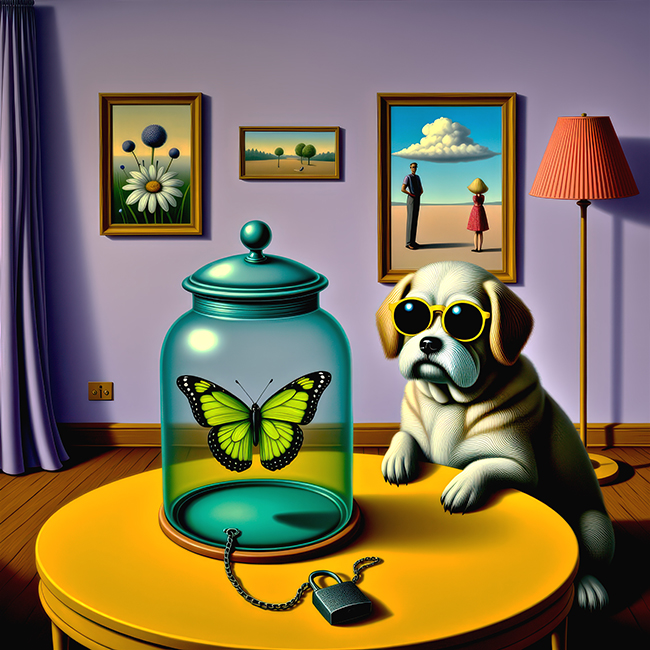
Take A Flutter. It’s an image with a sense of humor at first glance: a laid-back dog in sunglasses, posed like it’s on vacation. Next to it, a butterfly flits inside a locked jar. They share a frame, but not the same kind of freedom. One is a beloved pet, living within the bounds of affection. The other is trapped in a literal prison, colorful and frantic. Brown doesn’t tell you what to think—he just places both versions of captivity side by side and lets the tension hum. It’s about how we treat living things, the lines we draw, and the comfort we sometimes confuse for care.
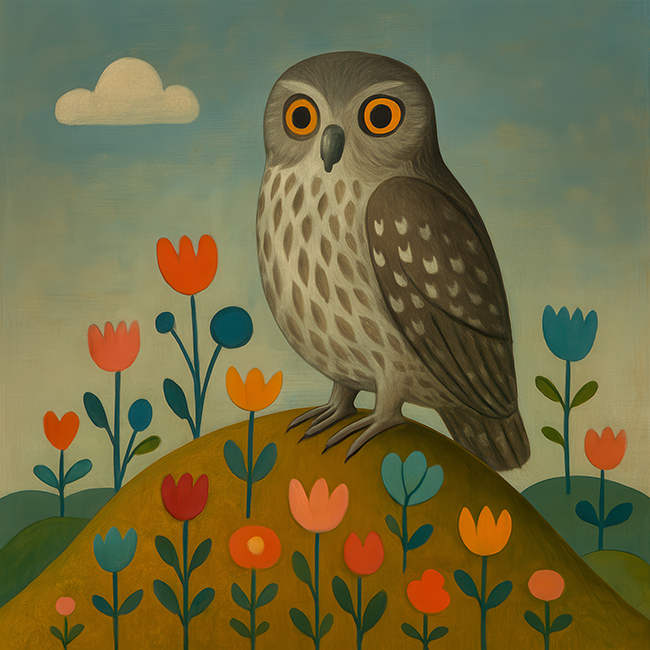
Birds of a Feather carries a different kind of weight. It’s brighter, softer, and more playful on the surface. An owl with glowing orange eyes sits on a green hill scattered with cartoon-like flowers. There’s a single cloud in a pale sky. It could be a page out of a picture book. But then you notice the stillness. The owl’s eyes don’t blink. The flowers don’t sway. Everything feels slightly too placed, too arranged. Nature is present, but it’s been tidied up. Brown’s flat shapes and careful composition echo folk-art styles, but they’re not naïve. The painting touches on how humans reshape wildness to make it more palatable—controlled, ornamental, safe. It’s a sweet image with sharp edges.
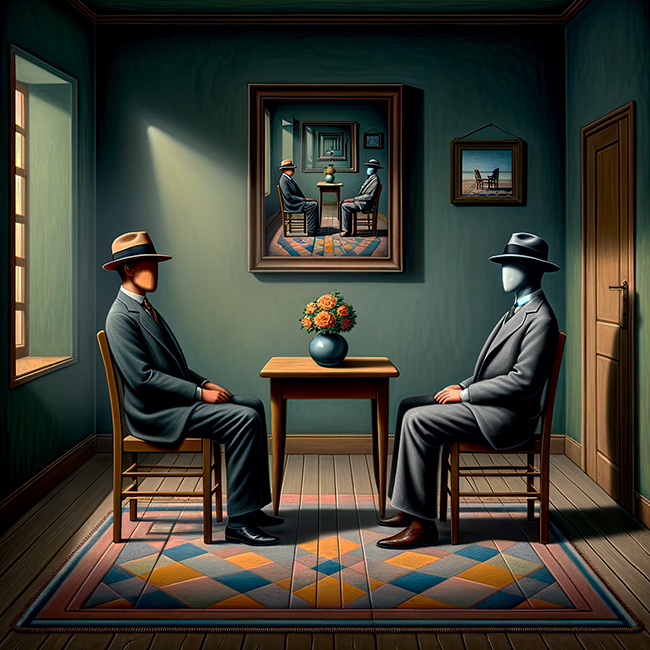
Then there’s A Meeting of Minds, which takes things into a dreamlike zone. Two men stand facing each other. They’re featureless—no faces, no expressions. Between them is a painting of themselves, creating a loop. You’re not sure where the conversation begins or ends—or if there’s one at all. With no facial cues to go on, the whole idea of communication gets put under the microscope. Can people understand each other when all the usual signs are gone? Is it connection or just reflection? There’s a little humor here, but also a quiet unease. Brown seems to enjoy the ambiguity. He’s not offering answers—just letting the moment stretch and echo.
Across all three works, Brown stays minimal. He uses space deliberately, never overcrowding his compositions. His work feels like a stage with just the essential props. There’s always a sense of order, but never rigidity. His simplicity isn’t shallow—it’s precise. He gives you room to think, to slow down, to wonder.
Brown returns to a few key ideas in his work: control, communication, perception. His animals feel like stand-ins for larger systems. His humans are often stripped of what makes them familiar. Nothing is fully literal, and nothing is just symbolic. He walks that middle ground and lets meaning drift in naturally.
What makes his work memorable is its patience. He’s not pushing for shock or spectacle. He builds images that unfold gradually, through suggestion and contrast. It’s the kind of art that rewards a second look—and a third. You don’t need to “get it” right away. In fact, you’re not supposed to.
Even after decades of creating, Brown hasn’t lost the sensibility that first drew him to the darkroom: letting something develop at its own pace. Whether it’s a butterfly behind glass or a pair of blank stares across a canvas, his work keeps circling the same quiet question—how much do we really see, and how much are we willing to look for?
