


Lidia Paladino’s approach is steady, almost contemplative. Based in Argentina, she’s recognized for her engraving and drawing, but her first steps as an artist were grounded in textile work. Needle, thread, fabric—those early materials taught her how to slow down and pay attention. The rhythm of stitching helped shape her eye. That quiet start gave her an instinct for texture, for layering, for what builds over time.
Eventually, she turned her focus back to engraving. It wasn’t just a shift in tools—it was a deeper return. A decision to pursue printmaking with the same patience she brought to fabric. That choice grew into something lasting. In 2003, she was awarded Argentina’s First Municipal Prize for Engraving. But accolades aside, what stands out is the way her prints unfold slowly. They don’t rush toward meaning. They let it settle.
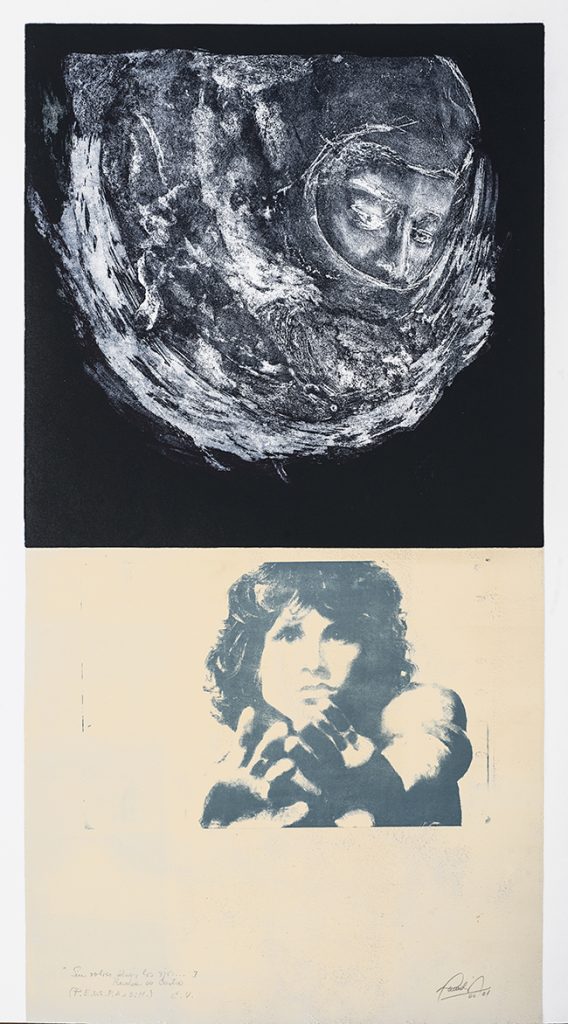
Her 2006 work “Sin volver atrás los ojos, ni mirar hacia adelante” II (roughly translated: “Without looking back or ahead”) is a clear example. The etching combines burin work, poupée inking, and slurry in a 70 x 50 cm composition that seems suspended in time. It doesn’t gesture toward movement. Instead, it holds still. The accompanying phrase, “Have the time to develop good thoughts,” feels less like advice and more like a way of working. There’s no urgency. No climax. Just a quiet image that invites pause.

That sense of suspended thought carries into “Instantáneo y Fugaz” (2005). The title means “Instant and Fleeting,” and the piece works in the same medium and size as the one before it. But here, the tone shifts. “A vision of man. Whether he emerges or sinks.” It’s a line that sits beside the work like a riddle. The figure isn’t clear. The space is murky. There’s movement, but you’re not sure in which direction. That ambiguity gives the piece its pull.
Paladino’s images don’t come with clear narratives. They suggest things—states of mind, moments of reckoning, fragments of experience. Her lines, made with a traditional buril, are exact but never cold. They carry a kind of intimacy. The poupée method, which allows for gentle, hand-applied color, softens the final print. These aren’t quick impressions. They feel lived in—scratched, layered, considered.
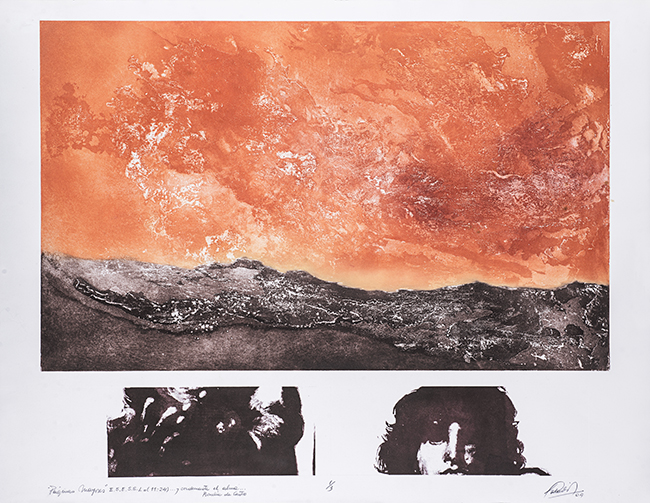
In “Páginas mayores – Y condenaste el alma” (2004), she moves into deeper territory. At 63 x 78 cm, the work is larger and integrates offset printing with etching and poupée. The phrase that accompanies it—“Man condemns himself throughout”—is heavy, but the image doesn’t push that weight outward. Instead, it turns inward. There’s a kind of resignation to it. Not defeat, but awareness. The texture of the piece feels like something left out in the open, weathered by time. You sense the plate has absorbed part of the message.
These works don’t compete for attention. They stay quiet. They let the viewer come to them. Paladino isn’t focused on spectacle—she’s focused on presence. The real thread that connects her images isn’t just her technique. It’s the time she puts into each one. Real time. The kind it takes to sit with uncertainty, to redraw an idea until it’s right, to wait for something subtle to surface.
You won’t find noise in her work. But if you sit with it long enough, you’ll feel something shift. A line that lingers. A silence that deepens. A thought that arrives, gently.
