


Eva Lemay doesn’t map out her paintings in advance. Her process begins in the body—through a feeling, a trace of memory, something sensed before it’s seen. What she paints doesn’t come from close study of the landscape, but from a long, personal relationship with it. Her connection to the land is emotional, physical, intuitive. She paints with oils, allowing the paint to remain loose and alive. Her colors—soft greens, ocean blues, sun-washed yellows—don’t illustrate what’s there. They respond to it. Her canvases aren’t fixed moments. They hover. Nothing is clearly drawn. Everything breathes.
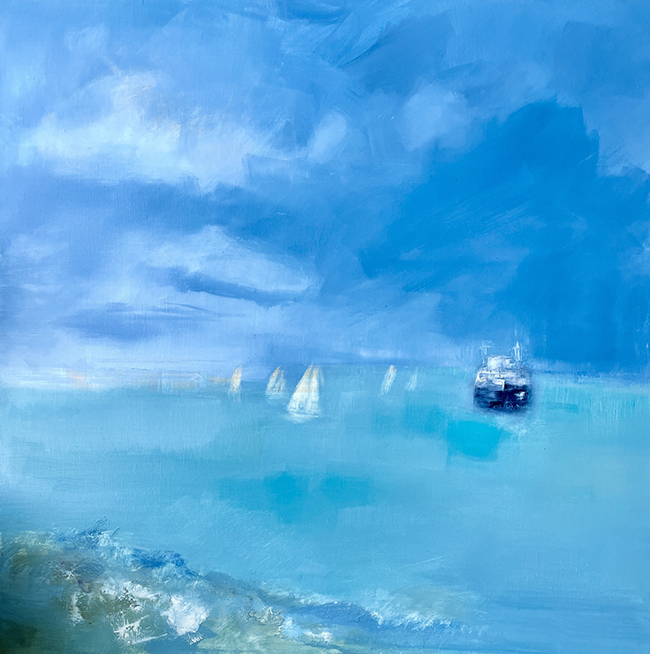
In one piece, the sea and sky seem to melt together. There’s no hard line at the horizon—just a band of turquoise, soft clouds, and the quiet drift of sailboats. Off to the side, a darker ship settles into place, giving the piece just enough grounding. The brushwork is delicate. Lemay doesn’t press down on the image; she lets it float. You can feel the stillness of the scene, but you can also feel it moving—like air shifting before a storm, or a moment waiting to pass.
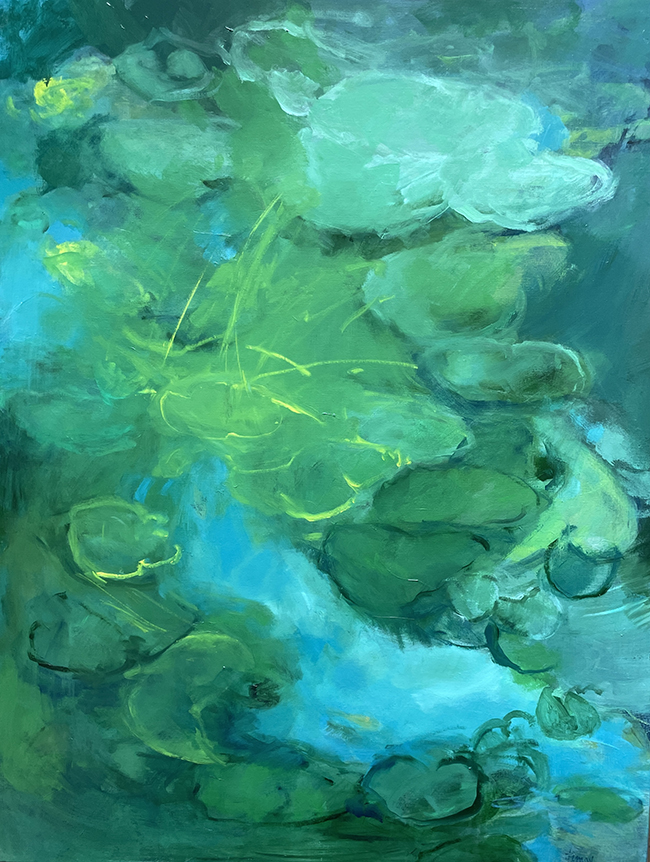
Another painting dips into water. It’s not a literal pond, but it brings one to mind. Colors swirl—deep greens, flashes of yellow, shadows in motion. There are hints of shapes—lily pads maybe, or light striking the surface—but they stay just out of focus. Lemay doesn’t force clarity. Instead, she opens a space that you can drift through. It’s immersive, slow, and slightly dreamlike. The surface is never still.
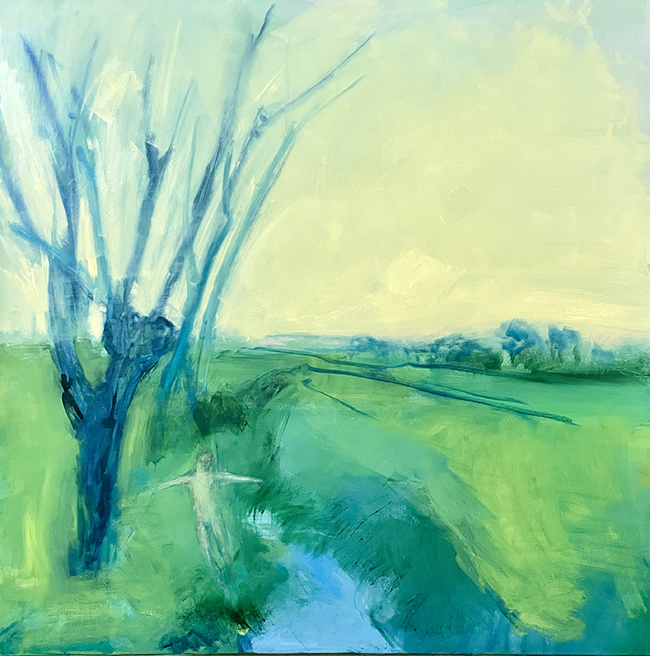
A third canvas follows a narrow stream through open fields. A tree stands on the left, bold and dark. Near its base, a faint figure hovers, arms stretched wide. It’s barely there, like a memory or a spirit. The land stretches back in bands of green and blue, disappearing into soft sky. The painting carries a quietness, not empty but thoughtful. There’s a kind of waiting in it—a suggestion that something is about to begin or has just ended. Lemay leaves room for that uncertainty.
Throughout her work, certain elements repeat: trees, water, figures, open sky. But they never arrive in the same way twice. They shift in meaning and shape. Some paintings lean toward realism, others pull toward abstraction. Lemay isn’t trying to pin things down. She’s trying to let them be—as they are, or as they’re remembered. Her work is full of what might be fading, or what might be returning.
Though her paintings are grounded in the natural world, they don’t speak in environmental slogans. There’s no declaration. No warning. Instead, her art speaks in a quieter register—through care, attention, and a gentle insistence on presence. She paints to stay close to what matters: a tree, a reflection, a patch of moving water. These details, when noticed, become enough.
Her brushwork reflects this mindset. It’s light, unforced, open. She doesn’t fill every inch. She lets her paintings breathe. In that breathing space, you’re invited to stop. To slow down. To return to things you may have forgotten to notice.

Lemay’s paintings carry both grief and gratitude. They hold the sorrow of what we’re losing, but also the beauty of what still surrounds us. They don’t try to convince. They don’t argue. They make space—so you can feel it for yourself.
Her work reminds us that nature isn’t something separate or spectacular. It’s close. Familiar. Worth pausing for. Sometimes, all we need is a reminder. Lemay’s paintings offer that. Not with noise, but with a quiet that stays.
