

Nancy Staub Laughlin works at the intersection of pastel drawing and photography. Her practice is both visual and conceptual—grounded in traditional materials but focused on constructing a layered visual experience that blurs reality and artifice. Laughlin holds a BFA from Moore College of Art in Philadelphia and has spent decades building a body of work that resists easy classification. She’s shown on the East Coast in galleries and museums, and her work has been featured in different art media. Collectors—corporate and private alike—have taken interest in her vibrant, constructed pieces. Sam Hunter, a well-known art historian and critic, once called her work “refreshingly unique,” a description that still fits.
Laughlin doesn’t just capture scenes. She builds them. That’s the essential difference in how her work operates. She sets up still-life arrangements in her studio—carefully curated elements that often include flowers, crystals, glass, and textured materials—and then photographs them under controlled lighting. These photos are not the final product. Instead, they become the foundation. She prints them and begins to work directly over them with pastel, creating what she calls a “continuum” between the photographic and the drawn. Her process is slow, deliberate, and immersive. You can feel that in the finished work.
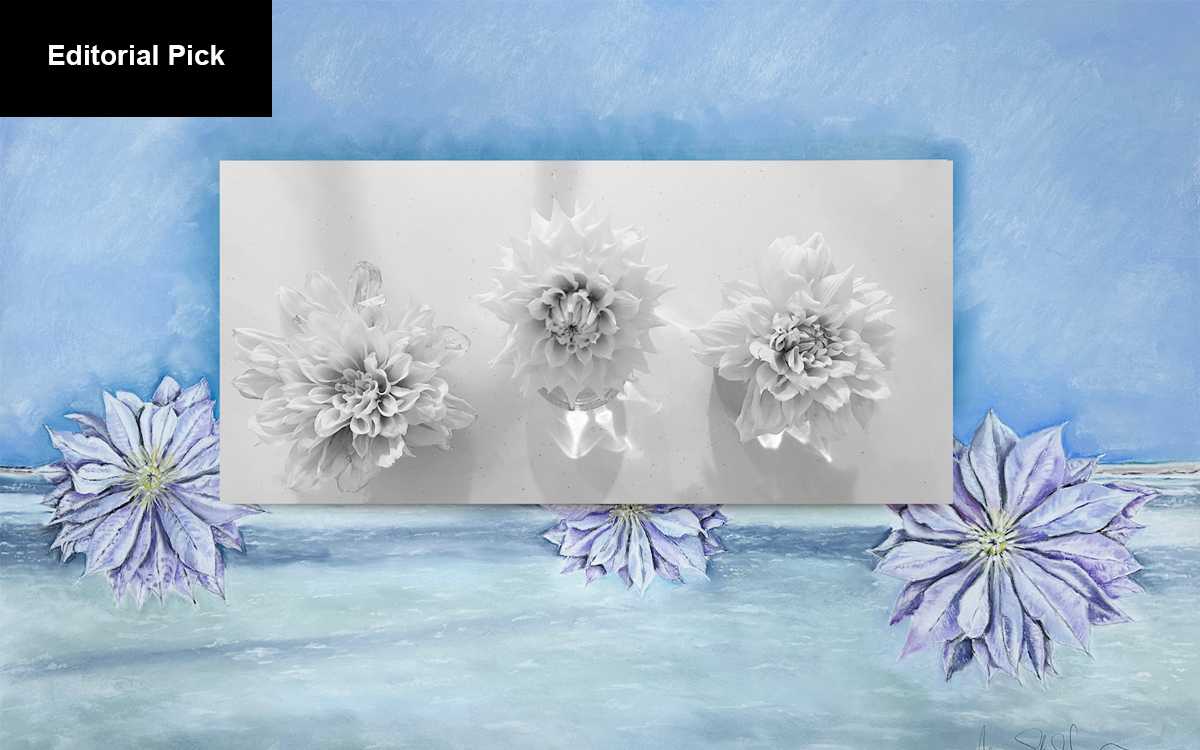
One of her pieces, The Luminescence of Light (27 x 43 inches, pastel on paper, mounted photograph), shows how she threads all of this together. It’s a vivid exploration of texture and light, where nature and abstraction seem to merge into a suspended moment. The salt flats—rendered as frothy, almost effervescent ground—anchor the image. Above or perhaps around it are fluffy dahlias and luminous lavender clematis. The composition plays with perception. Are these flowers placed on the flats? Floating above them? Reflected in some unseen surface?
The answer is: yes, and no. This is Laughlin’s signature technique—creating layered images that challenge how we think about depth and placement. It’s both real and constructed. The light is not incidental but carefully planned. You don’t stumble into this kind of glow. The lavender clematis, in particular, acts as a hinge in the composition—something that ties it all together, adding a soft radiance that blends with and enhances the color palette. Her pastels don’t overpower the photograph; they work in dialogue with it. The two mediums inform each other without dominating.
What makes this work interesting is its refusal to settle. It’s not a still life, not exactly. And it’s not pure abstraction. It falls somewhere in between. Laughlin calls it a “lure”—an invitation into her world. That word is important. She doesn’t try to replicate what she sees. She builds what she wants you to enter.
There’s also a conceptual layer worth noting. By combining ephemeral organic materials—like salt and flowers—with the permanence of photography and the delicacy of pastel, she’s hinting at something deeper. Maybe it’s about time. Or fragility. Or transformation. These aren’t loud messages. They emerge slowly, like the details in her work. You have to sit with them.
Her technique also speaks to her discipline. Pastel, especially on mounted photography, is not forgiving. It requires intention, layering, and control. The fact that her pieces feel both carefully composed and visually fluid is a credit to her years of practice. The result is a surface alive with texture—light catching on color in ways that feel organic and artificial at the same time.
The Luminescence of Light doesn’t rely on shock or bold gestures. Instead, it unfolds. The longer you look, the more you notice—how the light moves, how the colors connect, how the elements don’t just sit but interact. It’s a gentle pull into a world that’s clearly been built, but not in a cold or clinical way. There’s warmth here. There’s care.
That might be the heart of Laughlin’s work. It’s built—but it breathes. It’s composed—but never static. She gives you something to explore, but doesn’t explain it all away. The light does the talking. You just have to follow
