

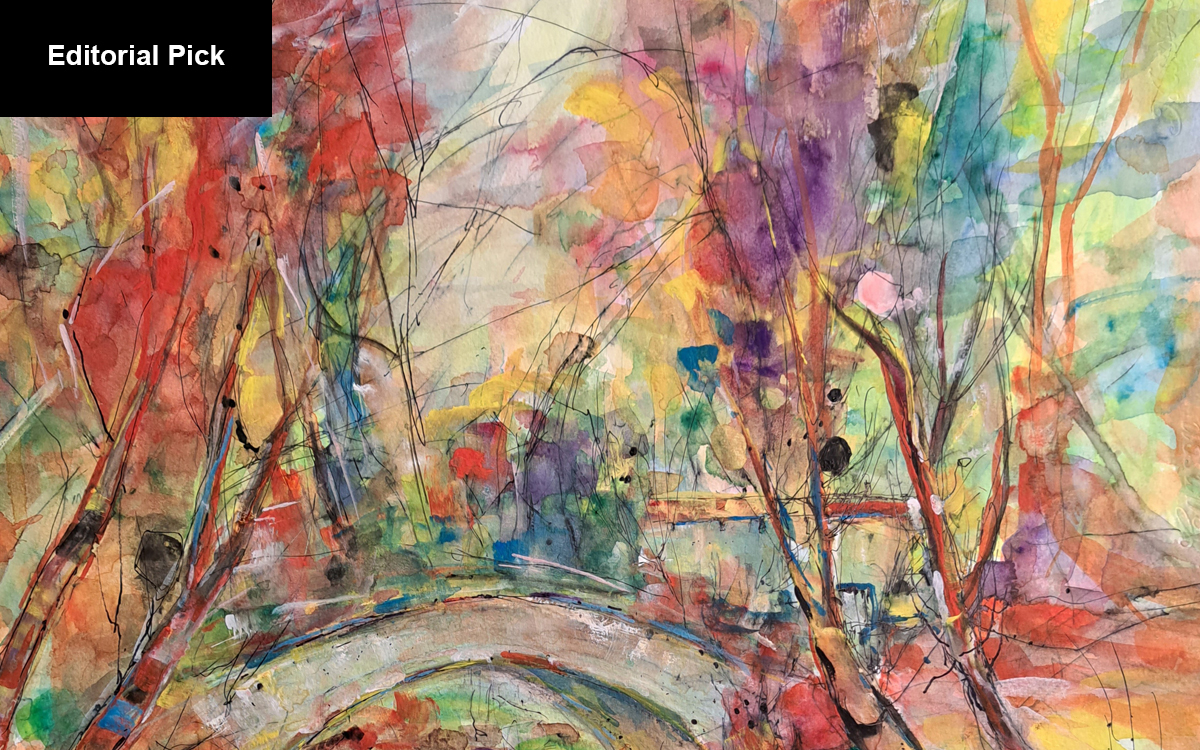
Born on February 28, 1963, in Alès, France, Patrice Layre has always moved through life with a painter’s eye. From early childhood, he found comfort in holding a brush, watching color spread across paper. His grandfather, a painter himself, played a quiet but powerful role in shaping this path. The bond they shared over art stayed with him long after his grandfather passed away. For Layre, painting is more than expression—it’s remembrance, connection, and a way to slow time.
Layre didn’t come to art through formal institutions. His approach is intuitive, personal, and anchored in observation. He paints not for spectacle, but for a return to something slower and deeper. In a world that often rushes by, his watercolors offer pause. His work doesn’t demand; it invites.
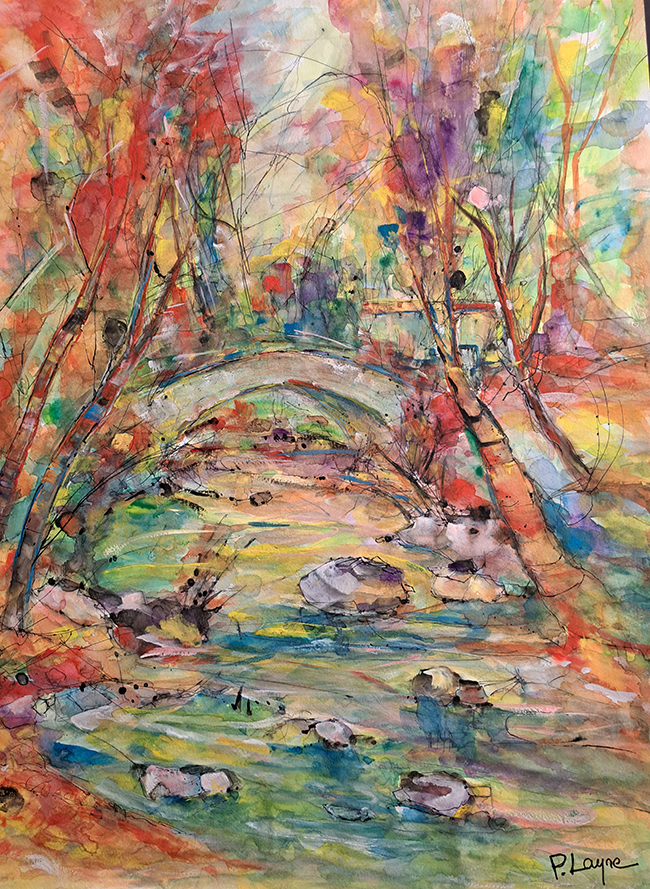
One of Layre’s recent works, a watercolor teeming with color and movement, captures his philosophy well. There is no title given, and none is needed. What we see is a woodland stream under a stone arch bridge. Trees arc gently toward each other across the stream like old friends meeting at a bend. Their limbs, both delicate and angular, echo the rhythms of nature—unplanned but not random.
The colors do much of the talking. It’s a wash of reds, oranges, purples, greens, and blues—nothing heavy, everything brushed in with a kind of trust in spontaneity. The pigments bleed and blend in places, while sharper, ink-like lines define the trees, the stones, the edges of the water. The result is both soft and structured. There’s a looseness to it, but it never feels chaotic.
Look at the water: transparent washes of turquoise and green move lazily between pale stones. The reflections are broken, as they would be in real life. No single detail overpowers the others, which gives the entire painting a sense of balance. The bridge, slightly off-center, becomes a quiet anchor. It’s not just a visual element—it’s a metaphor. A crossing point. A place between.
Layre himself has said his watercolors are “a message of happiness in a society that moves too fast.” That sentiment carries through clearly here. The painting doesn’t rush you. It lingers. There is serenity in the irregularity of the trees, in the way the colors stretch and fade. The work reminds us that grace often comes in fragments—not in bold declarations, but in soft tones, quiet lines, and spaces left open for breath.
But there’s more than nostalgia here. This isn’t just about beauty or peace. Layre’s work subtly points to something deeper—a reminder that small moments matter. The stream doesn’t roar. The trees don’t shout. Yet together, they build a whole that makes you want to stop and look.
Technique-wise, Layre blends wet-on-wet and dry brush approaches. The background—especially where the foliage becomes loose color fields—is soaked and fluid. But there’s restraint in how he draws in the trunks and stones. He knows where to hold back. That’s part of what gives the work its sense of calm: the balance between freedom and intention.
In an art world that often prizes the provocative or the conceptual, Layre’s work feels like a quiet stand for sincerity. He isn’t trying to impress. He’s trying to connect—with nature, with memory, with whoever stands before the painting. There’s a humility in that. And in many ways, it’s what makes his work resonate.
We don’t know where this stream is. It could be France. It could be anywhere. But maybe that’s the point. The scene isn’t about place—it’s about feeling. And in that sense, it becomes universal.
Patrice Layre gives us a chance to slow down. To look at the spaces between the lines. To find color in shadow. To cross the bridge, not to escape, but to return—to stillness, to self, to something that has always been there, waiting.
