

Sylvia Nagy’s work sits at the intersection of art, technology, and global movement. Trained in both industrial design and fine art, she blends material knowledge with expressive intent in a way that feels at once grounded and visionary. She studied at Moholy-Nagy University of Art and Design in Budapest, where she earned an MFA in Silicet Industrial Technology and Art. That technical foundation would evolve as she explored ceramics more deeply—especially during her time at Parsons School of Design in New York. There, she not only taught but also designed a course in mold model making using plaster, pushing traditional processes into new conceptual territory.
Her art has taken her around the world—Japan, China, Germany, the USA, and Hungary—through various artist residencies. She is a member of the International Academy of Ceramics in Geneva, and her work is included in museum collections in France, Spain, Korea, and beyond. In addition to her studio practice, Nagy is drawn to movement in all forms—dance, fashion, styling, photography, and trends—adding layers of rhythm and design thinking to her ceramic work.
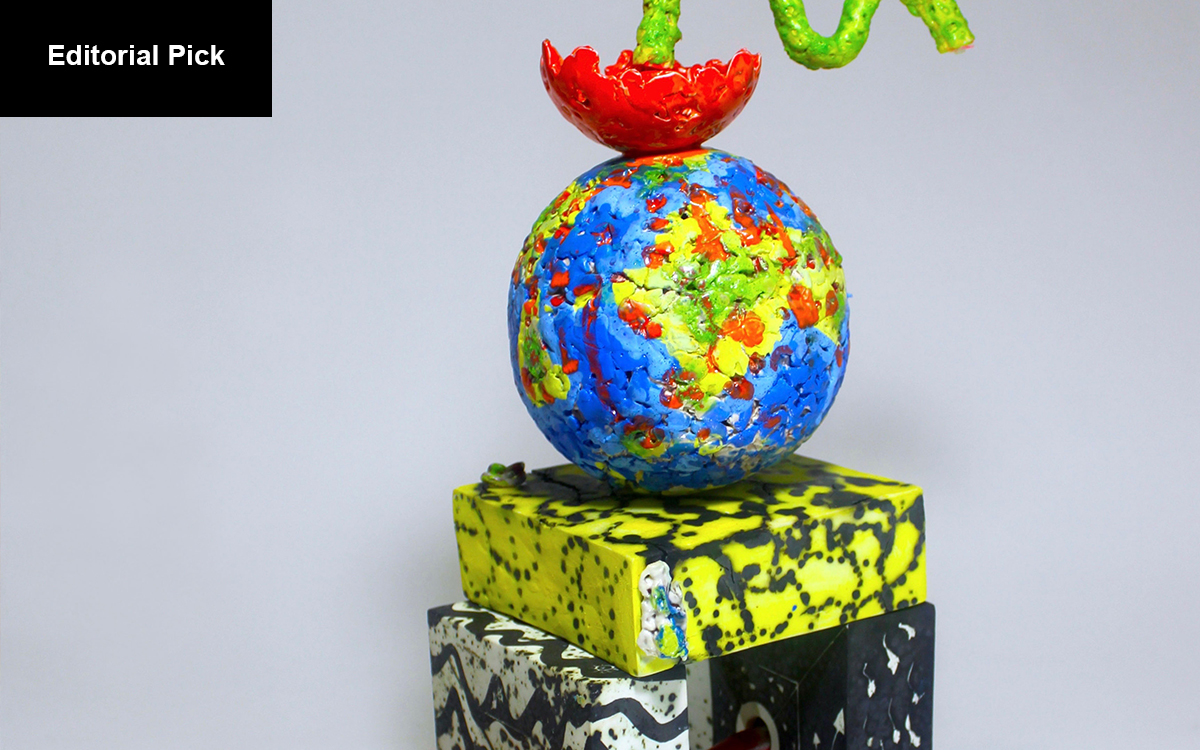
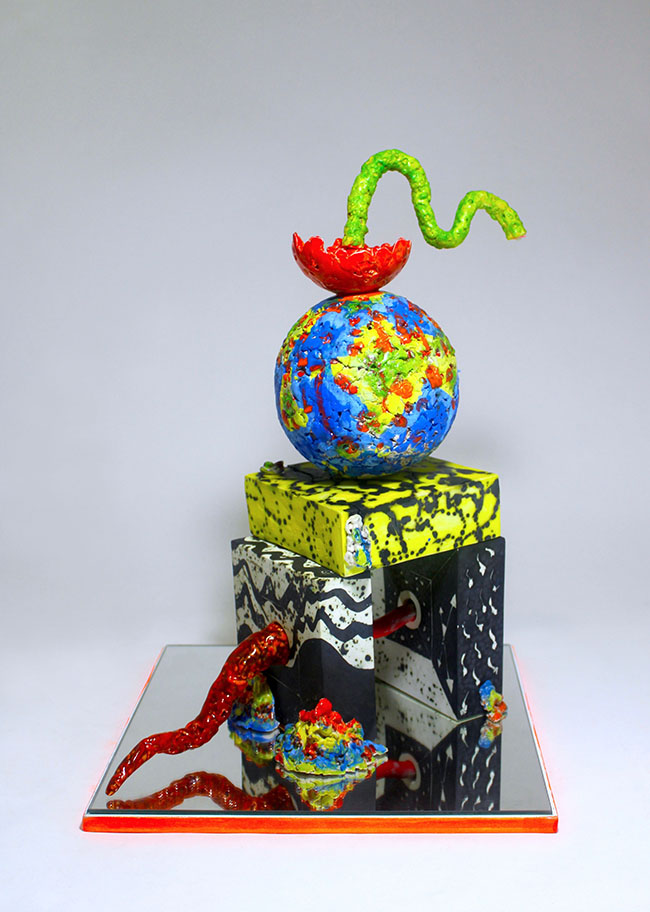
Sylvia Nagy’s project Our Globus isn’t a collection of objects as much as it is a field of energy. The work considers the planet as a spinning system—unstable, symbolic, and in constant motion. She brings to the table a clear vision: the earth isn’t static. Its structure is fragile. Its pillars—social, ecological, emotional—can shift at any time. And when they do, it is the artist’s role to rebalance, to recalibrate, and to respond.
In Our Globus, Nagy isn’t making a literal globe. She’s not recreating a sphere or geographic map. Instead, she builds ceramic forms that represent energy fields—tactile, sometimes fractured, often glowing. She uses symbols pulled from ancient cultures and spiritual systems, grounding her forms in something old, even as she moves forward into ideas of future time and quantum energy. There’s a weight to her pieces, but also a lift—like something under tension but still reaching upward.
The materials matter. Her ceramics often bear traces of fire, oxidation, or crystalline glazes—evidence of transformation, temperature, and process. These aren’t pristine surfaces. They are records. Each form is a response to pressure, much like the world she’s referencing. And just as the earth holds both beauty and damage, Nagy’s work holds balance and disruption side by side.
In this context, the “pillars” she refers to are both real and metaphoric. War, climate shifts, and disasters can weaken societal structures, but so can cultural fragmentation and personal despair. Her ceramics don’t fix any of these things directly—but they serve as small acts of restoration. They carry intention. Through her work, she tries to release calm energy, as if the act of creating and firing clay can become a stabilizing gesture.
Nagy is also very aware of synchronicity—how events line up without direct causation, yet somehow carry meaning. Her forms often reflect this: a carved surface echoing a forgotten symbol, a glaze pattern that seems to reference something astrological, or a broken line that looks like a map, a scar, or a soundwave. These connections aren’t forced. They happen naturally, and she lets them emerge. It’s part of the way she trusts the process and lets the materials speak back.
There’s also an open-endedness in her work. She doesn’t try to explain everything. Instead, she invites viewers to sit with the forms, feel the frequencies, and reflect on what might be happening underneath. The goal isn’t to teach but to transmit—something quieter, deeper, and emotional. Her pieces don’t scream. They hum.
Our Globus is one artist’s attempt to tune the world’s static into something calmer, something resonant. It doesn’t offer solutions, but it does offer grounding. And in times of uncertainty, that might be enough.
Nagy’s ceramics are less about objects and more about presence. They ask: what does it mean to hold space for the earth’s energy? What does it mean to be a stabilizer rather than a disruptor? And what does it look like when the act of making becomes a form of healing?
For Sylvia Nagy, those questions are always in play. Her work spins with them. And it keeps spinning forward.
