

Aliza Thomas, an artist living in the Netherlands, was born and raised in Israel. Her life’s path reflects the quiet depth that comes from years of exploration—both creative and personal. She is a visual artist and papermaker, but that’s just one layer. Thomas is also a devoted teacher, both in art and in practices like Qigong and Taijiquan, disciplines that emphasize balance, flow, and presence. Her daily life is deeply rooted in family, as a mother of three and grandmother to three more. These roles don’t compete—they complement. Thomas brings the same attentiveness to her teaching and art as she does to her family. Each facet of her life feeds into the next. Her work is tactile, personal, and process-based, often involving reused or repurposed materials. The result is an artistic voice that feels lived-in and grounded, with a philosophy that leans into quiet resilience, renewal, and awareness.
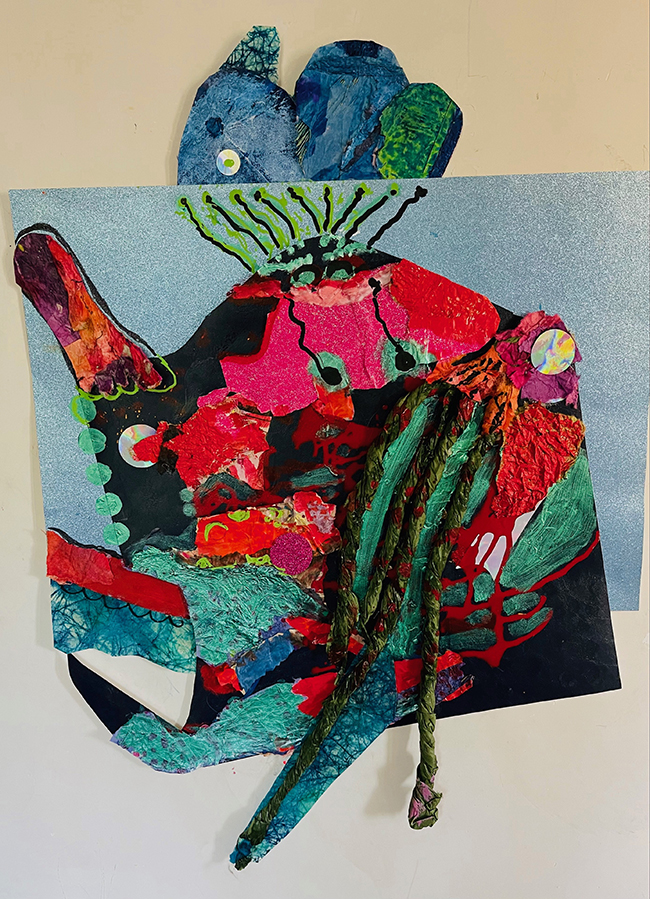
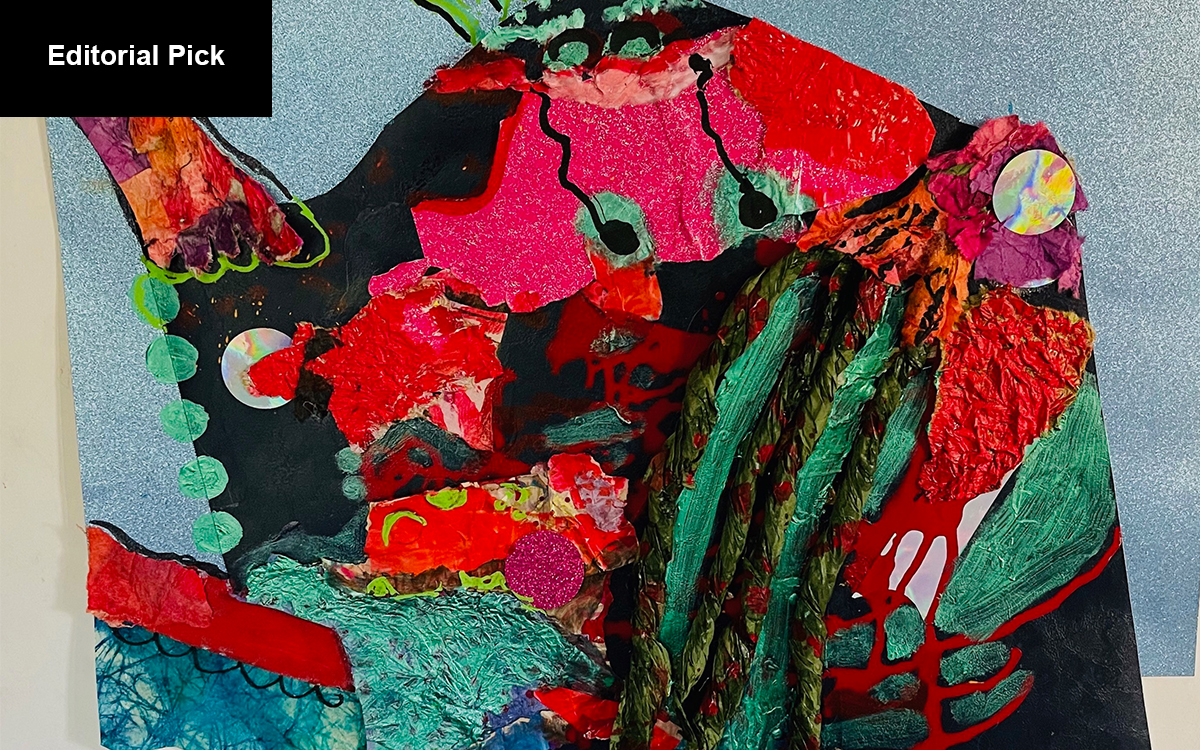
Swimming in 2030 is one of those pieces that sits with you differently each time you return to it. Created on paper—measuring 97 by 70 centimeters—Thomas uses paint and her own handmade paper to construct a work that speaks to transition, impermanence, and something like cautious hope.
There’s a loose sense of narrative to the piece, but it’s more about experience than story. The viewer isn’t told what to see; instead, they’re invited to feel it. She describes the work as reflecting “the change the world is experiencing”—a transformation not just of environment or technology, but of perception. In her view, even “shapes, forms, colors, and odors” are shifting. This isn’t nostalgia for what’s been lost; it’s an attentive eye on what is becoming.
Thomas doesn’t offer easy answers. The painting feels like a space between things—between past and future, chaos and renewal. The title, Swimming in 2030, places us just far enough ahead that the scene feels speculative but not fantastical. It echoes today, only with a different rhythm. The artwork plays with abstraction in a way that resists closure. You can sense movement in the composition—soft waves, scattered forms, a tension between dissolution and assembly.
But what grounds it is the tone of the accompanying words. Thomas writes as though guiding us into this moment: “Tiptoe in no one’s land, make your heart like a shiny lake mirroring sun and moon with great depths of kindness.” It’s poetic, but direct. The painting and the writing together offer a quiet resistance to panic. Instead of despair, Thomas offers presence. Instead of control, she invites surrender—to observation, to transformation, to kindness.
In a world where environmental, political, and technological upheavals shape how we live and relate, Thomas’s work serves as a gentle nudge toward balance. Her practice of Qigong and Taijiquan shows up not in the imagery, but in the way the piece breathes. There’s no rigidity. Her choice of paper—a medium she creates herself—speaks to patience and texture. This is not mass-produced art. It’s slow, layered, and intentional. Even the paper holds meaning: she often reuses old works, giving them new life in altered forms.
Thomas’s use of handmade paper as a foundation isn’t just a technical detail—it’s part of the work’s philosophy. Paper is fragile but adaptable. It records every pressure, every mark, every layer. Like skin. Like memory. Her approach—rooted in re-use—adds depth to the notion of transformation. What was once discarded or overlooked becomes something worth seeing again.
The imagery in Swimming in 2030 doesn’t demand interpretation. You don’t need to decode it. You just need to sit with it for a while. The visual elements—fluid, sometimes fragmented—mirror the emotional tone of her writing. Both suggest that we’re not in control of this shift, but we can choose how we move through it. Thomas’s invitation is to move with care.
The world she hints at isn’t utopian or dystopian. It’s open. That’s what makes her work feel current. In an age of hyper-definition and digital overload, Thomas slows things down. She encourages a return to texture, breath, and quiet attention. Her work doesn’t shout. It doesn’t warn. It hums.
And perhaps that’s what makes Swimming in 2030 resonate. It isn’t about predicting the future. It’s about being ready to meet it—with heart, with humility, and with the kind of grace that comes from having walked a long path already. Thomas isn’t interested in spectacle. She’s interested in the unseen, the layered, the tender—and how we might carry those qualities with us, even as the world around us keeps changing.
