

In the vibrant capital of Canberra, Australia, Bruce Cowell has spent over 40 years behind the lens—quietly observing, documenting, and interpreting the world. His work as a fine-art photographer is grounded in both technical skill and emotional insight. Cowell isn’t interested in flashy trends or passing movements. He’s more concerned with what lies underneath: the moments we miss, the stories etched into landscapes, and the quiet weight of being alive.
Cowell’s photography bridges his experience as a commercial and professional photographer with his deeper pursuit—using visuals to explore what it means to be human. For him, photography is less about the gear and more about what the image says. It’s how he speaks to the world.
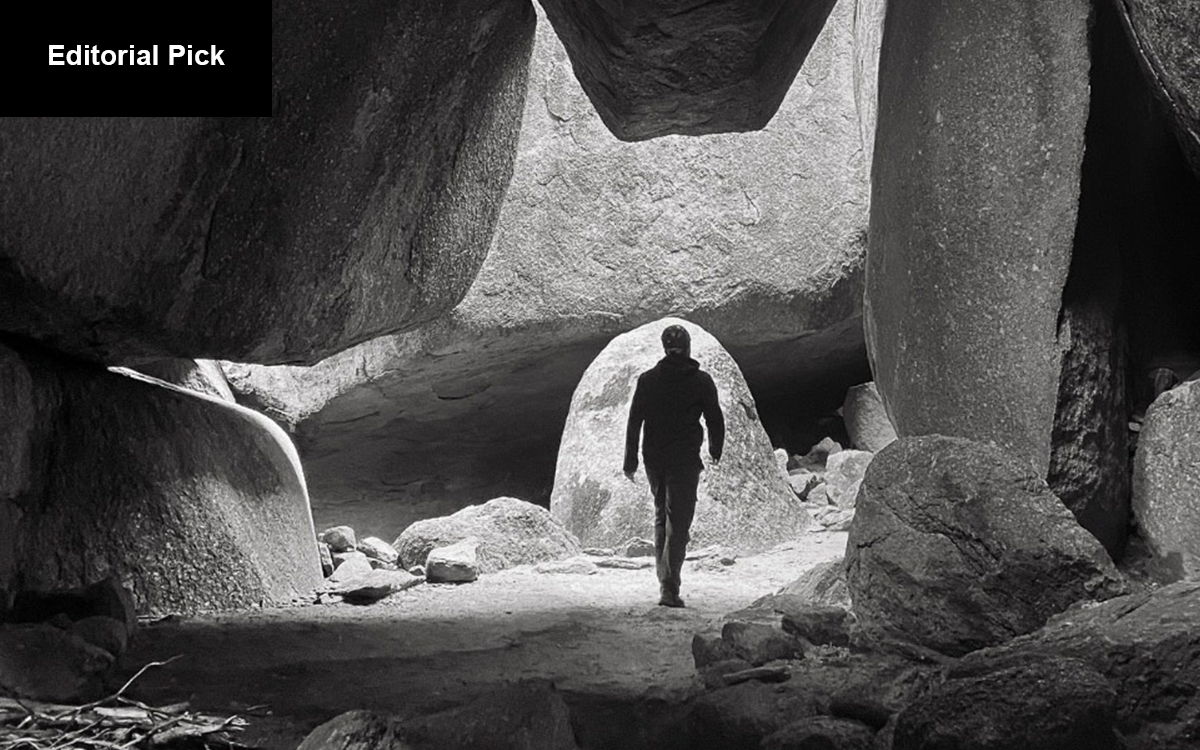
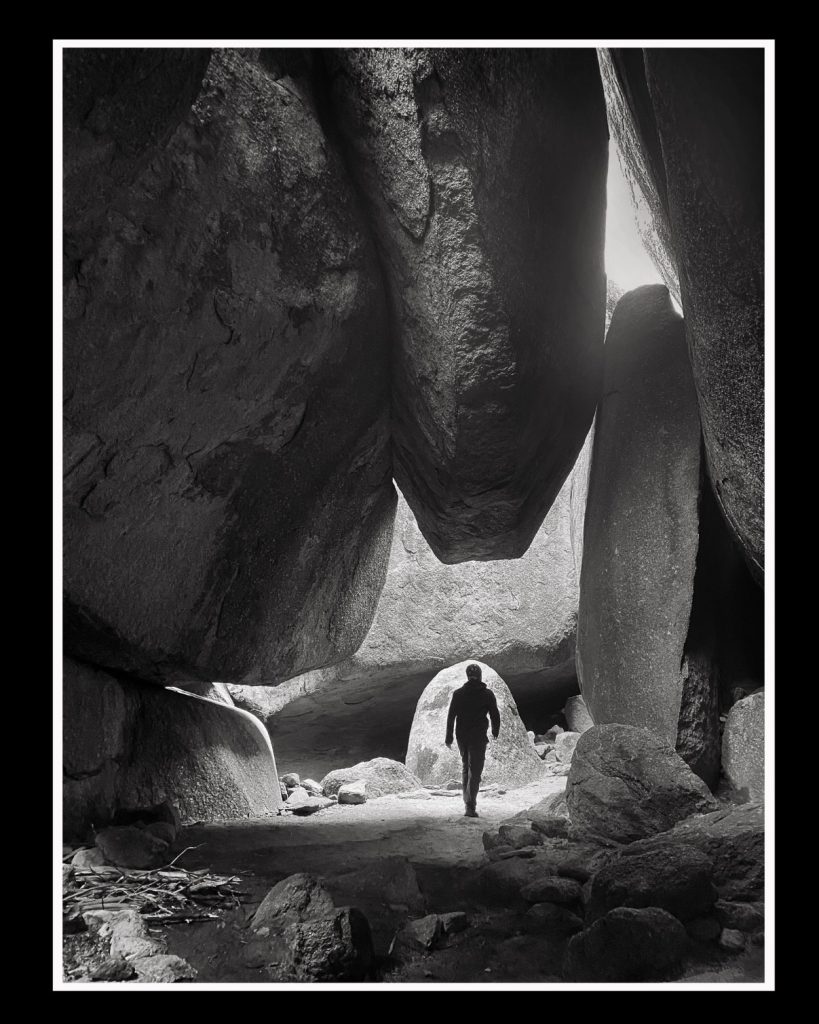
One of his recent works, a black-and-white photograph taken at a rock formation just outside Canberra, is a strong example of his approach. At first glance, the image is a study in contrast and composition: towering granite boulders form a kind of natural architecture, dwarfing the lone human figure standing beneath them. Light pours in from an opening above, washing over the stone and casting deep shadows in the cavern below.
But Cowell’s interest goes beyond the geological drama of the setting. The image, he explains, speaks to something more personal and universal. “I was struck by the impressive mass of the large granite rocks and the way they loom threateningly above people who venture there,” he says. “On a deeper scale, it speaks to me of how we navigate life’s uncertainties and how we live and love in spite of the difficulties.”
That reflection runs throughout Cowell’s work. His photos often use natural settings to frame bigger questions—about fragility, resilience, fear, and hope. He isn’t staging scenes or digitally manipulating meaning into them. He’s patient. He waits, observes, and steps into spaces that already have something to say.
The human figure in this particular image—small, centered, and in motion—offers a kind of quiet defiance. There’s no panic. No theatrics. Just a person walking through a landscape that could crush them. The metaphor is clear but understated. Life is heavy. Unpredictable. And yet, we move through it anyway.
What Cowell captures isn’t spectacle. It’s confrontation with stillness. His work resists easy interpretation. It’s visual poetry grounded in everyday truth. Whether photographing wild terrain or subtle urban spaces, Cowell shows a world that’s always speaking—if we choose to listen.
Though he’s based in Canberra, his photographs feel untethered to any single place. They are universal, grounded in the emotional rather than the geographical. What ties them together is his consistency in tone: quiet, reflective, and unflinchingly human.
Cowell’s process is intuitive but deliberate. His background in commercial photography gave him the tools; his fine-art practice gives him the space. He knows how to frame a shot, how to work with light, how to find a story in a scene. But it’s his way of seeing—his interest in emotional weight over visual noise—that defines his voice.
In this age of fast content and filtered perfection, Cowell’s work stands in quiet opposition. It asks for time. For reflection. For presence. He doesn’t tell the viewer what to think. He gives them a space to feel.
The rock formation photograph is just one moment in his ongoing conversation with the world. It’s not an image about rocks, or even about a person. It’s about what it means to keep walking—despite uncertainty, despite fear, despite the looming weight above.
And in that way, Bruce Cowell isn’t just making pictures. He’s offering a way to see. A way to stand still. And then, to move forward.
