


In Canberra, Australia, Kirandeep Grewal is building something that goes beyond the studio. Her art lives at the edge of personal and collective memory, rooted in community and cultural reflection. Grewal isn’t content to simply make something beautiful. She’s asking questions, challenging assumptions, and quietly reimagining what it means to be an artist. Her background bridges creativity with service. As a teacher, she shares her process. As a community collaborator, she fosters healing and conversation. And as an artist, she creates work that is layered, tactile, and deeply meditative. Sustainability isn’t an afterthought—it’s central. Each piece carries the imprint of intentional reuse, from the fibers she selects to the meanings embedded in her forms. Kirandeep Grewal’s practice is as much about care as it is about critique. Through it, she invites others to slow down, look deeper, and reconsider what they’ve been taught to accept.
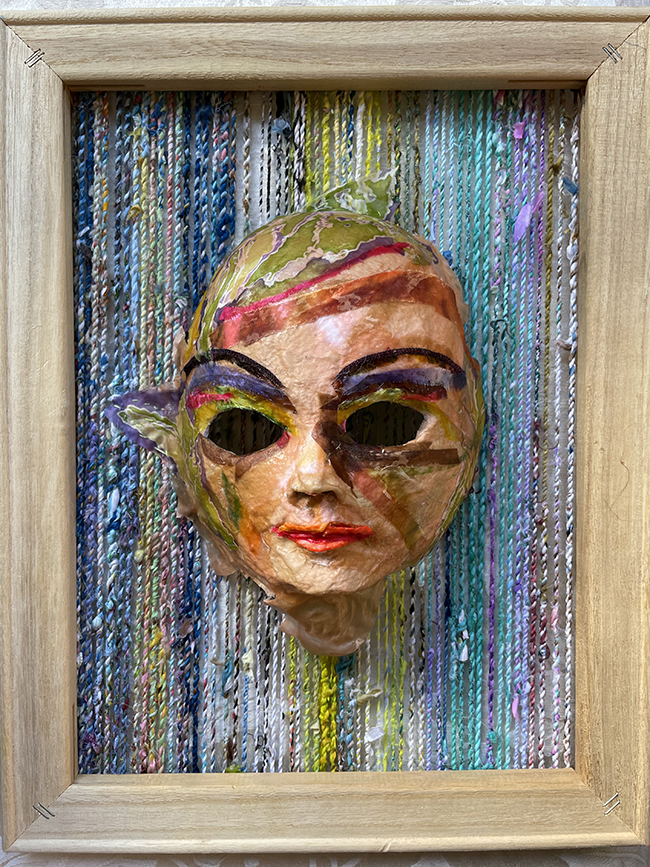
“Become – Nice Girl” (2022) is one of those works that speaks softly but lands hard. Made from papier-mâché, silk collage, and recycled silk strings, the artwork is mounted on an upcycled frame and measures 53 cm by 35 cm. It was part of Grewal’s solo exhibition Become, and it captures the tension between softness and structure, between surface and story.
At first glance, the piece reads as delicate—woven silks, gentle materials, hand-dyed remnants from her studio scarf-making practice. But the deeper you go, the more it asks of you. The woman in the artwork wears a mask. It isn’t meant to disguise her in the traditional sense. Instead, it reveals something else: a social conditioning. Grewal invites us to reflect on how girls and women are taught—quietly, persistently, and often unconsciously—to be polite, to smile, to behave. To be nice.
The title “Nice Girl” is doing a lot of work here. It’s both an echo of a phrase so many have heard growing up, and a provocation. What does it mean to be ‘nice’ in a world that often rewards compliance over authenticity? Who benefits when women hide discomfort or bite their tongues to keep the peace?
By choosing to work with silk scraps—specifically the leftover hand-dyed material from her own textile work—Grewal links the personal with the political. These pieces carry the memory of something worn, something touched. Silk is traditionally seen as precious, even luxurious, but here it’s been reimagined as something raw and repurposed. It’s not just about reducing waste. It’s about giving new life to something cast off, and allowing its imperfections to tell a story.
The recycled materials aren’t incidental. Grewal works intentionally, not just aesthetically. She considers the lifecycle of her art, how each element breaks down, what stays and what fades. “Nice Girl” was made to be sustainable in both form and message. Even the frame was rescued and reused—an act that echoes the broader themes of recovery and reclamation.
This isn’t a loud piece. It doesn’t shout. But it lingers. And that’s by design. Grewal wants viewers to sit with it, to notice the mask and ask why it’s there. To think about the masks they’ve worn, or asked others to wear. To question who gets to remove theirs—and who doesn’t.
There’s a kind of softness in “Nice Girl,” but it’s not passive. It’s the softness of slow resistance. The kind that reshapes over time, that challenges the viewer without confrontation. That’s one of Grewal’s strengths. Her art doesn’t deliver answers. It offers an opening.
In the context of Become, her solo exhibition, “Nice Girl” was just one part of a larger exploration of identity, conditioning, and personal transformation. The exhibition asked: What do we become when we live inside someone else’s expectations? And what happens when we choose to step outside them?
Kirandeep Grewal doesn’t romanticize change. She understands that unlearning takes work. But through pieces like “Nice Girl,” she shows that the materials of transformation are often already in our hands—scraps of memory, recycled language, old frames we can learn to see differently.
Her work is grounded, thoughtful, and quietly challenging. It reminds us that beauty and critique can sit side by side. That what we throw away—whether material or metaphor—can still have value. And that sometimes, the nicest thing we can do is question the story we’ve been told.
