


Alexandra Jicol is an artist who doesn’t just make work—she searches. Her art is shaped by a deep need to understand what it means to be human. Emotions, memories, and fleeting expressions are at the center of her practice. She doesn’t stay within stylistic borders or follow expected paths. Instead, she moves where the feeling takes her. Jicol’s work is personal, intuitive, and grounded in a genuine fascination with people—their joy, their pain, their truths.
Over the years, she’s created a style that resists easy labels. She’s not interested in technical perfection. She’s after something much harder to pin down—what lingers behind a glance, what pulses beneath the skin. Her work sits somewhere between painting, symbolism, and emotional abstraction. Through it, Jicol invites viewers not just to see, but to feel. That, more than anything, is her language.
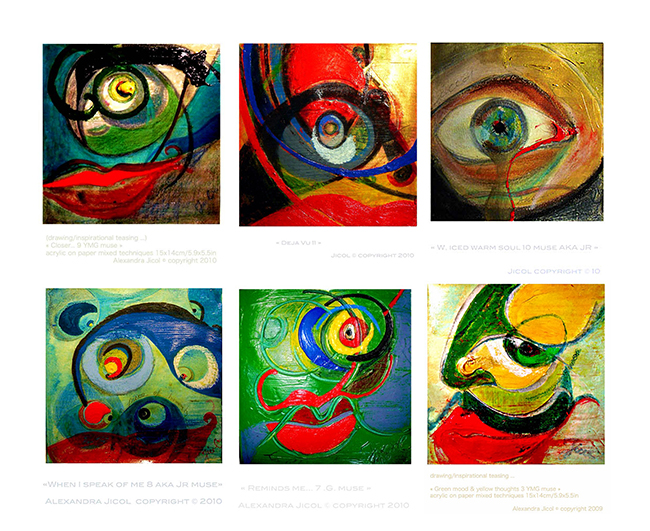
The Art of Seeing: Jicol’s Fascination with the Eye
For Alexandra Jicol, everything begins with the eye.
More than a subject, it’s a gateway. A passage into what’s hidden and what’s revealed. She’s long been captivated by how eyes reflect inner states—joy, grief, desire, love, fear, longing. “To me,” she says, “when looking into a human’s—or any living being’s—eye, I can almost perceive the infinite.”
This obsession has fueled much of her work. She isn’t trying to paint eyes literally. She’s trying to capture what happens within them, or maybe what they awaken in us when we look closely. For Jicol, eyes are vessels. They absorb, they project, they communicate silently. She describes them as places where “truth cannot be hidden” and where “colorful waves of aliveness burst and burn.”
This vision forms the basis of her series titled simply, EYES. But what Jicol creates isn’t portraiture. She isn’t interested in precise anatomical renderings. Instead, she chases feelings—those moments when an emotion builds in someone’s eye and almost spills over, becoming something you can’t look away from.
To translate this into visual form, Jicol uses a mix of colors, textures, and symbolic shapes. She often works with soft, vibrant tones layered in a way that mimics the energy of an emotional release. Sometimes it’s golden, like champagne bubbles catching light. Other times, it’s bold and chaotic, like a storm of color crashing into itself.
These aren’t just visual effects. For Jicol, they’re attempts to express what can’t be said in words—the things we feel deeply but don’t fully understand. Her process is less about design and more about reaction. She lets her materials speak, lets intuition lead. “I drink these emotions with my soul,” she says, “feed from them, and insatiably get inspired.”
That hunger—raw and unfiltered—is what gives her work its charge. You feel it immediately. Her pieces don’t ask for passive observation. They pull you in, whispering, sometimes shouting, truths you recognize in yourself. Her paintings are mirrors in that way—reflecting not just her vision, but something deeply human.
Still, there’s a challenge in what she does. Emotions are slippery. They shift, fade, come back stronger. Jicol’s task is to hold them in place long enough to capture them. That’s why she leans into abstraction. It allows her to express what can’t be explained, using shape, symbol, and suggestion.
Much of her visual language is built around contrast. Light and dark, soft and sharp, motion and stillness. She plays with those tensions, weaving them into pieces that feel alive—vibrating just under the surface. The eyes in her work might not always be visible. Sometimes they’re implied. Sometimes they dissolve into color. But their presence is always there, watching or being watched.
What Jicol creates isn’t comfortable art. It doesn’t settle. It asks you to stay a little longer, to look a little deeper. She isn’t offering answers. She’s offering a space to wonder, to connect, to feel.
In a time when so much art leans into concept or spectacle, Jicol returns us to something quieter and older—the need to be seen, and to see. Through her eyes, we are reminded of how complex and beautiful it is to be human. Not in theory, but in emotion. That’s her gift. She turns looking into a kind of listening. And through her work, we’re reminded that truth doesn’t always shout. Sometimes, it stares.
