

Bea Last is a Scottish artist whose work cuts deep into the intersections of memory, material, and meaning. Living and working in the Scottish Borders, Last builds her practice around what she calls “sculptural drawing,” using salvaged, recycled, and gifted materials to shape installations that feel both grounded and ephemeral. Her art doesn’t exist to sit quietly in the corner. It speaks, it pushes, it mourns, and it reflects. Every piece she creates seems to ask the same question: how much can a material hold, and how far can it stretch to carry the weight of lived experience?
She doesn’t hide the rawness of her process. Instead, she invites it in. She constructs her work not only from physical fragments—bamboo poles, torn fabric, string—but from the psychological remnants of trauma, migration, identity, and the complexity of being human in a fractured world.
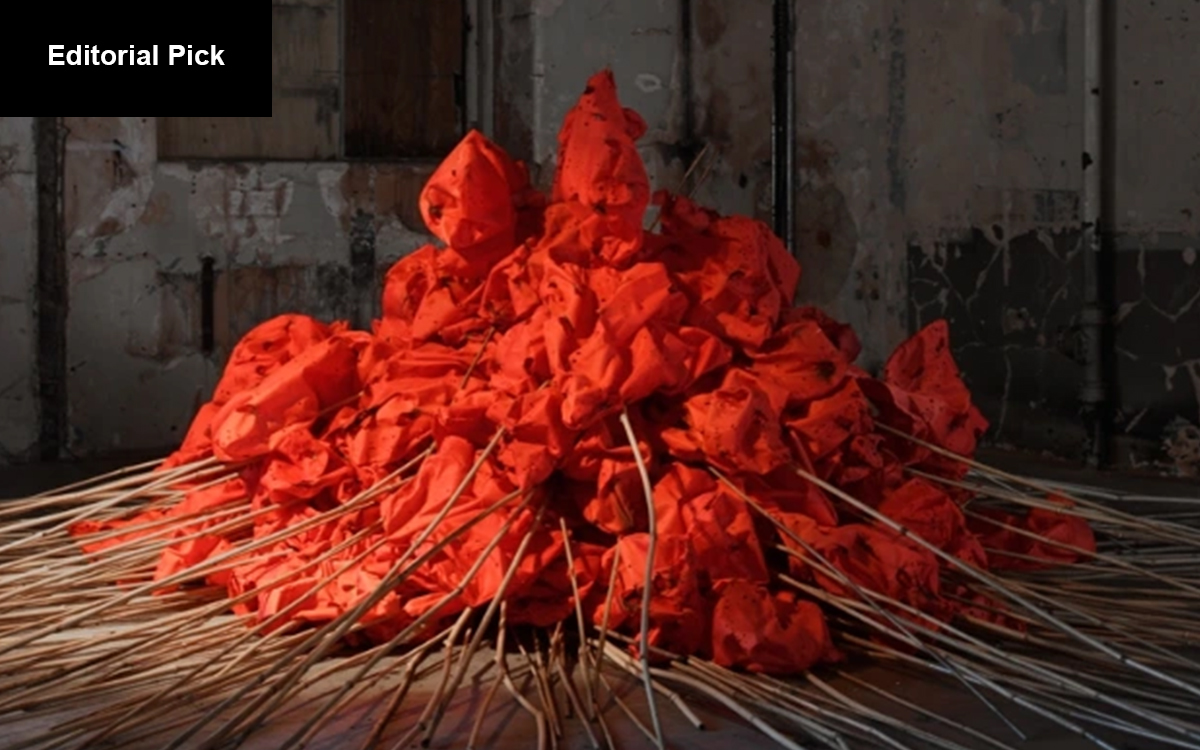
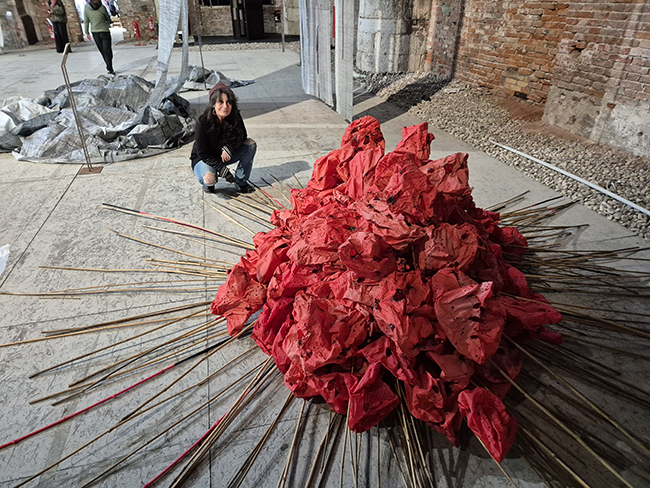
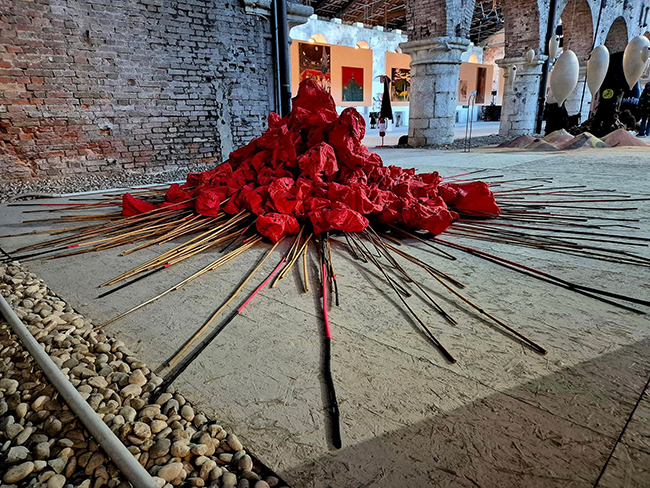
One of the most impactful examples of this is The Red Bags, a traveling and shifting installation that has evolved over several years and multiple settings. In 2024, the work was reimagined and exhibited at Arsenale Norde in Venice, as part of the Laguna Arte Prize exhibition. That year, Last was also a finalist for the Visual Arts Association’s Artist of the Year Award and had been recognized by the Aesthetica Art Prize in 2023. The Red Bags continues to gain traction because it refuses to be just an installation. It’s an ongoing conversation—between artist and space, between past and present, between crisis and resilience.
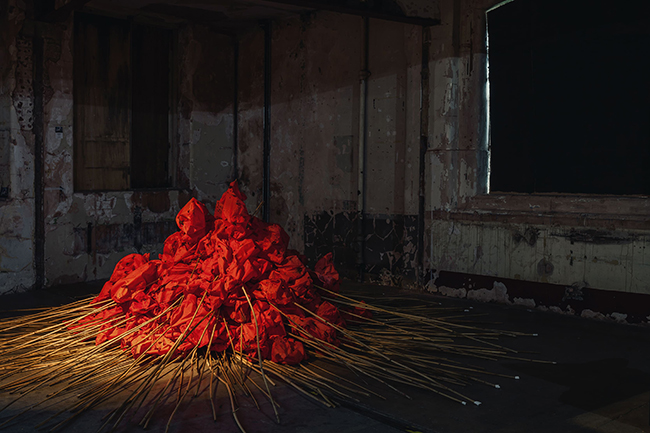
The piece is composed of repurposed and recycled materials—mainly fabric and bamboo—and each iteration adapts to the space in which it’s installed. Bullet holes pierce some of the materials. Nothing about this work is incidental. These details are deliberate and jarring, underscoring its themes of violence and rupture. The bullet holes are not metaphorical; they’re confrontational, physical reminders of trauma, conflict, and vulnerability.
Originally conceived in 2022, The Red Bags has since been presented in multiple contexts, each one adding another layer to its meaning. This isn’t a static sculpture. It’s a living memory. And just like memory, it shifts, frays, and endures. The red fabric used in the work is weathered and scarred from previous installations—marked by sunlight, dirt, wind, and time. These traces aren’t repaired or concealed. They’re kept visible, intentionally, to remind us that healing doesn’t mean erasure.
At its core, the installation addresses themes that span both the personal and the political. Last is interested in the weight of generational trauma and the impact of birthright, but she also connects that personal experience to larger global issues. Migration, displacement, and the fragility of home are all wrapped into the piece. The bags themselves seem to carry not only symbolic weight, but the imagined contents of those forced to flee—everything taken, and everything left behind.
There’s a tenderness to how she assembles these works, but also a hardness. It’s not sentimental. It doesn’t ask for pity. Instead, it invites quiet reflection and a recognition of resilience. Last allows space for contradiction: strength and fragility, chaos and control, destruction and repair. The very fact that the bags are reused and reshaped each time shows how memory itself can be repurposed—how even trauma can take new form through expression.
In Venice, the installation stood as both art and statement. Surrounded by the history and splendor of the city, The Red Bags disrupted the expected. It brought the reality of global crises into a space traditionally reserved for contemplation and critique. But rather than preach, it sat in silence, its torn red surfaces and empty interiors doing the speaking.
Bea Last doesn’t try to clean up the messiness of the world. She works with it. Her materials aren’t neutral, and her installations don’t pretend to offer neat solutions. Instead, they ask us to sit with discomfort, to look closely, and to think about the stories our materials carry—what they once were, what they survived, and what they still have to tell us.
In an art world often preoccupied with polish, her work feels like a raw nerve exposed. It doesn’t scream, but it lingers. It hangs in the air long after you’ve left the room. And in that way, it fulfills her mission: to make the invisible visible, to honor what has been broken, and to carry it forward, one bag at a time.
