

Pasquale J. Cuomo has spent over fifty years behind the lens, navigating photography’s changing landscape with a quiet but unwavering commitment. An American photographer with deep roots in the craft, Cuomo has witnessed photography evolve from analog to digital and, in a way, back again. Where others chased convenience, Cuomo found value in process—particularly in the tactile, deliberate approach of film. His work reflects patience, a sharp eye, and a deep connection to place. Today, as many rediscover the power of traditional film, Cuomo stands as someone who never let it go. He doesn’t just take pictures—he builds them from start to finish, frame by frame, with intent. In a time of speed and saturation, Cuomo’s work is a reminder that slowing down can be a form of artistry too.
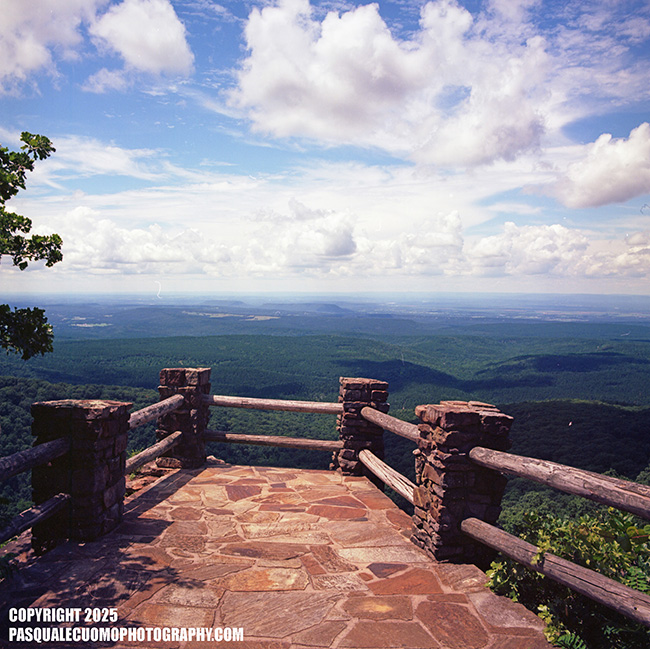
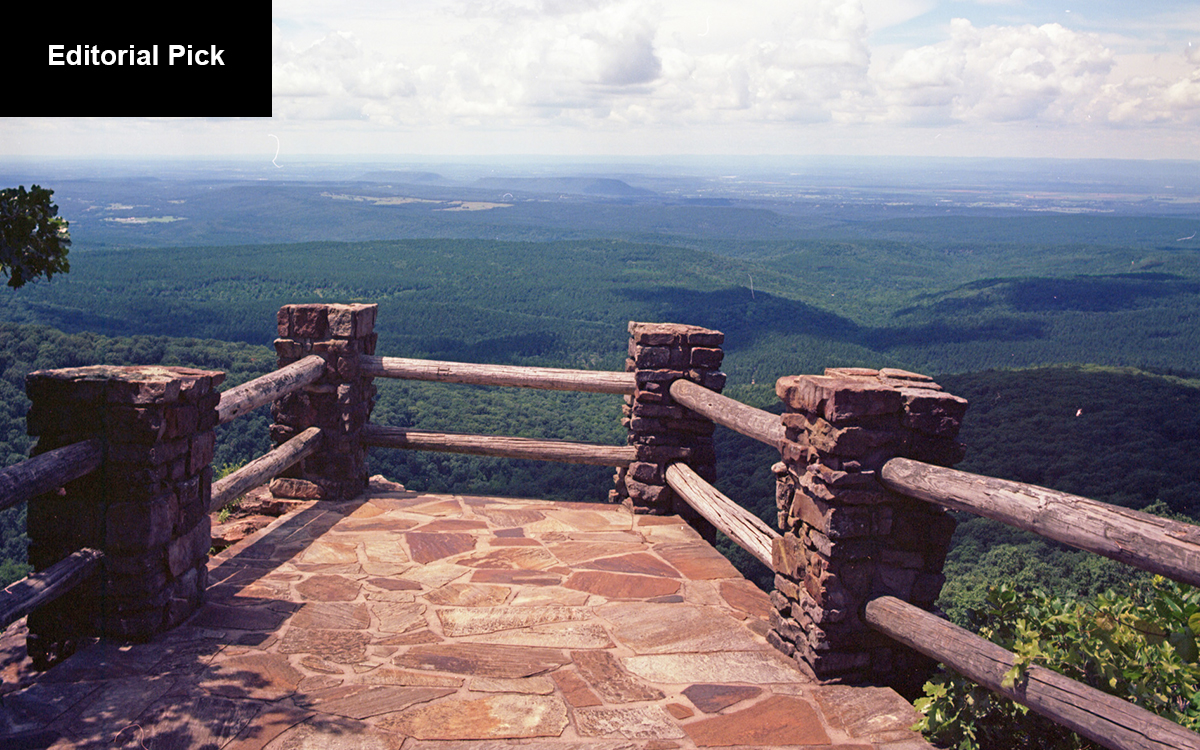
One of Cuomo’s recent images brings us to Mt. Magazine, Arkansas. At 2,753 feet, it’s the state’s highest point, a plateau overlooking a wide sweep of land that shifts with the light. What’s remarkable about Cuomo’s image isn’t just the view—it’s the way he frames it. He chose to photograph not only the distant vista but the built overlook itself, the constructed tableau that serves as a kind of stage for the scenery beyond. It’s a duality many photographers might ignore in favor of a wide-angle landscape, but Cuomo leans into the conversation between human-made and natural.
Shot on a Hasselblad 500C/M with a Zeiss 50mm lens—equipment known for its precision and depth—the image carries the distinctive characteristics of Ektar 100 film. That film, with its rich color saturation and fine grain, feels especially suited for landscapes like this. Cuomo says Ektar 100 is almost all he uses now, and it shows. There’s a warmth and richness to the tones, a soft clarity that balances realism with mood. The greens and browns of the Arkansas forest don’t shout—they settle into the frame with confidence.
Cuomo’s decision to use the Hasselblad, a medium-format camera introduced in the 1950s, also speaks to his respect for craftsmanship. This isn’t casual photography. It’s composed, considered. The 6×6 negatives the camera produces allow for incredible detail, but they demand more from the photographer. You don’t fire off dozens of frames hoping for one to land. You slow down. You wait for the right light. You line things up carefully. You make choices.
That sensibility defines Cuomo’s broader approach. Over the decades, he’s photographed across the U.S. and in other parts of the world. But no matter where he points his camera, he seems to look for what sets a place apart—some quiet characteristic that isn’t trying to impress but does anyway. He appreciates things that feel settled, or still, or built with care. The Mt. Magazine image is no different. The overlook itself, likely constructed with tourists in mind, becomes part of the visual story. Cuomo isn’t just showing us nature—he’s showing us how we engage with it.
There’s a subtle irony in how modern the scene is and how timeless the photo feels. Shot on film, with gear decades old, it has a permanence that digital sometimes lacks. The color palette isn’t flashy. There are no dramatic edits. It feels honest, like standing there yourself. Cuomo’s respect for the moment comes through.
For Cuomo, photography isn’t about chasing trends or jumping on the latest technology. It’s about staying present in a place, using tools that ask you to look harder, think more, and trust your instincts. His choice to continue working in film—especially medium format—isn’t nostalgic. It’s functional. It lets him work the way he wants to, in tune with light and time and scene.
There’s something reassuring in that. In a world saturated with instant images, Cuomo’s work reminds us that some things are worth the wait. A photograph can be more than a quick capture—it can be an act of observation, of patience, of care. And maybe that’s why his Mt. Magazine image lingers in the mind. It doesn’t just show you a view. It lets you stand still and see.
