

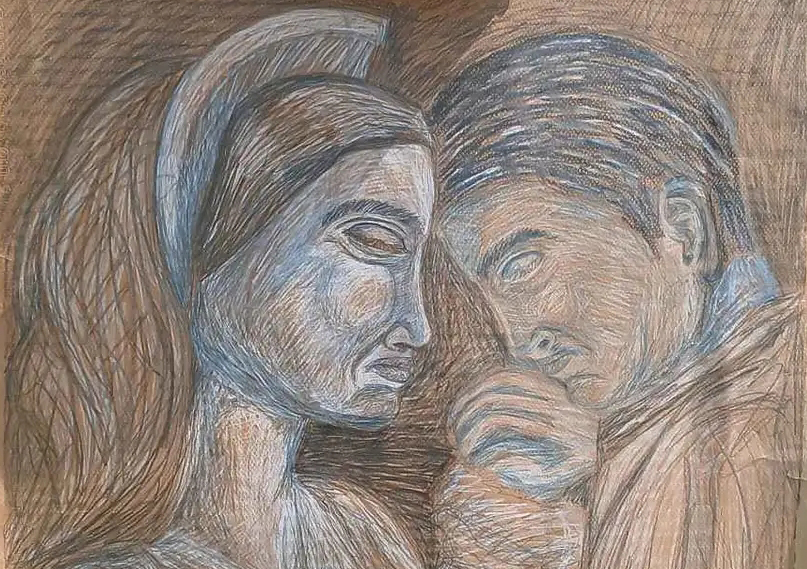
David R.L., 29, is an autistic artist, poet, and musician based in Marshalltown, Iowa. Seventeen years of creating have shaped his life, with art as both compass and anchor. He picked up a pencil at seven, drawn first to ancient Egyptian objects and still life studies, not knowing those early sketches would open a path that now includes painting, poetry, and music. For him, creativity is not hobby or escape—it is language. It is how thought takes form, sometimes through paint, sometimes through rhythm, sometimes through silence. It links what he feels inside to the world outside.
His work does not sit neatly in one style. Realism, abstraction, and symbolism often overlap. Memory collides with art history in ways that give his pieces weight and texture. A night sky, two figures leaning into each other, or an angel at rest in a field—all carry an urgency that feels honest, unvarnished, and direct.
The River Under the Sky
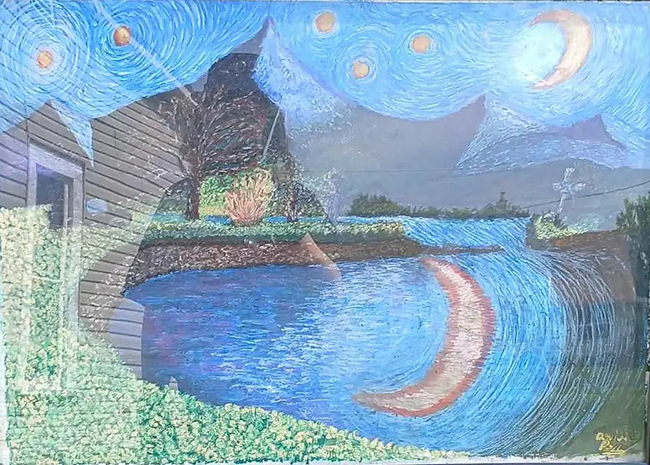
One painting borrows from Van Gogh’s Starry Night but speaks with David’s own voice. A river flows under a sky alive with motion, a crescent moon above and again in reflection below. A house and trees ground the scene, yet the sky carries the real drama, restless and filled with light. The doubled moon suggests dual vision, the idea that what is seen once can always be seen again in a different way.
The river ripples with strokes of blue that feel active, not still. It is less background than mirror, less scenery than threshold—a place where the act of looking changes what is seen.
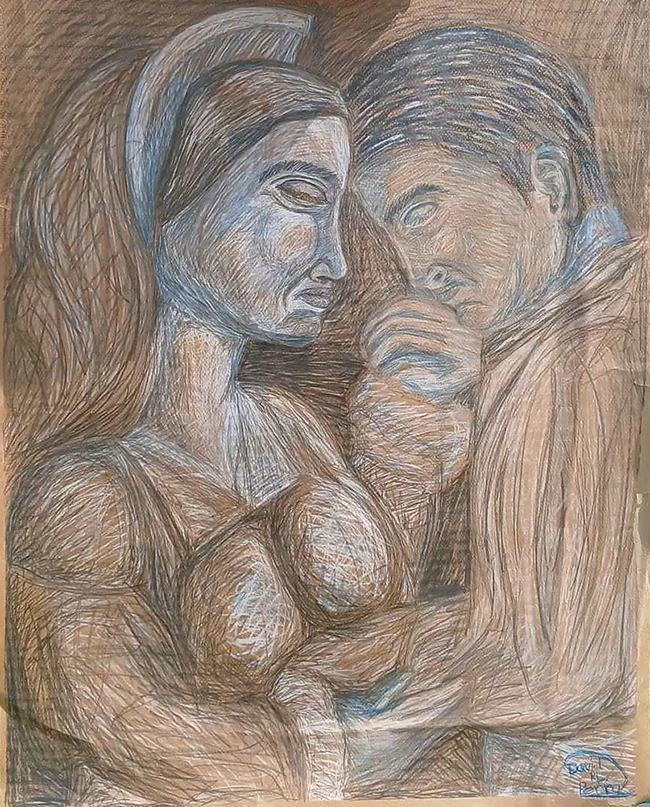
Another piece leaves the landscape behind and moves to intimacy. Two figures stand close, heads leaning together. Their bodies are drawn in layered browns, grays, and whites, built up like stone or carved wood. They look heavy, but their closeness softens that weight. The man leans in, the woman steadies, and in their shared space there is tenderness.
The style recalls ancient reliefs, figures that feel outside of time. The texture does not chase beauty; it presses into emotion. Vulnerability sits beside strength. Here, David shifts from the wide world into the private one, suggesting that connection can be just as vast as the sky.
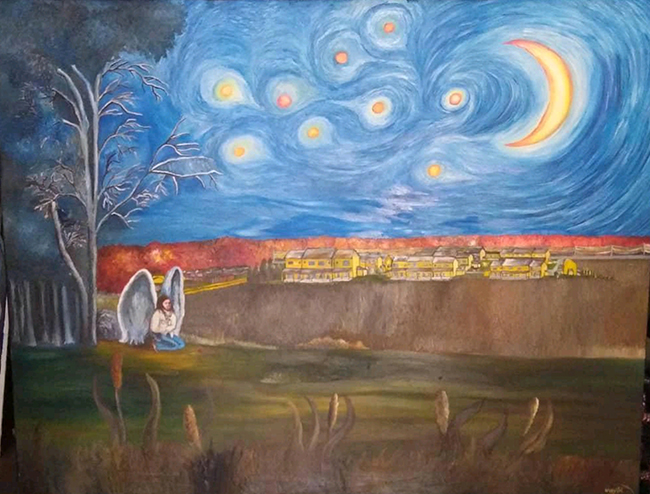
A third canvas again looks upward, recalling Van Gogh’s turbulent stars, but this time the earth is equally present. In the foreground, an angel kneels, wings folded, head bent. Behind, a town glows warm with light, while the field between lies shadowed.
It feels like prayer, but not one of grandeur. The angel does not proclaim—it reflects. The scene layers human life, spiritual presence, and cosmic movement into one frame. The angel is not far away in myth; it is near, placed into ordinary ground.
Between Silence and Expression
Seen together, David’s works reveal an artist moving through thresholds—between Iowa and Van Gogh, between personal memory and shared imagery, between intimacy and open sky. His choice to keep his art raw rather than polished gives it honesty. It speaks not of perfection but of truth.
To view his work is to enter a dialogue. History is there, but so is his lived experience. His reinterpretations of Starry Night are not echoes; they are questions. His figures are not likenesses but vessels of feeling. His angels inhabit fields, not cathedrals, reminding us that spirit belongs everywhere.
David’s story began simply—with a pencil at age seven. Today it continues in paint, poetry, and music. For him, art is not something added to life. It is life speaking back.
