

Nancy Staub Laughlin is an American pastel artist and photographer whose work moves between two mediums—the precision of the camera and the softness of pastel. She studied at Moore College of Art in Philadelphia, PA, where she earned her BFA, and since then has exhibited in museums and galleries across the east coast. Her art has appeared in interviews, articles, and has found its way into both private homes and corporate collections. The late critic Sam Hunter once called her vision “refreshingly unique,” and it’s easy to see why. Laughlin’s practice feels balanced between dream and design. She gathers imagery from nature—flowers, clouds, horizons—and places them into compositions that hover between reality and imagination. Her pictures are not simple reflections but meditations on how we see, how memory persists, and how beauty lives in both fleeting and permanent forms.
The Luminescence of Light
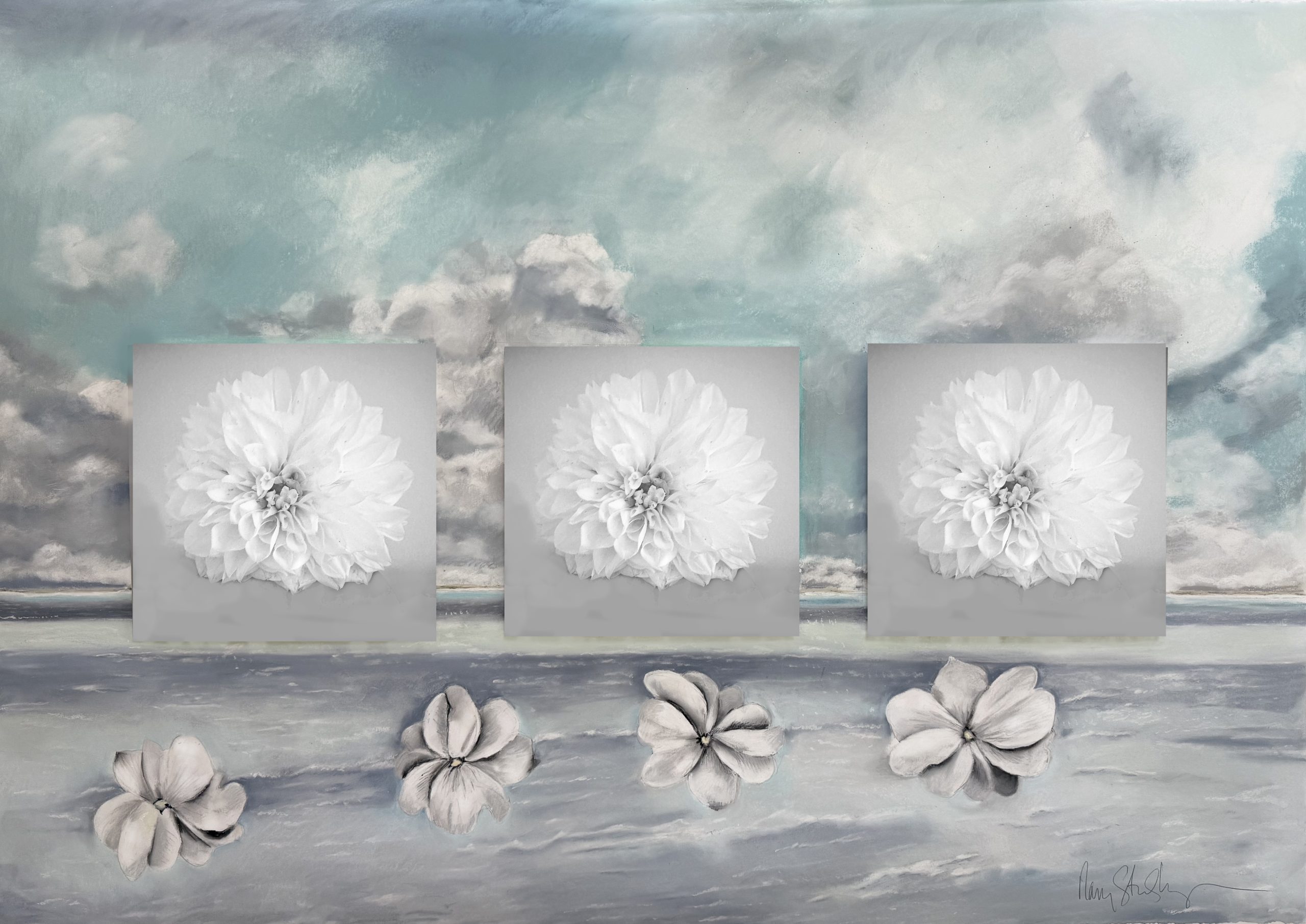
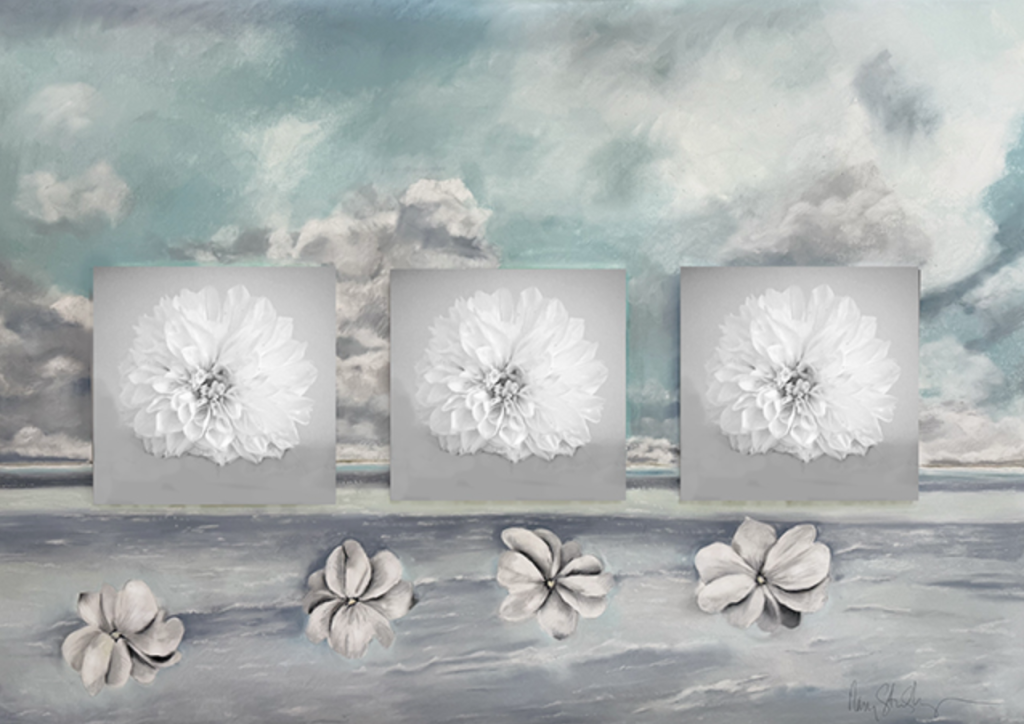
“The Luminescence of Light” pulls the eye into a quiet atmosphere. The sky, brushed in muted pastel tones, shifts with soft turbulence. Clouds roll across in whispers, carrying the work’s mood. Below them, a calm surface of water mirrors the sky, dissolving the line between reflection and depth.
In this setting, three square photographic panels sit in a row. Each holds a single white flower, sharp and detailed, suspended against a plain gray background. Their precision interrupts the painted world, yet they also settle seamlessly into it. Below the panels, drawn blossoms float on the water, lighter, less anchored, fading as if they belong to memory more than presence.
The dialogue between these layers is what animates the piece. Photographed flowers carry weight and clarity, while the drawn ones are spectral, dissolving into haze. Together, they spark questions: what belongs to the real, what belongs to the imagined?
The composition feels almost theatrical. The clouds and water are the stage. The photographed blooms stand as performers, vivid and deliberate. The sketched blossoms are shadows—echoes of past gestures or fading thoughts.
Choosing white flowers is intentional. Without color, the forms depend on light, shadow, and structure. They glow on their own terms, showing that clarity and beauty can emerge from restraint. “The Luminescence of Light” isn’t about flowers alone. It’s about transition—light falling, memory shifting, forms blurring but still present.
The Radiance of the Illumination
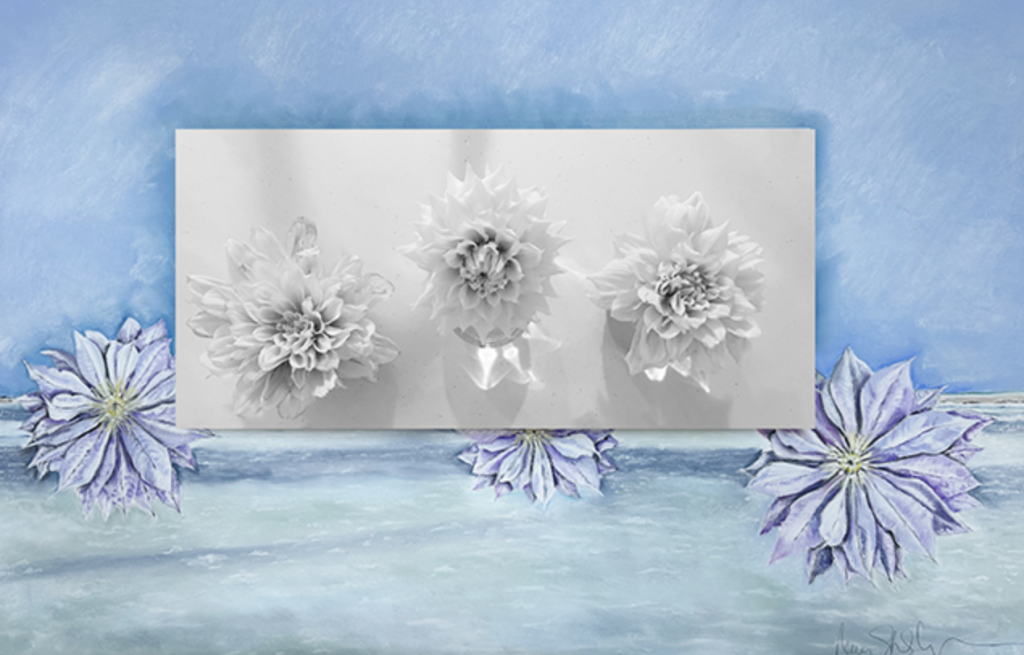
Where “Luminescence” is hushed, “The Radiance of the Illumination” feels more open and clear. The palette shifts to cool blues. The water stretches wide, crystalline, calm. It has the kind of stillness that carries a sense of endlessness. Star-like blossoms float across the painted surface, touched with violet and blue, their points reaching outward. Unlike the ghostlike petals in the earlier piece, these flowers feel steady, embedded in the painted plane.
Across this backdrop sits a rectangular photograph with three blooms in grayscale. Each is bold, its petals reaching with quiet force. The central bloom feels strongest, its core defined, its structure almost architectural. Against the soft pastels of the sea, these flowers stand firm, undeniable.
Here, the dialogue is more assertive. The photographed flowers demand recognition, while the painted blossoms drift and extend outward. The piece keeps the viewer’s attention moving—between the clarity of photography and the softness of pastel.
The work’s radiance isn’t tied to color. It comes from the contrast of two mediums speaking at once. The pastel setting suggests dream, distance, the intangible. The photographed flowers fix themselves in reality. The push and pull between the two creates a rhythm, an oscillation between what is stable and what is fluid.
Compared to “Luminescence,” this work feels anchored. The flowers here act less as fleeting symbols and more as markers of endurance. Yet the surrounding sea and sky remind us that nothing stands still for long.
Closing Thoughts
Nancy Staub Laughlin’s practice lives in contrasts: soft pastel against hard lens, permanence against transience, the seen against the remembered. Both “The Luminescence of Light” and “The Radiance of the Illumination” embody this balance. In them, natural forms—flowers, skies, waters—do more than decorate. They act, they question, they converse.
Her art defies simple categorization. It is part still life, part landscape, part dream-state. It doesn’t rush to resolve. Instead, it lingers, inviting the viewer to rest in the tension of what is solid and what is dissolving. Light, in her work, is not just a condition but a teacher—always changing, always reminding us to look again.
