

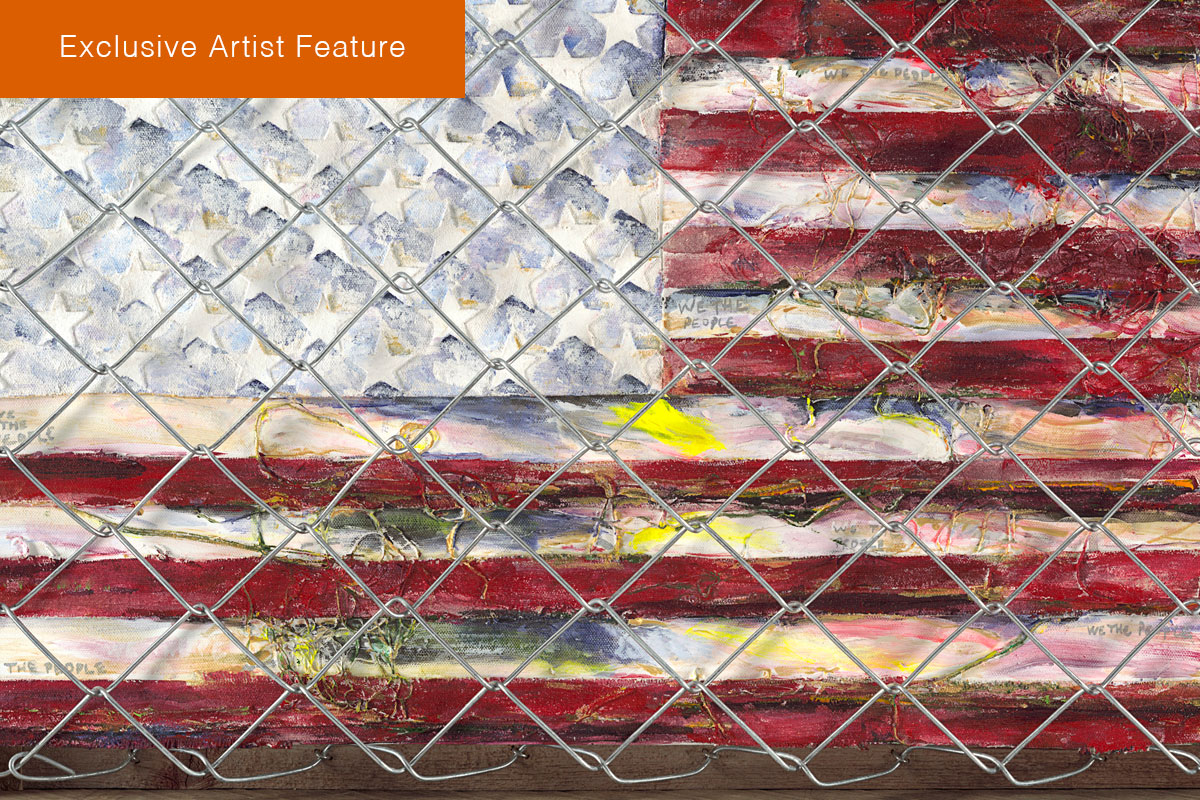
L. Scooter Morris describes herself as a sensory illusionist, and the description fits the way she works. Her paintings are not simple images. They don’t just show what the eye can record. Instead, they linger in the space between memory and perception, taking hold of brief moments and translating them into forms that feel both immediate and lasting.
At the core of her practice are what she calls “Sculpted Paintings.” These works carry depth, not just visually but physically. Layers of acrylic and mixed media build upon one another until the canvas seems to press outward, pushing past its boundaries. Texture, light, and color collide to create works that are experienced as much as they are seen. Morris doesn’t separate beauty from meaning. For her, the surface of a painting can carry questions about justice, equity, and the shared world we are making together.
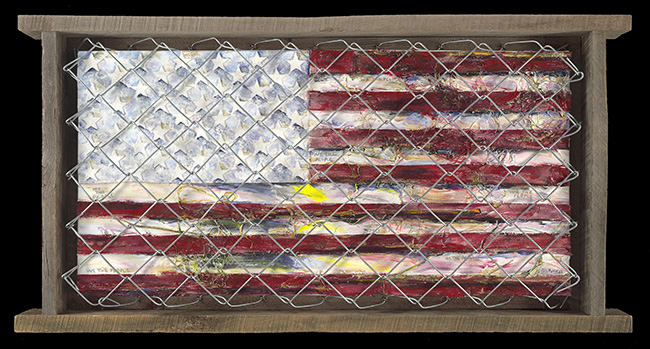
Of Our Own Making (2023, Acrylic and Mixed Media, 19”x37”)
This piece lands with weight. The surface is built up like strata, each layer stacked on top of the other, the way history leaves its mark. Nothing about the painting is quiet; every part of it presses forward. The title frames it as a meditation on responsibility—on what we shape and the residue of choices we leave behind.
The painting plays with opposites. Gloss against matte. Smooth beside rough. The eye shifts between surfaces that shine and those that swallow light. This duality feels human, echoing creation and destruction, growth and erosion. Morris doesn’t hand out judgment. Instead, she creates a space where the viewer feels the pull of consequence.
The horizontal shape recalls a landscape, though not a natural one. It reads more like a built terrain, formed by our own hands. The painting ends with a quiet question: if this is the ground we have made, what will we choose to build next?
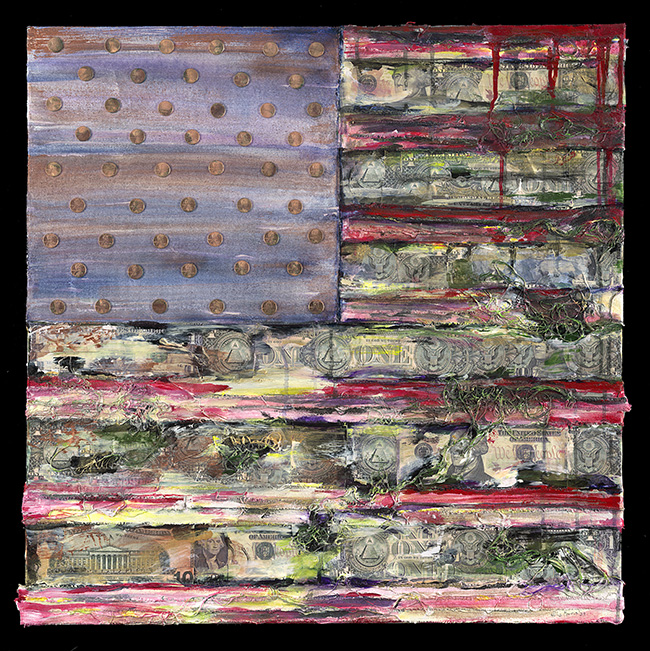
Dark Money Pulls Strings (2023, Acrylic and Mixed Media, 30”x30”)
If Of Our Own Making looks outward to shared responsibility, Dark Money Pulls Strings turns to hidden forces. The title names the subject before the painting does—power that operates unseen, shaping outcomes without notice.
Morris brings this idea to the surface through her materials. Some areas feel dense and heavy, while others stretch thin like thread. The work resembles a web of tension, with strings pulled tight and others left slack. Within its square frame, balance is elusive. The painting seems unsettled, vibrating with the sense that control is never equal.
It can be viewed as pure abstraction—lines crossing, textures colliding—but once the title is known, the imagery shifts. It becomes impossible not to think of influence, of unseen money shaping politics and policy, bending systems meant to be fair.
A Dialogue in Paint
Placed together, the two works speak across their differences. Of Our Own Making feels broad and reflective, a long horizon. Dark Money Pulls Strings feels tense and confined, a closed chamber. Both reveal Morris’s interest in how personal choices and political systems overlap.
Her process is part of the message. By layering paint until it carries physical density, she mimics how society itself accumulates. Nothing stands alone. Every action adds weight. Every decision reshapes the structure. The result can feel overwhelming, yet within those layers lies resilience. Renewal is always possible.
These paintings are not quiet. They draw the viewer in, asking for time and attention. By folding social commentary into her visual language, Morris makes art that is both reflective and urgent, both tactile and ethical.
Closing
Morris’s “Sculpted Paintings” live where surface and meaning meet. They carry critique, but they also carry beauty. Of Our Own Making and Dark Money Pulls Strings differ in shape and tone, yet both serve her larger project: to take fleeting impressions and urgent truths and hold them in paint long enough for us to face them.
Her use of acrylic and mixed media allows the work to shift with light and angle. The paintings change as the viewer changes position, reminding us that reality itself is layered, perception never fixed, and the traces we leave—whether personal or collective—always remain.
