

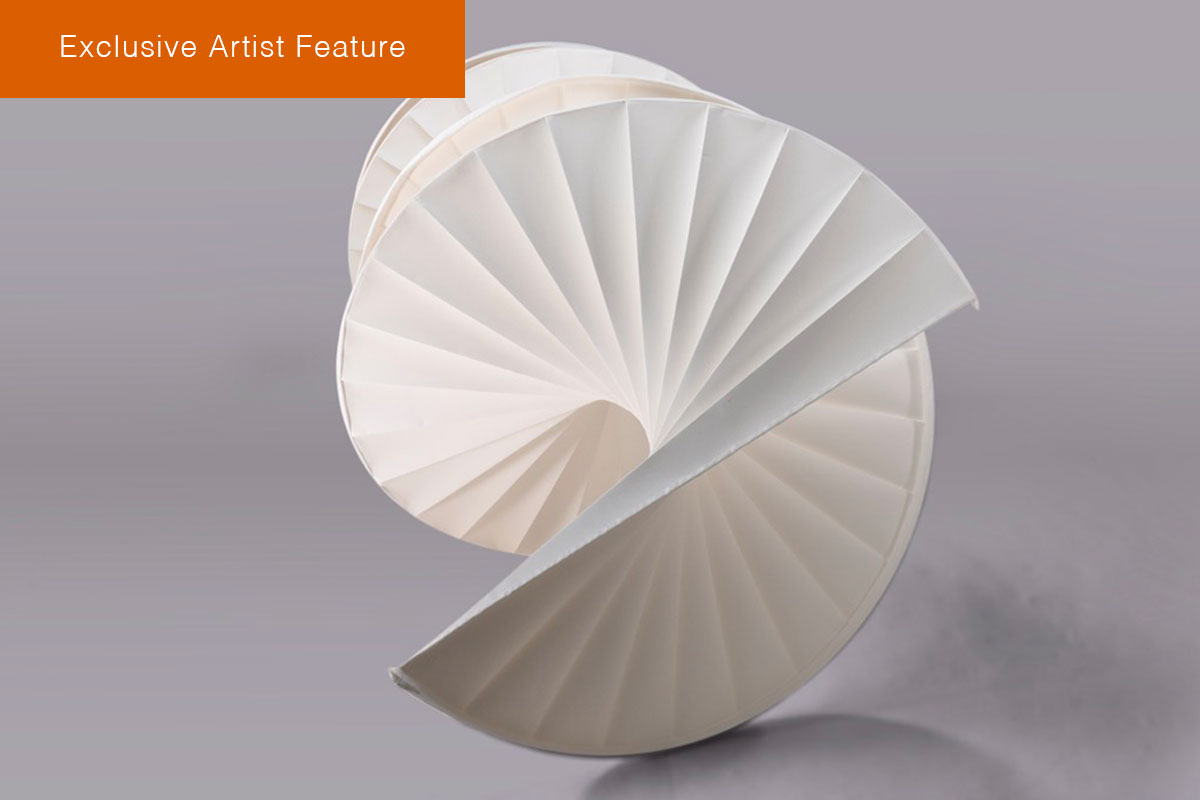
Haeley Kyong’s art begins where noise ends. Her practice is built on the idea that simplicity can reveal truths complexity tends to hide. “I love creating artwork that captivates and inspires people’s minds,” she says, and her work holds to that intention. She doesn’t chase spectacle or drama; she pares things down until what’s left feels inevitable. Her language is one of form, color, and silence—basic elements that, when balanced just right, speak to something beyond logic. Each piece is an invitation to look closer, to sense rather than analyze.
Kyong finds her rhythm in nature. She studies patterns, repetitions, and the quiet intelligence of organic design. Her art reflects the precision of natural systems but retains a human warmth. The goal is not to imitate but to connect—to show how structure and emotion can coexist within a single gesture. Her minimalism is not cold or distant; it’s a form of attention, a way of clearing space for thought and feeling to surface.
A Circular Story Teller
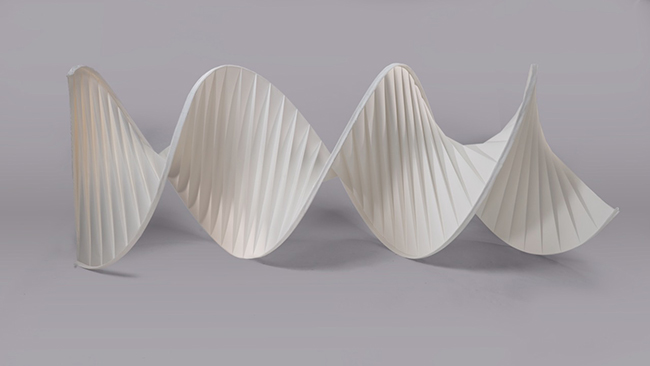
In A Circular Story Teller, Kyong turns her attention to what lies beneath the skin—the invisible blueprint of life. “I am fascinated by what makes us who we are,” she writes, “from the visible aspects to the invisible roots.” Her curiosity leads her to DNA, the hidden code that binds all living beings. To her, it’s both scientific and spiritual: a record of inheritance and a symbol of continuity. “We didn’t ask to be made this way,” she reflects. “We just inherited it. Without choice.”
The work takes shape as a vast expanse of Arches watercolor paper, forty-two inches high and one hundred ninety-two inches long. Kyong folds it by hand using traditional methods, transforming it into a structure that echoes the double helix. The result is neither painting nor sculpture but something between—an unfolding meditation on repetition, memory, and creation. The folds catch the light differently throughout the day, their shadows shifting like breath. Each crease suggests replication, a quiet echo of life’s ongoing rhythm.
Folding becomes both process and philosophy. The act is slow, deliberate, and physical, demanding patience and precision. The paper bends and resists, holding tension the way DNA holds information. Kyong’s touch becomes part of the structure; her presence is felt in every contour. The folds serve as markers of both control and surrender—gestures that embody the balance between design and chance, intention and emergence.
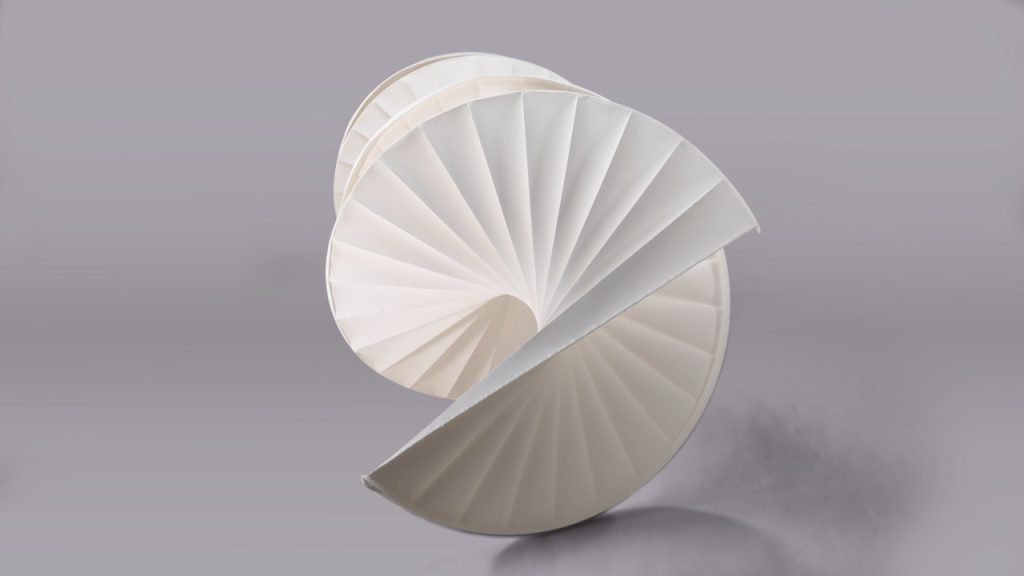
Kyong’s interest in DNA reaches beyond biology. For her, it’s a metaphor for belonging and continuity—a reminder that we are all part of the same unbroken story. The title A Circular Story Teller captures this idea. Life, she suggests, does not follow a straight path. It loops, renews, and returns. The circular form reflects the cycles that govern existence—birth, decay, transformation, and regeneration.
The choice of watercolor paper carries meaning, too. Unlike metal or plastic, paper absorbs light and memory. It records touch. The folds create tiny imperfections, soft edges, and subtle asymmetries that humanize the work. Fragility becomes strength; impermanence becomes beauty. The piece doesn’t assert permanence—it breathes. Kyong’s material choice reminds us that life, like paper, is delicate yet capable of holding immense complexity.
The process of making A Circular Story Teller borders on ritual. Folding a fifteen-foot sheet by hand is a meditative act, mirroring the endless replication taking place inside every living cell. Each fold is a decision and a discovery. What emerges is a visual rhythm—repetition as language. The scale of the work might be monumental, but it invites intimacy. People lean in, tracing the folds as if reading a silent narrative.
The piece exists in a space between mediums and meanings. It’s part sculpture, part drawing, part scientific reflection. Geometry here is not rigid; it’s alive, breathing with emotional intelligence. The play of light and shadow across the surface turns structure into sensation. Every crease feels like a heartbeat, every curve like a memory suspended in space.
Kyong’s fascination with DNA ultimately becomes a meditation on human existence. We live according to patterns we cannot see, bound by histories we did not choose. Yet within that structure lies freedom—the chance to observe, to understand, to create. Her work is not about solving the mystery of life but about honoring it.
Through A Circular Story Teller, Haeley Kyong transforms science into reflection and matter into metaphor. Each fold holds both precision and tenderness. Together, they form a quiet continuum—a story written without words, repeating endlessly, like life itself.
