

There’s a dreamlike stillness in Natali Antonovich’s art—an awareness that seems to hover between waking and sleep. Her paintings open quiet spaces where thought and feeling merge, where the visible world fades and something deeper takes form. She paints not to describe, but to listen—to herself, to silence, to the delicate pulse beneath experience. For Antonovich, creating is not a display but a kind of meditation, a conversation with the unseen. Each work emerges slowly, guided by reflection and patience rather than urgency.
From an early age, Antonovich was drawn to observation. She found beauty in the subtleties others might pass over—the soft shift of dusk, the stillness before rain, the tender light cast across familiar walls. That attentiveness became her compass. It shaped how she moves through the world and how she translates what she feels into image. In her paintings, color becomes language and shape becomes emotion. Though born from introspection, her works extend an open hand to the viewer, inviting them into a shared space of contemplation.
The Power Is in You (2024)
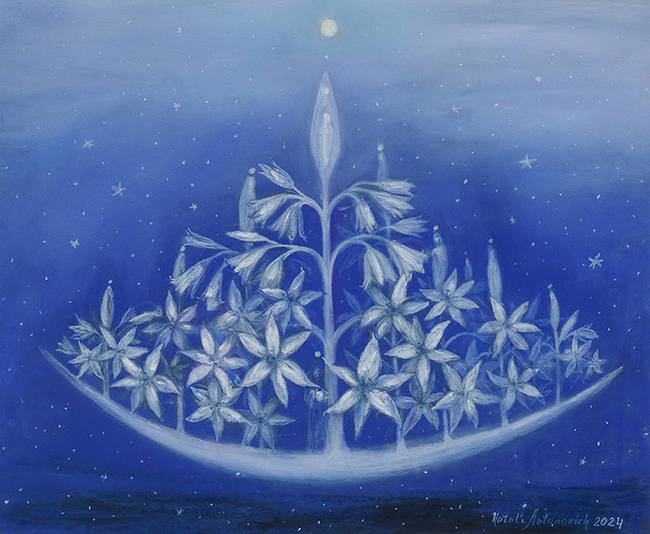
In The Power Is in You, Antonovich paints strength as quiet radiance. The scene glows in tones of pale blue and soft white, like the breath of night before dawn. The painting feels still, yet alive—its calm surface vibrating with a sense of renewal.
A crescent form holds a cluster of flowers that reach upward, their delicate petals reflecting moonlight. They rise from an unseen source, carrying both fragility and persistence. Above them, a single star-like moon casts its watchful light, suggesting rhythm, time, and the cycle of becoming. The image feels both earthly and celestial—a harmony between what grows and what guides.
Antonovich’s pastel work heightens this sense of balance. Edges dissolve gently, giving each bloom a sense of motion suspended in air. Her limited palette works in soft gradients, each tone chosen to soothe rather than startle. The effect is one of gentle resonance—an atmosphere of peace that holds quiet intensity.
The message of the title echoes through the composition. The Power Is in You speaks not of dominance but of presence. True power, Antonovich suggests, comes from stillness—from recognizing what already exists within. Her painting does not urge action; it reminds us to trust the slow unfolding of our own nature.
The Twenty-Sixth Crown (2024)
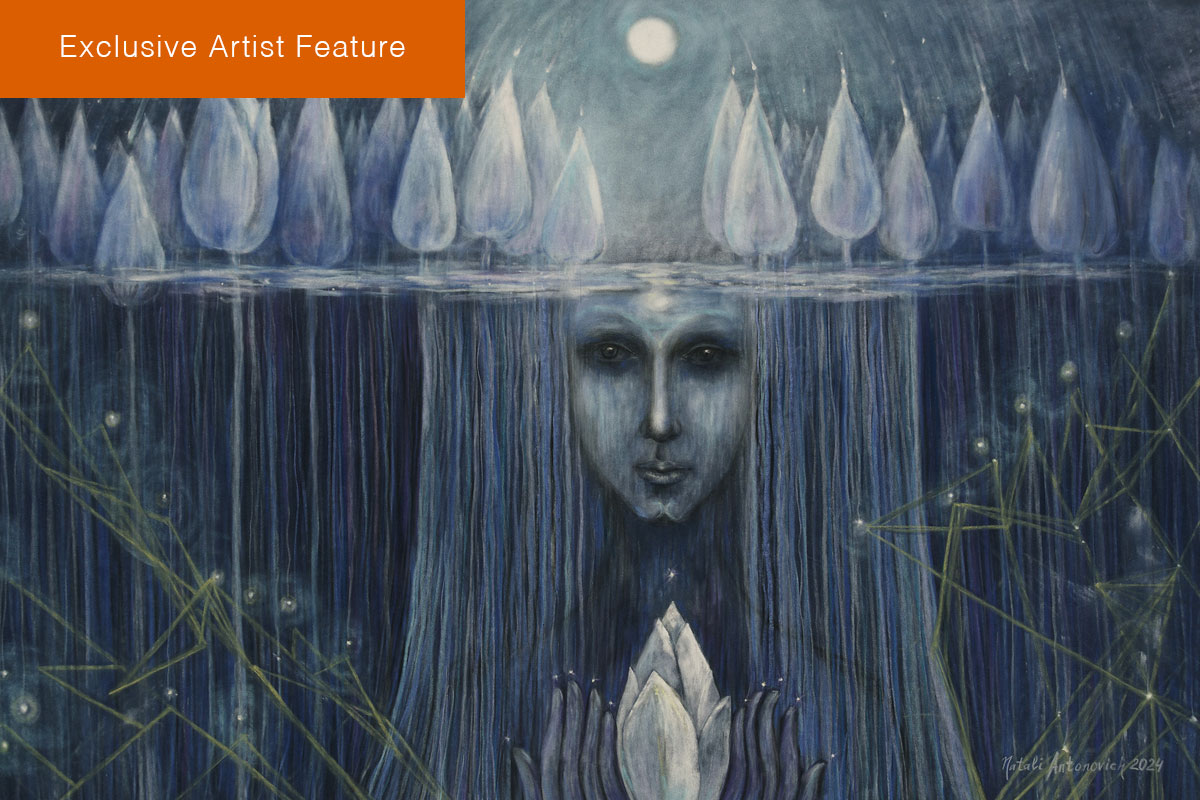
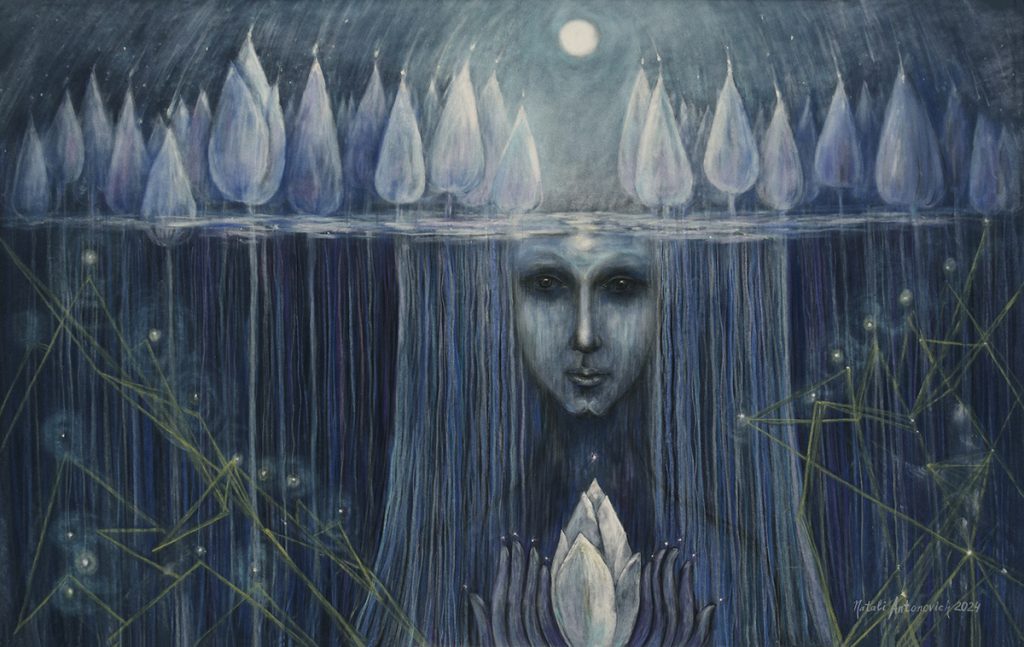
The Twenty-Sixth Crown moves in the opposite direction—not upward but inward. The tone darkens, the rhythm slows. It feels like descending beneath the surface of thought into the deep waters of reflection.
The work is divided between two realms: above, a row of buds floats in silver-blue light, poised to bloom; below, a human face emerges through a veil of fluid lines, serene and knowing. The figure seems neither separate from the water nor entirely part of it—an embodiment of still consciousness. Cradled at the chest, a single flower opens, luminous against the surrounding blue.
The title carries ritual weight. The “twenty-sixth crown” sounds like a marker of passage, an unseen milestone reached through quiet endurance. The moon once again presides, less as decoration and more as companion—its glow suggesting wisdom earned through time.
In her pastel technique, Antonovich layers transparency upon depth until form and atmosphere seem to breathe together. The piece feels fluid, its motion slow and eternal, like memory drifting in water. Each mark is tenderly placed, each glow intentional.
Emotionally, this painting is about acceptance. It looks into the hidden spaces of the mind and finds serenity there. If The Power Is in You celebrates emergence, The Twenty-Sixth Crown honors surrender—the peace that comes from letting go and allowing the depths to speak.
Between Silence and Light
Taken together, these two paintings mirror the conversation that defines Antonovich’s art: ascent and descent, awakening and introspection, the visible world and the invisible one beneath it. Her work doesn’t seek attention—it offers rest. In a world that prizes noise and speed, she paints the value of quiet.
Her compositions are careful, her light tender. Each gesture seems to carry a breath, each color a whisper. The emotion in her art comes not from spectacle but from sincerity—from the patience to let stillness reveal meaning.
Antonovich’s paintings speak in the language of calm, where understanding arises not from explanation but from recognition. They linger after the gaze moves on, like echoes from a dream remembered at dawn. Through her work, she reminds us that gentleness can hold great power, and that reflection—when allowed its full depth—can lead us closer to truth.
