

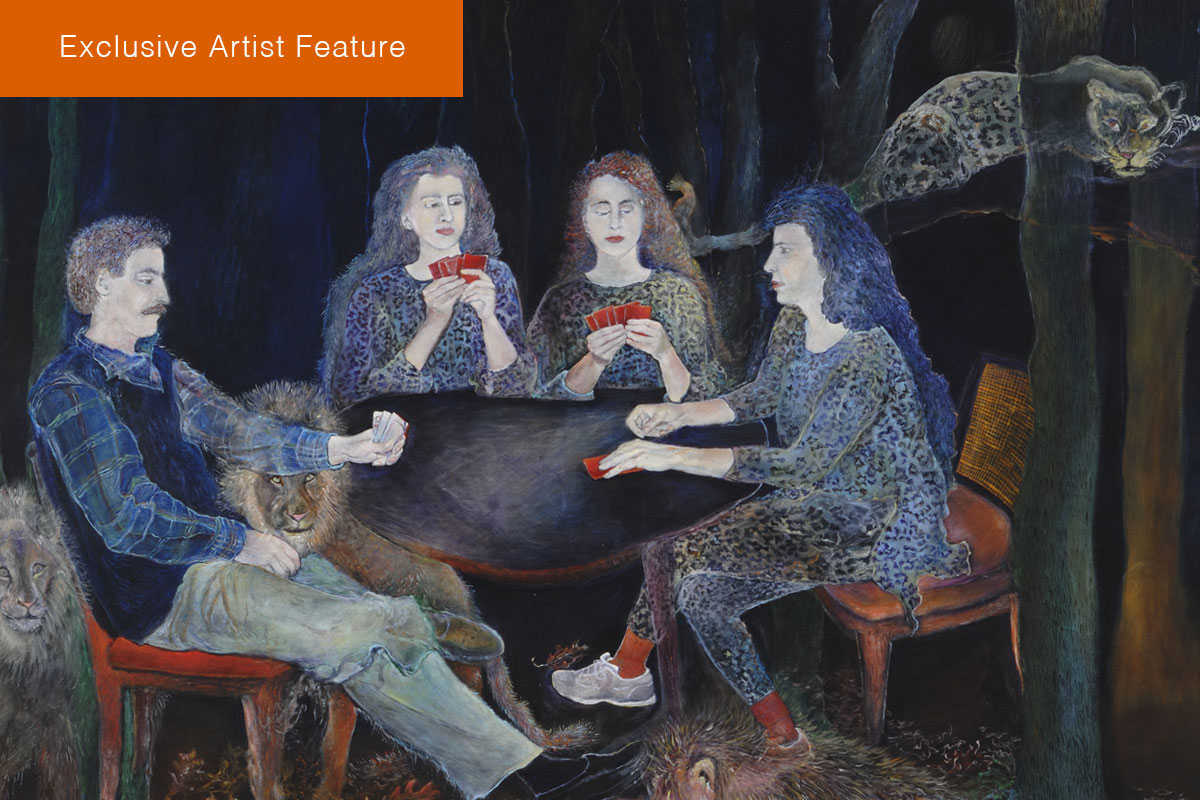
Ruth Poniarski’s artistic journey moves effortlessly between the realms of structure and dream. After earning her Bachelor of Architecture from Pratt Institute in 1982, she spent ten years in the construction world before redirecting her focus toward painting in 1988. That transition marked a deeper awakening—an urge to give form to thoughts that architecture could not contain. Her work draws on myth, literature, philosophy, and psychology, weaving these influences into surreal, introspective narratives. Through her art, she bridges the rational and the imaginative, exploring how human experience unfolds within the tension between order and chaos.
Who’s Game
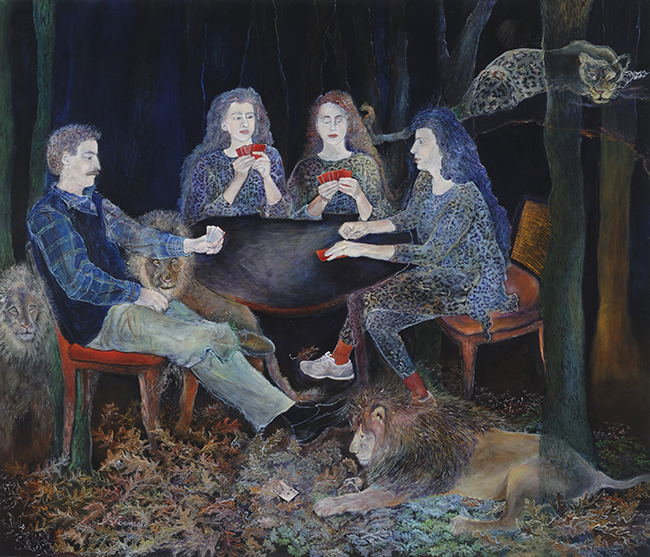
In Who’s Game, a simple card match becomes something far greater—a quiet battle of perception and instinct. Four figures sit around a dark table in a dense forest, each lost in thought. Their faces are calm but distant, their gestures measured. Beneath them, lions rest, their golden bodies merging with the earthy tones of the ground. The wild and the human coexist in uneasy harmony, as if one wrong move could tip the balance.
The scene feels both familiar and dreamlike. Poniarski’s deep greens, blues, and shadowy browns blur the line between night and imagination. The uneven light casts patches of clarity and mystery, reflecting how people often hide their truest emotions behind social rituals. Her brushwork walks the fine edge between control and looseness, grounding the figures in realism while keeping the atmosphere uncertain and symbolic.
Each detail plays into an unspoken dialogue. The lions mirror the players’ restrained power—their pride, ego, and latent aggression. The table becomes a battleground of wit and silence. Poniarski transforms a casual pastime into a study of human nature: how we measure risk, mask intention, and play our roles even when the stakes are invisible.
The painting leaves the game unresolved. There’s no victory, no closure—only the suspended tension of intellect against impulse. Who’s Game becomes less about cards and more about the quiet theater of control, where even calm faces conceal inner storms.
Reflections
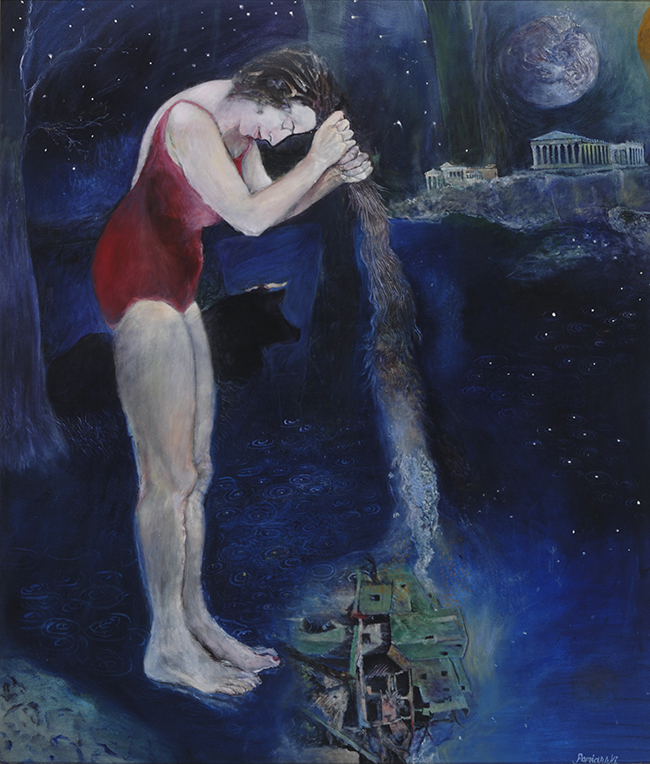
If Who’s Game explores interaction, Reflections turns inward. A lone woman, wearing a red swimsuit, stands under a starlit sky. She bends forward, wringing water from her hair, the liquid streaming into an endless blue expanse below. Beneath the surface, a drowned city sleeps; above, ancient ruins rise against a celestial backdrop. Time seems to collapse—past, present, and myth merging into one continuous image.
Here, Poniarski’s architectural sensibility surfaces clearly. The ruins and submerged buildings are drawn with precision, suggesting a world in flux—destroyed, yet quietly rebuilding. The woman feels both human and divine, part creator and part mourner. In her gesture lies an act of release—an offering, perhaps, or a renewal. The flowing water connects heaven to earth, mind to memory, spirit to matter.
The palette of deep blues and purples envelops the figure in a meditative calm. Light glows faintly on her skin, illuminating her solitude. The rhythm of her movement—squeezing, releasing—becomes a metaphor for artistic creation itself: the process of transforming what’s internal into something visible. Poniarski turns a simple moment into an existential reflection on renewal, grief, and the cyclical nature of life.
The submerged houses feel like fragments of memory—personal histories half-lost but still shimmering under the surface. In this painting, nothing is gone, only transformed. The cosmos above and the ruins below mirror one another, suggesting that destruction and rebirth are intertwined.
Surface and Depth
Across both works, Poniarski explores the unseen forces that shape emotion and thought. Her compositions retain the structure of her architectural background, yet they breathe with intuition and imagination. Each scene feels carefully designed but never static—alive with tension, mystery, and symbolism.
Who’s Game and Reflections share a quiet duality: one speaks to the external play of control, the other to the inner act of release. In both, Poniarski contemplates how people navigate the fragile balance between intellect and instinct, logic and feeling.
Her art doesn’t seek escape—it seeks understanding. Through her surreal lens, Ruth Poniarski turns inward reflection into visual poetry. Her paintings invite us not only to look but to pause, to sense the quiet tremor beneath the surface of our own minds.
