

Born in 1973 in Graz, Austria, Gerhard Petzl has spent more than three decades exploring how art and everyday life can intertwine. Dividing his time between Vevey, Switzerland, and Kalsdorf/Graz, Austria, he works across a wide range of materials—from bronze and wood to chocolate and recycled fragments. What unites them is not the medium, but his curiosity about transformation. Petzl’s creative path is less about producing an object than about tracing a process—how something used, forgotten, or fragile can find new meaning. For him, life and art are inseparable; cooking, collecting, and creating all belong to the same rhythm of attention and renewal.
The Four Masks Collection

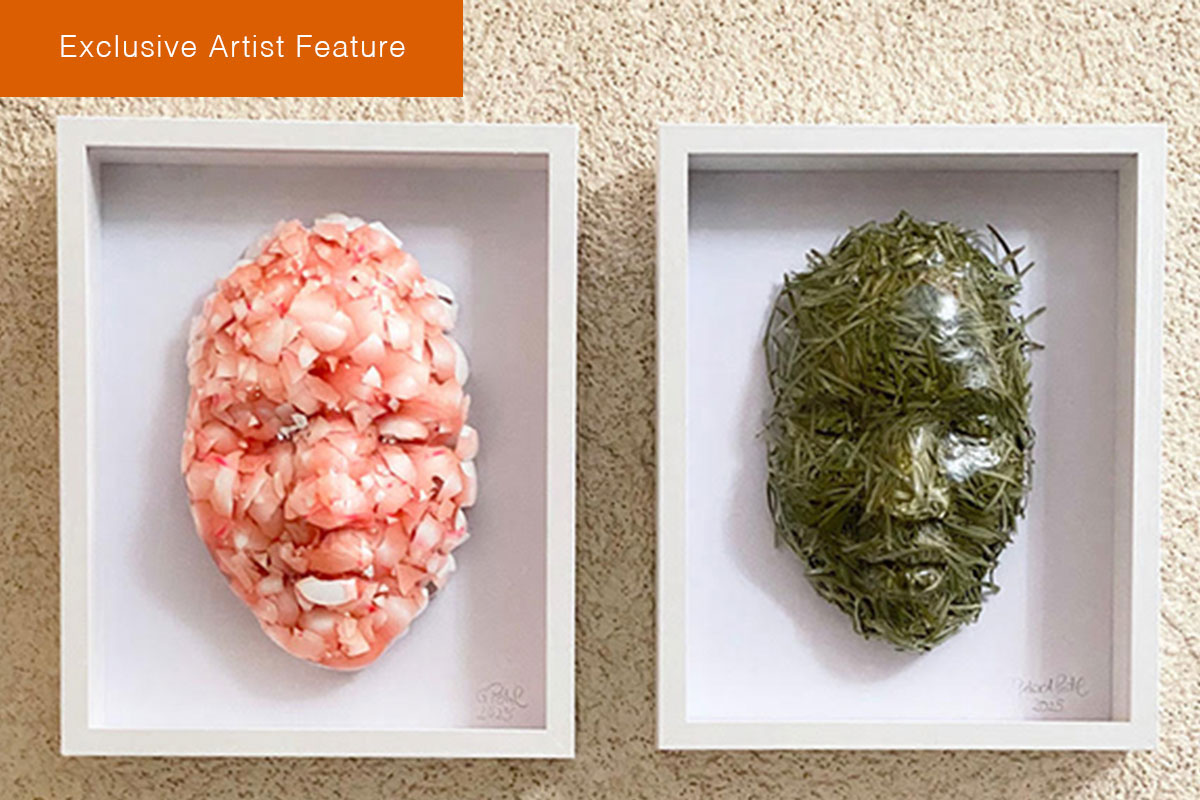
With his Four Masks Collection, Petzl reimagines remnants of daily life into reflections on fragility and resilience. The works are crafted from simple organic matter—egg shells, fir needles, woodchips, and onion husks—preserved in resin, each becoming a study in permanence and change.
The Fragile Egg Shells Mask glows with a soft orange tone, composed of shells saved from five-minute eggs. What might have been discarded becomes a meditation on vulnerability and persistence. The thin, cracked surfaces, sealed in resin, hold the tension between delicacy and endurance—proof that even the smallest fragments can carry strength when transformed.
Beside it, the Nordmann Fir Needles Mask speaks of renewal. Made from a recycled Christmas tree, it turns a fleeting symbol of festivity into a lasting work of remembrance. Petzl transforms what was once a part of temporary joy into a quiet reflection on time’s passage and the enduring nature of celebration itself.
The Woodchips Warrior Mask, assembled from forest woodchips and painted by hand, carries a grounded energy. Its surface feels both ancient and alive, channeling the spirit of the forest into human form. Petzl’s “warrior” is not a figure of conquest but of balance—an emblem of quiet resilience and harmony with nature.
Then comes the Onion Lover Mask, made from the papery skins of onions gathered during ordinary kitchen work. Each translucent layer catches the light like memory itself. In Petzl’s hands, these fragile husks become tokens of intimacy, turning daily gestures—like cooking—into small rituals of creation.
Together, these masks form more than a collection; they create a meditation on the connection between life, decay, and renewal. Petzl blurs the line between artist and participant, showing that art need not stand apart from experience. By embedding the remains of everyday moments in resin, he preserves not only form but feeling—giving weight to the unnoticed.
His process reminds us to slow down and see differently. What we throw away or overlook might hold quiet significance. Through Petzl’s work, the mundane becomes meaningful, the temporary becomes timeless. The discarded becomes sacred again.
Moon and Earth
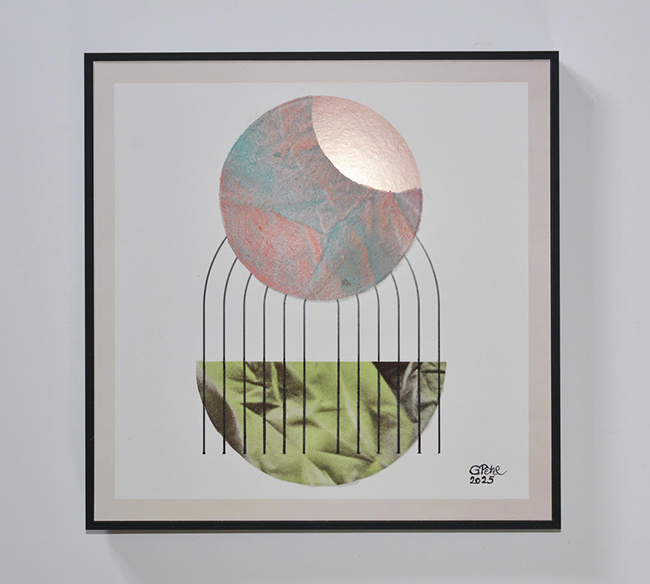
In Moon and Earth (2025), Petzl continues his exploration of transformation, this time through fabric, paint, and collage. The 30×30 cm mixed-media piece began with a purchased print—an everyday image that he layered with aged cotton fabric, giving the surface both texture and history.
Using an acrylic airbrush, Petzl created his signature “wrinkle designs,” organic folds that suggest lunar craters, worn textiles, or shifting landscapes. These marks blur the boundary between accident and intention, between the physical and the imagined. Later, he accentuated the surface with delicate painted lines, turning spontaneous textures into quiet rhythms of form and color.
The work carries the softness of age and the freshness of rebirth. Through recycled materials, Petzl continues his dialogue with the idea that art can be an act of re-seeing. Creation, for him, is not about starting from emptiness but about extending the life of what already exists. “Moon and Earth” becomes a small yet profound meditation on time, showing how wear and renewal coexist in every surface.
Both Moon and Earth and the Four Masks speak to Petzl’s larger philosophy: that art can emerge from ordinary life and that transformation is a daily act. His materials hold memory, his gestures carry care. Through quiet experimentation, he invites us to look closer—to find beauty in the overlooked and meaning in what remains.
In Gerhard Petzl’s world, creation isn’t separate from existence—it is the essence of it. His works breathe with the rhythm of living, where every layer, wrinkle, and fragment tells a story of change, continuity, and the art of seeing.
