

Bea Last, a Scottish artist rooted in the wild beauty of her surroundings, works where sculpture meets drawing. Her practice revolves around transformation—she reclaims discarded, repurposed, and found materials, shaping them into what she calls sculptural drawing. In her studio, remnants of the world—bamboo, cloth, wire, fragments of waste—become vessels of meaning. Her work is not about decoration; it is about truth. Through abstraction and physical labor, Last examines how people endure conflict, displacement, and ecological collapse. Her art is less a comfort and more a reckoning—inviting reflection on fragility, repair, and the quiet strength required to rebuild what has been broken.
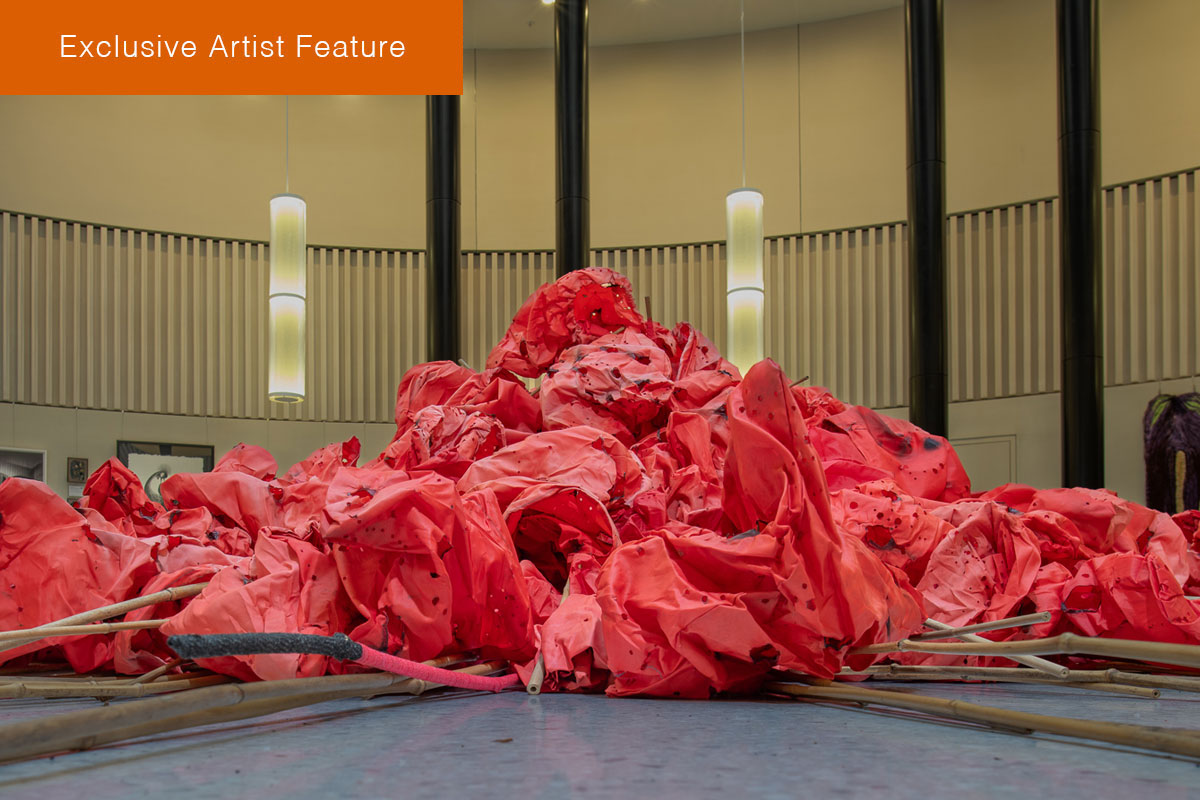
Images of The Red Bags – Sculptural Drawings Installation
At first, Images of The Red Bags might appear straightforward: a suspended field of red shapes, hundreds of them, floating in the air. But as the viewer lingers, the installation deepens in resonance. Made from 700 hand-constructed bags—crafted from recycled materials, bamboo, and cloth bearing real bullet holes—it carries a layered emotional charge. Presented at the VAO 2025 (Visual Arts Open) Finalist Exhibition at The Minster in London, the work occupied the space with quiet gravity, as though the room itself inhaled and exhaled through the red forms.
Each bag feels singular, yet collectively they form a living network—echoing the movement of people, the persistence of memory, and the shared pulse of survival. The color red dominates, bold and unavoidable. It suggests both life and warning, blood and resilience. Within this saturation of color lies contradiction: destruction that births beauty, and beauty that acknowledges pain.
The bullet holes embedded in some of the materials serve as small ruptures of truth. They don’t sensationalize violence; they record it. Others in the installation seem to close their own wounds through tension and shape, transforming damage into recovery. Through these gestures, Last reshapes violence into tenderness—turning evidence of harm into symbols of endurance.
Her process is deliberate and grounded in repetition. She scavenges what others discard, reclaiming fragments of the everyday world and granting them a second existence. The making of each bag is meditative, almost ritual. Every twist, knot, and fold becomes an act of care, an assertion that attention itself is a form of healing. For Last, materials are not passive—they hold memory, labor, and human touch.
In the gallery, the work fills the air like suspended breath. Visitors move around and through it, becoming part of its rhythm. There’s a sense of floating between density and silence, between what is seen and what is remembered. The Red Bags hum softly with presence—they are sculptures, but also echoes of stories, each one holding what words cannot contain.
The title Images of The Red Bags feels intentional. Each form functions as both a literal bag and a metaphorical image—something that holds, conceals, or carries. Collectively, they become an archive of emotion, of lives displaced or transformed. They might recall bags carried by refugees, medical pouches from conflict zones, or sacred offerings. What they contain is invisible, yet palpable—the unseen weight of survival.
This work bridges the personal and the collective. It acknowledges the global crises that shape our age—violence, migration, environmental degradation—while also reflecting the artist’s own persistence in the face of uncertainty. Through repetitive labor, Last turns making into empathy. Her hands trace resilience into form, suggesting that art can hold grief without breaking under it.
Standing before the installation, there’s a sense of time suspended. You feel the patience required to make it, the histories embedded within its materials, and the silence that follows creation. It’s not an artwork that asks for admiration—it asks for presence. The bullet holes do not shock; they remind. They insist that beauty and trauma coexist, that what is wounded can still be whole.
Bea Last’s sculptural drawings resist spectacle. They speak in the language of endurance—slow, deliberate, and human. Images of The Red Bags stands as both a memorial and an offering, inviting reflection rather than resolution. It suggests that repair does not erase damage; it honors it. In Last’s hands, art becomes a quiet form of resistance, a place where empathy and matter intertwine—one red bag at a time.
