

Carolin Rechberg treats art as something alive—an ongoing exchange between presence, material, and motion. Born in Starnberg, Germany, she works across painting, ceramics, sculpture, sound, performance, poetry, installation, and photography with the ease of someone following intuition rather than discipline. Each form she touches becomes a continuation of her exploration into awareness. For Rechberg, art is not a product but a process—something that happens in the body before it reaches the canvas or clay. Her practice invites viewers to step into that space of attention, to sense how movement turns into stillness and how matter becomes thought. In her world, creation is not an act of control but of listening—listening to the rhythm of the breath, the weight of the brush, the texture of silence. What she offers is not a message but an experience—one that encourages slowing down, noticing, and simply being.
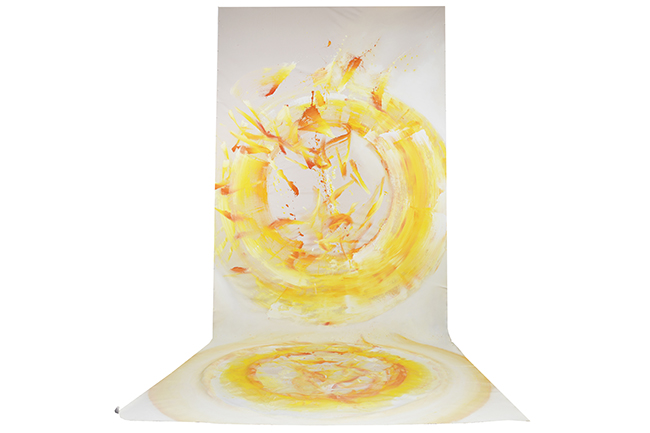
Cradle the Essence of Your Being / A Gateway to Conscience / Ascend to Your Potential of Presence
Painting — Gesso and Tempera on Raw Canvas (H 308 × W 211 × D 179 cm, 2025)
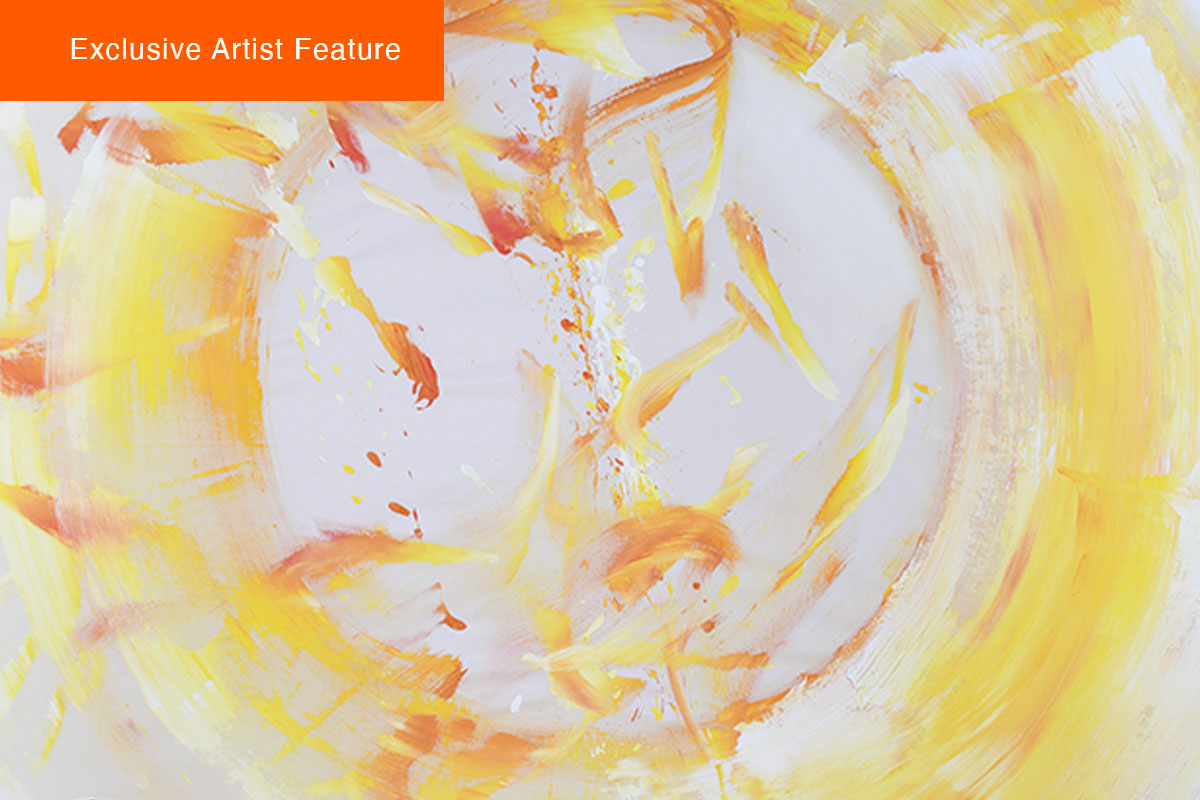
To stand before Cradle the Essence of Your Being is to step inside a circle of light. The work doesn’t hang so much as unfold, cascading toward the floor, blurring the line between painting and environment. Its sweeping rings of yellows and oranges pulse with warmth, as if the piece were alive and exhaling. The color radiates like sunlight filtered through breath, suggesting transformation rather than depiction.
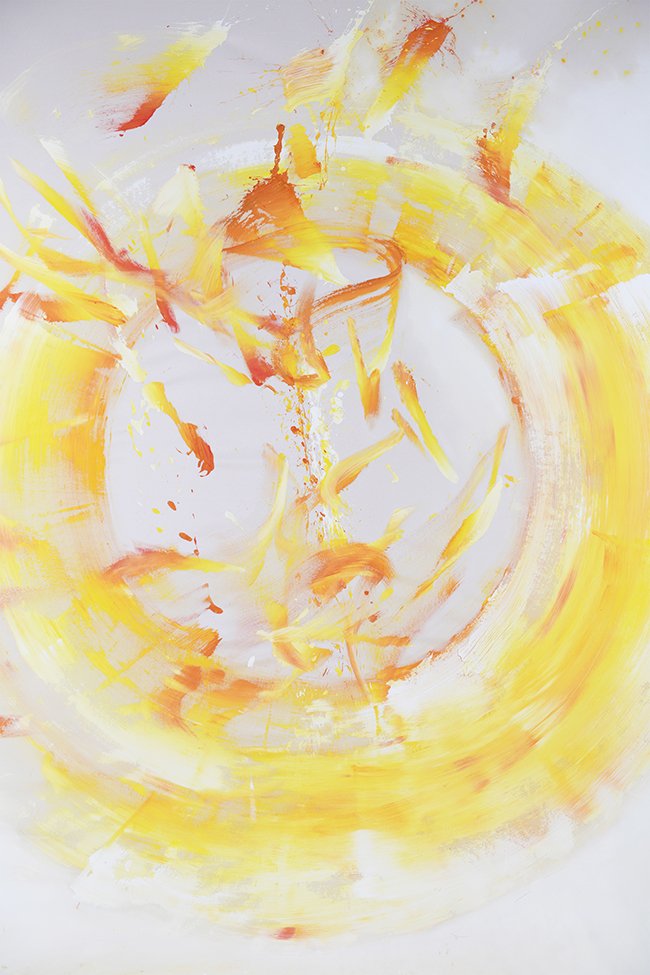
Rechberg’s gestures are deliberate yet fluid, capturing the sensation of movement rather than an image of it. Each brushstroke feels like a trace of energy rather than paint. The spiraling motion draws the viewer into its rhythm—an endless loop of expansion and return. There’s a sense of both meditation and eruption here, of stillness vibrating beneath motion.
Her use of gesso and tempera is intentional—materials that carry an ancient honesty. The surface remains raw, revealing the evidence of process. Every stroke, every touch, is visible, creating a rhythm between doing and being. There is no illusion or finish—only the immediacy of gesture. Through that openness, the painting becomes an act of awareness, a mirror reflecting the way consciousness moves through space and form.
The work feels ritualistic, but not ceremonial. It recalls the discipline of Zen brushwork or the quiet repetition of a mantra. The circular forms echo ideas of unity, cycles, and breath, yet nothing feels imposed. The energy radiates naturally, inviting the viewer into a shared state of mindfulness. In this way, the painting becomes more than an image—it’s an encounter, a space where perception itself becomes the subject.
Contemplation Stone XXI
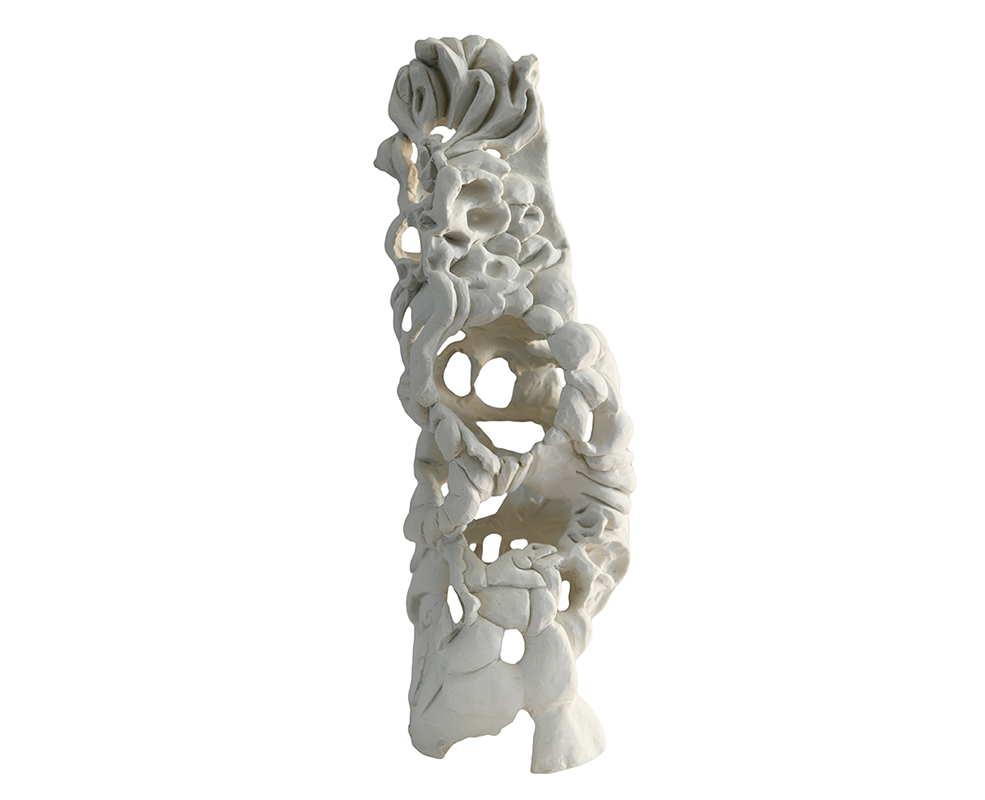
Sculpture — Porcelain (H 43 × W 15 × D 14 cm, 2021)
If Cradle the Essence of Your Being reaches outward, Contemplation Stone XXI retreats inward. The porcelain sculpture stands quietly, its form full of folds and hollows that invite the gaze to linger. It feels both organic and elemental—like something discovered rather than made. The light passing through its openings turns solidity into transparency, transforming the object into an experience of rhythm and air.
Rechberg approaches clay as if in conversation with time. She allows the material to move, to twist, to breathe. The sculpture bears the evidence of her touch, yet it also feels as though nature had a hand in its making—like a stone shaped by erosion or a coral grown by slow persistence. Every indentation and curve seems to mark a dialogue between intention and surrender.
The title, Contemplation Stone, captures its quiet authority. It doesn’t symbolize meditation—it is meditation. The work invites stillness, offering a tangible pause in a world that rarely stops moving. Walking around it, one discovers how emptiness defines form, how absence holds as much presence as matter. It’s an object that absorbs awareness, returning it in silence.
Together, Cradle the Essence of Your Being and Contemplation Stone XXI create a conversation between motion and stillness, color and void, gesture and breath. One expands toward light, the other contracts into quiet. Between them lies the essence of Rechberg’s vision—a space where art becomes an act of being present, and where seeing transforms into feeling.
