

Miguel Barros makes art that feels like a conversation with place—sometimes quiet, sometimes dreamlike, and often layered with a sense of longing. Born in Lisbon in 1962, he carries the influence of three distinct geographies: Portugal, Angola, and Canada. Each one has shaped the way he sees color, form, and the emotional undercurrent that runs through a landscape. When he moved from Angola to Calgary in 2014, he found himself surrounded by new skies, new seasons, and new rhythms. These changes didn’t replace what came before; instead, they blended into his work, creating a dialogue between past and present.
Barros studied Architecture and Design at IADE Lisbon in 1984, but his art resists strict lines. His paintings loosen structure, letting intuition take the lead. He treats painting not as a mirror of the world but as a space where memory, imagination, and geography meet. The pull of Portugal remains constant, even as his vision expands outward.
Miguel Barros and the Reimagining of Lisboa
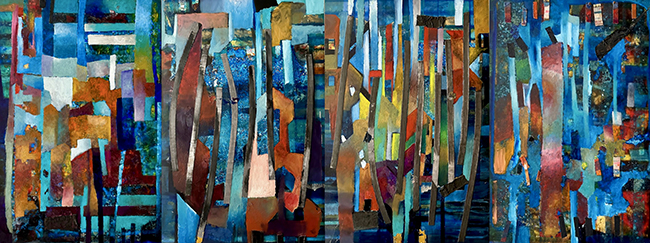
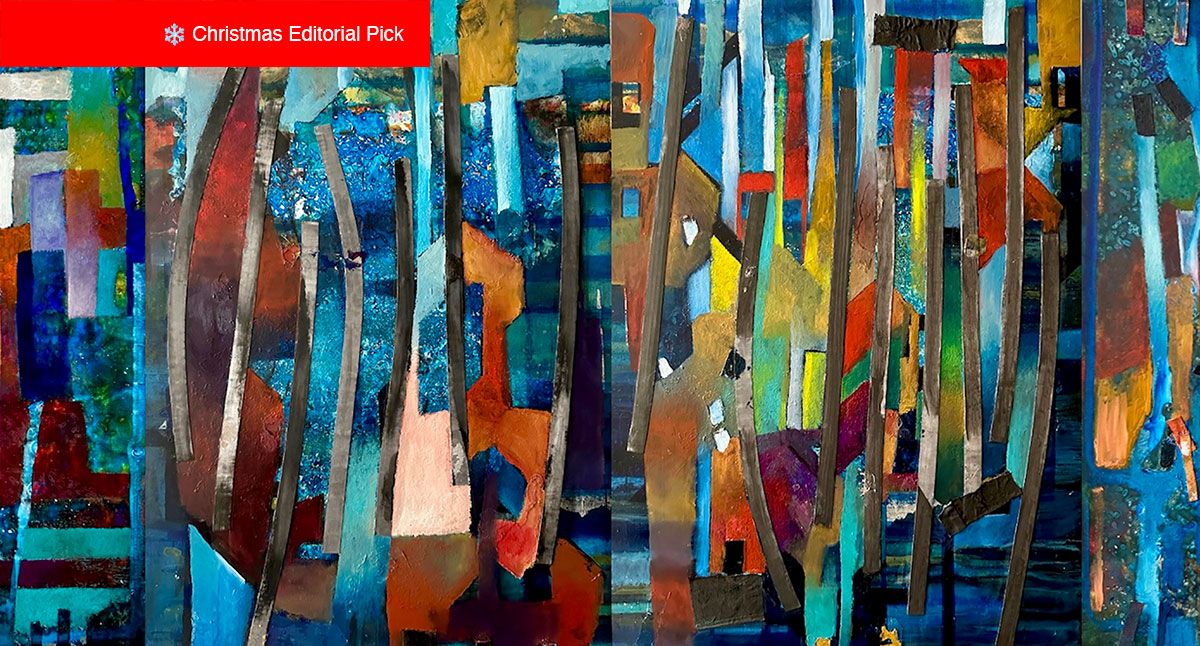
In Miguel Barros’ painting “My Lisboa Is Reborn as Enchanted Ulissipo” (60×160 cm, Oil & Mixed Media, 2025), the familiar city becomes something more than a physical place. It shifts, opens, and folds into a mythic landscape shaped not only by memory, but by the stories that run underneath it. Barros isn’t trying to recreate Lisbon as it stands. Instead, he brings forward a Lisbon that belongs to the inner world—a place where history mixes with dreams, and where personal origin merges with legend.
He describes this work as a transformation of memory into fantasy. That line reveals the heart of the painting. Barros is not painting what he saw; he is painting what Lisbon has become inside him after years of distance, travel, and return through art. The idea of Lisbon as Ulissipo—a city shaped by the imagined footsteps of Ulysses—gives the painting its mythic spine. This isn’t the Lisbon of maps. This is the Lisbon that might have existed if myth had woven itself more tightly into its streets.
Across the wide canvas, a bluish light radiates from the hills. It feels both oceanic and atmospheric, suspended between water and sky. This blue isn’t simply color; it functions like a pulse. It suggests evening light after the heat has faded, or dawn rising from the Atlantic. The city glows as if viewed through a thin, shifting veil—something seen not just with the eye but with memory’s softened edges.
Barros lets the Tagus play a quiet, essential role. In the painting, the river murmurs its ancient secrets, echoing stories told long before his birth. The Tagus becomes more than a geographical presence; it becomes a keeper of history, the element that connects the Lisbon of today with the Lisbon of myth. The river has always shaped the city, but here, it shapes the imagination. It whispers, it glimmers, it pulls the viewer into the timelessness of Barros’ emotional landscape.
The city hangs in suspension between the real and the legendary. Buildings appear as impressions rather than exact replicas. Streets seem to bend toward something unseen. Barros paints Lisbon as if it remembers Ulysses not as a distant tale but as a living influence—a force embedded in its stones, its winds, its horizon line. The hero’s myth becomes a metaphor for creation itself: the idea that a city can be born out of a story, and that a story can be born out of longing.
Barros’ training in architecture surfaces subtly here. Even when the structures are softened by dreamlike distortion, they still carry a sense of balance and intention. Yet he refuses rigidity. He allows movement to override strict geometry. This looseness mirrors the way memory behaves—never precise, always shifting, always tinted by emotion.
What stands out most is the sense of rebirth. Barros is not painting the Lisbon he left, nor the Lisbon tourists know. He is painting the Lisbon that emerges after years of distance, the Lisbon reconstructed through affection and imagination. When he writes that the city “still holds the magical trace” of Ulysses, it feels like he’s describing the way origin stays alive inside a person. Even as life moves on, certain places remain charged, luminous, and alive within us.
In this work, Lisbon becomes a mythic homeland—reborn, reimagined, and reshaped by the currents of memory. Barros invites the viewer not just to look at the city but to feel it: its nostalgia, its mystery, its shimmering blend of reality and legend. Through color, texture, and story, he builds a place where past and present coexist, where home transforms into myth, and where imagination fills the space between what was and what might have been.
