

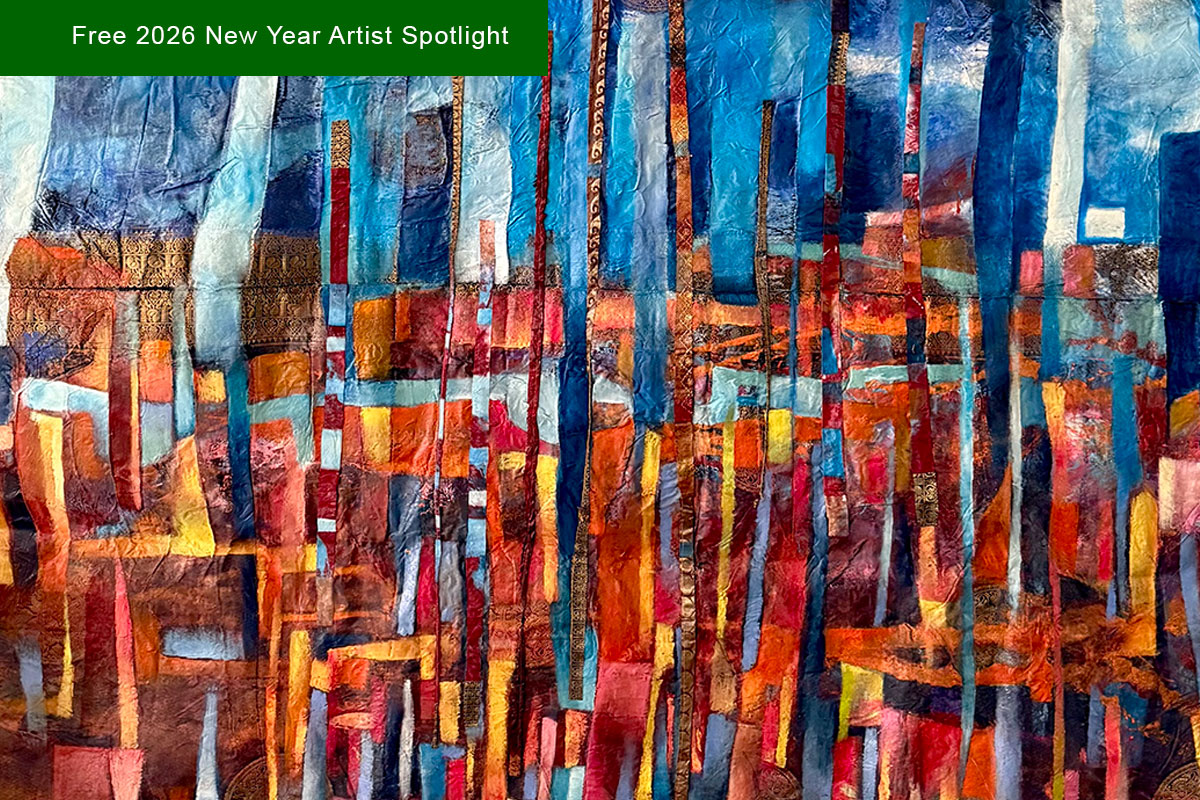
Miguel Barros, born in Lisbon in 1962, makes art that feels shaped by a life in motion. Moving between Portugal, Angola, and Canada has widened his understanding of what a place leaves behind—how it forms identity, settles into the body, and keeps traveling through memory long after the suitcase is unpacked. He studied Architecture and Design at IADE Lisbon, graduating in 1984, and that training still anchors his painting. You can feel it in his sense of proportion, his timing, and his ability to organize space without draining the work of feeling. When he relocated from Angola to Calgary, Alberta in 2014, it didn’t replace his roots—it added another layer. Since then, he has kept searching for a visual language spacious enough to hold several cultures at once, turning surfaces into points of contact where lived experience becomes color, light, and form.
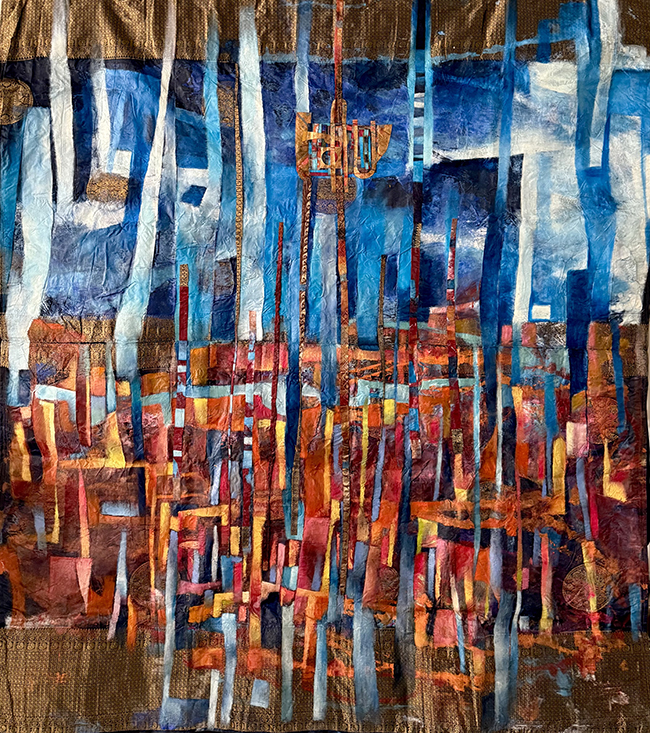
Barros’ paintings come from an artist who treats “home” as plural. It isn’t one fixed location, but a shifting set of references that overlap and echo. Migration doesn’t appear in his work as a loud statement; it’s present in subtler ways—in palettes that hint at different climates, in moods that shift like weather, and in materials that carry their own histories. The picture plane becomes a threshold: something you enter, not just something you look at. For Barros, travel is not a theme added later to dress up the work. It’s built into how he works, keeping the studio open to movement, change, and layered belonging.
His architectural background is a clear doorway into his process. Architecture is, at its core, a discipline of layers—structure, surface, light, and all the hidden systems that hold a space together. Barros paints with that same layered thinking. He doesn’t rely on a single burst of expression. He builds, edits, balances, and returns. Even when the surface reads as airy or atmospheric, there’s a quiet logic underneath. Shapes sit where they need to sit. Space is calibrated. Transparency isn’t there for decoration—it’s doing the work of creating depth and steering the eye. The result feels crafted with intention, held in a steady tension between control and discovery.
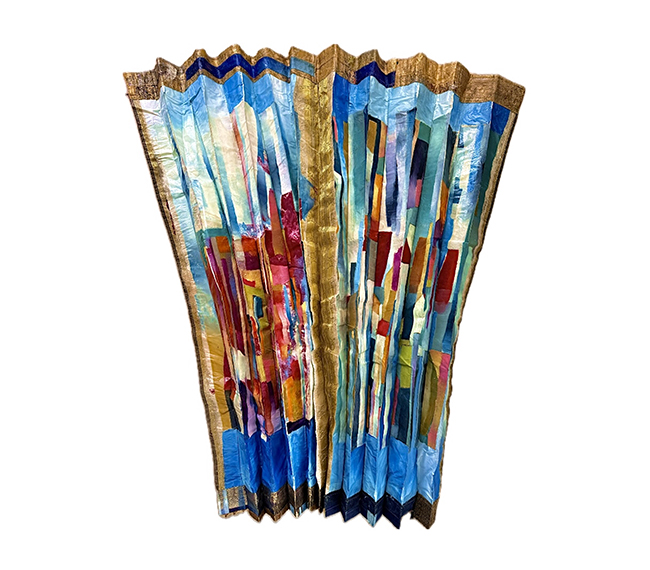
What gives his work its distinct energy is the way cultural experience is woven into that structure. Portugal appears less as an image and more as a sensation—gesture, heat, memory, and a pull toward tradition. Africa, India, and Canada aren’t distant references either; they arrive as lived realities that have shaped his daily life. Rather than leaning on symbols, Barros often lets the materials carry meaning. This shifts the relationship between surface and story. A textile isn’t just a support—it’s an object with a past, marked by touch, use, exchange, and time.
That approach is most vivid in works made on fabrics like silk sarees, African cotton capulanas, and Portuguese textiles such as Chita bedspreads from Alcobaça, along with cotton and paper. Each support arrives with its own identity: weave, pattern language, cultural memory, and the specific way it accepts or resists paint. A sari can suggest ceremony and everyday life at once—dye, sheen, softness, strength. A capulana carries rhythm and social presence, a vocabulary of pattern that feels both intimate and communal. Portuguese Chita textiles bring domestic memory and craft history into the room. Barros doesn’t use these materials as exotic scenery. He treats them as proof—physical traces of the places that have shaped his journey.
There’s also a personal intimacy in how these materials enter the work: they traveled with him in his own luggage. That fact turns the paintings into objects of passage. The supports have been folded, carried, protected, and reopened for labor. The journey isn’t only metaphorical—it is lodged in the material life of the piece. Each work becomes an accumulation of travel, time, contact, and sustained attention.
Barros pushes every surface according to what it can handle. Fabric isn’t predictable like stretched canvas; it absorbs unevenly, shifts, and responds differently under layers. He doesn’t fight those qualities—he works with them. Oil paint is built up through repeated veils, and translucency becomes central. Light moves through thin films of paint, creating depth that feels almost spatial—like looking through gauze, glass, or layered screens. The dimensional effect comes less from thickness and more from optical distance, where what sits beneath remains present enough to linger.
Out of that layering, figures sometimes rise—rarely as direct portraits, more like partial presences. Faces, silhouettes, and shadows appear and fade, like fragments of memory that won’t settle into one clear narrative. Elsewhere, complex forms and saturated fields are cut by sharp light, creating reflective moments that feel mirror-like. At times the paintings suggest interiors, corridors, or city fragments—spaces that feel recognizable yet dream-shifted, as if the city is being remembered rather than documented.
Even when the work turns inward, it doesn’t seal itself off. At its center is a belief in shared human dignity. Barros speaks of keeping people at the core—honoring what is true within different cultures and the generosity he has experienced across them. That stance prevents the work from turning culture into decoration. Instead, the paintings point toward common needs—safety, joy, peace, connection—and toward art’s ability to bring distances closer without flattening difference.
The viewer is invited to complete the work. Because so much is partly concealed, the paintings ask for time and return. They shift with light, distance, and the mood you bring into the room. Meaning forms in the space between what is offered and what remains hidden. Barros seems to trust that each gaze will find its own path through the surface.
Ultimately, Miguel Barros treats painting as a form of translation—between climates and histories, between textiles and lived experience, between inner life and shared ground. His work doesn’t argue for one homeland over another. It suggests identity can be carried in layers, unfolded and reassembled, into a visual language where structure holds feeling—and where borders become meeting points, not walls.
