

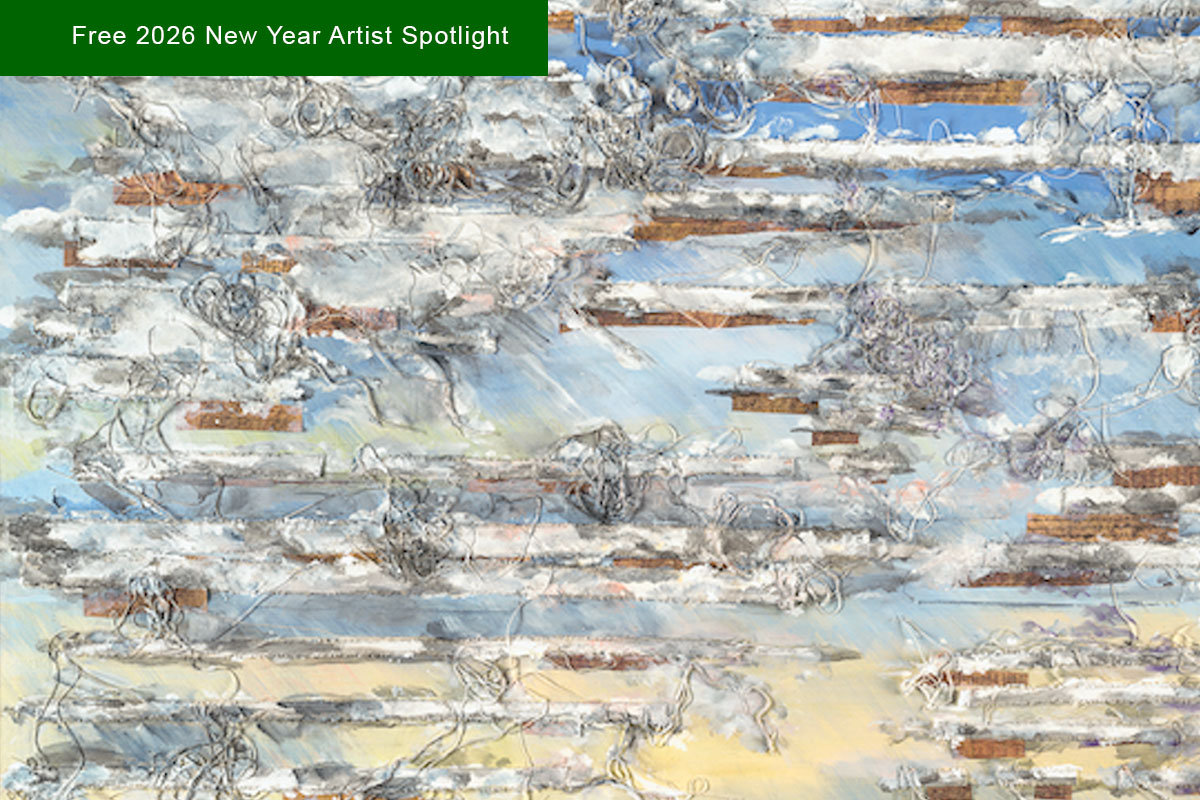
L. Scooter Morris makes work that refuses to behave like background. Her pieces don’t simply hang on a wall—they take up space with the insistence of something alive. Morris calls herself a sensory illusionist, and it fits once you spend time in front of her art. The experience starts in that instant before you can explain what you’re seeing—when your eyes register color and form, but your body picks up depth, weight, and shift first. Her “Sculpted Paintings” don’t stay politely flat. They press outward, sink inward, and change depending on where you stand. A ridge catches light and the composition recalibrates. Move in close and you see the construction: acrylic combined with mixed media, thickened passages, seams, edges, and shadow pockets that feel almost touchable. Step back and the image reorganizes again, as if it’s adjusting itself to your distance. Morris isn’t aiming for something that merely looks attractive in a room. She’s after an encounter—something you feel in your gut, not just process with your eyes.
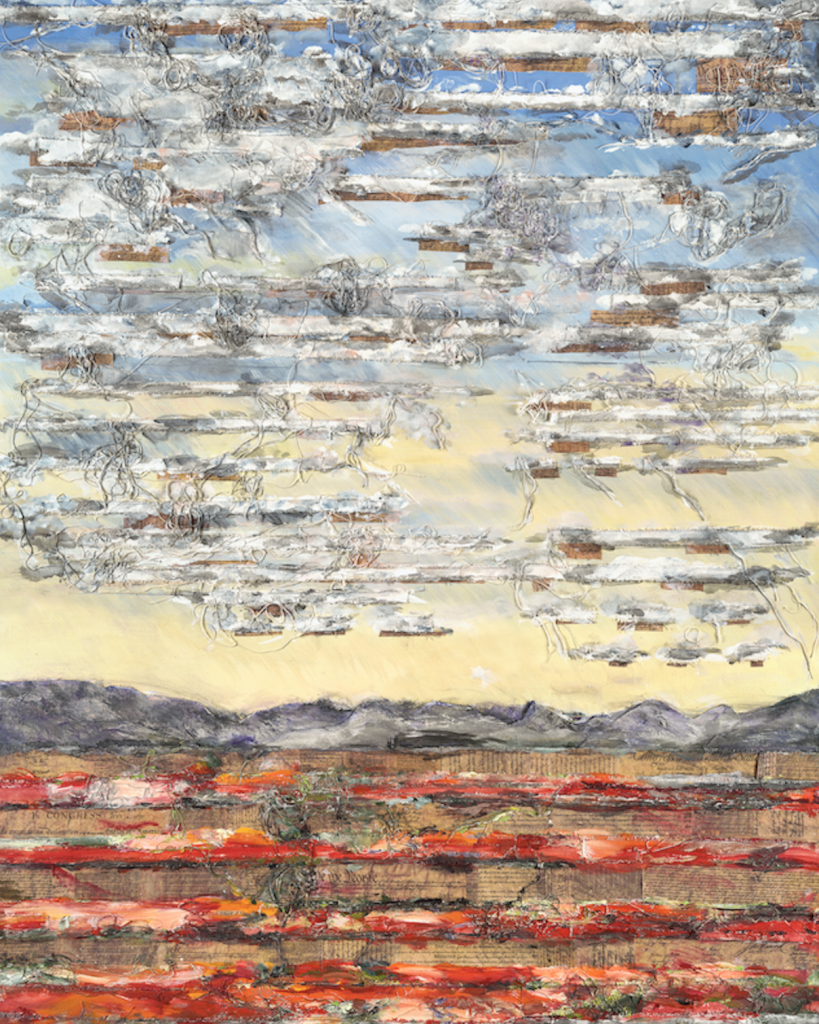
Her practice sits in the overlap between painting and object. In Morris’s hands, “sculpted painting” isn’t a catchy phrase—it’s the method. The surface rises and falls, breaking the expectation that a painting should behave like a smooth plane. That instability is intentional. At one angle, you read the work through composition—color relationships, balance, rhythm. At another angle, you start reading the material decisions: how a raised strip bends brightness, how an incised channel holds darkness, how a rough patch refuses to dissolve into the rest. The artwork doesn’t settle into a single “correct” view. It keeps offering new information as you move, making the act of looking active and physical.
Texture is the backbone of her language. Acrylic gives directness and clarity, while mixed media adds grit, density, and consequence. Together they create surfaces that look worked through—revised, tested, insisted upon. You can sense time inside the finish: build up, pause, return, scrape back, rebuild. That labor matters because it shows up in the presence of the piece. These surfaces feel constructed rather than simply applied. They carry the feeling of effort and decision-making, like a record of process you can still read.

Light is not an accessory in Morris’s work. It’s a collaborator. Her surfaces don’t merely reflect what’s around them; they respond. A raised edge can flare, then fall into shadow when you shift a few inches. The change is subtle but constant—less theatrical than perceptual, like your vision being reminded that it can’t lock anything down. In that sense, Morris turns the room into part of the artwork. The piece comes fully alive through changing light and a moving viewer.
Her titles often tether this sensory experience to real-world tension. They point toward questions about belonging, identity, power, and the way language can seal a person’s fate. Morris uses abstraction not as a way to dodge meaning, but as a way to compress it. Rather than delivering a direct statement, she concentrates big themes into surface, material, and light—letting the viewer feel pressure before they find words for it.
That strategy is especially clear in We Are The People (2025), acrylic and mixed media, 60” x 48”. The size matters because it meets you at a bodily scale. It’s large enough to hold your field of vision and keep you from treating it like a quick glance. The phrase “We Are The People” arrives loaded with civic weight, but Morris doesn’t treat it as a tidy declaration. She treats it as an unsettled question. Who belongs inside the “we”? Who gets pushed out? What happens to the idea of “people” when systems divide, sort, and rank?
Visually, the work reads like a constructed landscape. The surface rises and dips like a terrain of pressure points, as if the painting has its own geology. Light glides across the high areas and disappears into recesses, echoing public life: certain stories get illuminated, while others stay buried. The layered build suggests accumulation—history stacked on history, conflict piling up, ideals pressing against what actually happens. The artwork carries momentum, but it also shows restraint, as if it’s holding itself together while still exposing strain lines.
If We Are The People holds the hum of collective life, Felon (2025), acrylic and mixed media, 24” x 48”, lands like a blunt stamp. Its narrow vertical format feels direct and confrontational—like a posted notice you can’t ignore. The title compresses a person into a single word, and Morris translates that compression into physical structure. The surface interrupts the eye with breaks, stops, and detours, suggesting limitation and containment without spelling out a literal story. The material feels lasting in the way labels can feel lasting. It holds marks the way memory holds marks—uneven, layered, and hard to erase.
Morris doesn’t lecture through these pieces. She sets conditions where recognition can happen. You’re asked to move, look again, and notice how quickly perception shifts—and how easily judgment can follow. Her art doesn’t demand agreement; it demands attention. It slows you down and makes you stay with complexity instead of flattening it. That pursuit of contact—real, physical, human—is what gives her sculpted paintings their pull, and why they linger after you’ve stepped away.
