

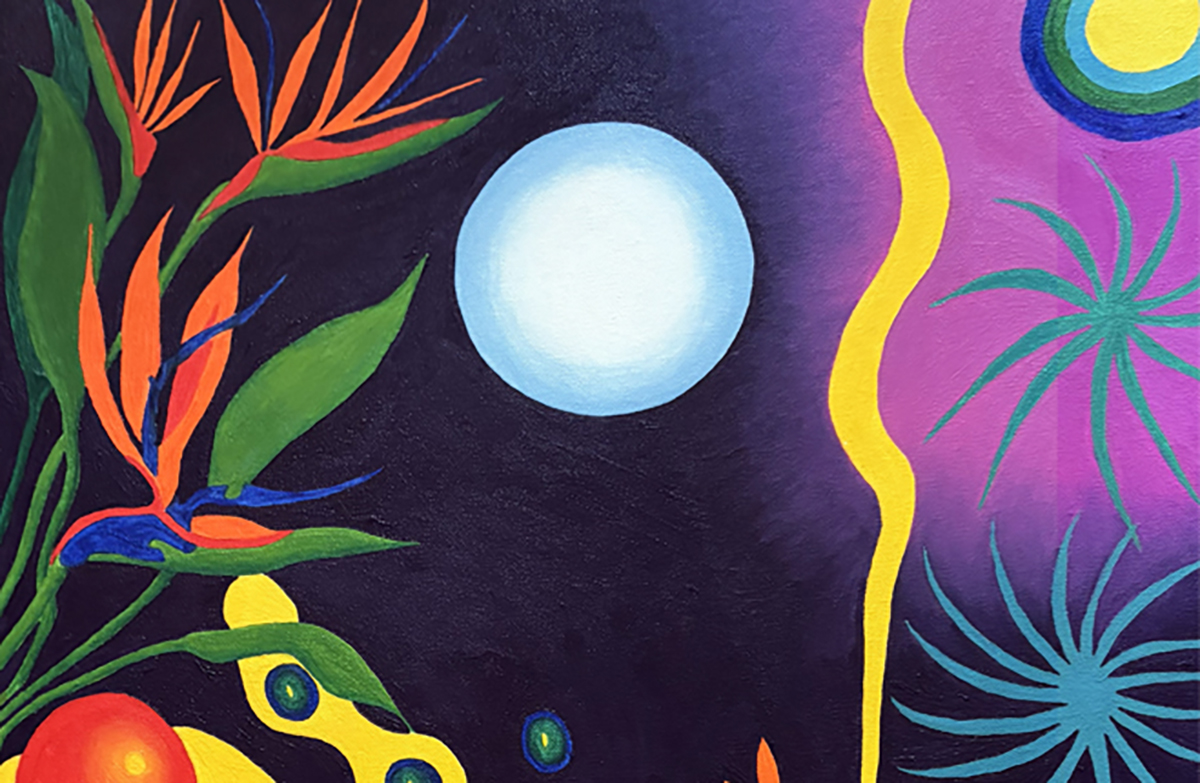
Oenone Hammersley moved to Palm Beach Gardens in 2024, and the shift has fed directly into her visual world. She arrives with a practice shaped by theatre design, decades of travel, and a steady devotion to the natural environment. Known internationally for mixed-media paintings built from saturated color, textured surfaces, and radiant light, she often returns to water—its shimmer, its motion, its vulnerability. Her paintings have been shown in Palm Beach, New York, London, Paris, Washington D.C., and Miami, and they sit in both private and public collections. Florida’s tropical gardens have become fresh material: thick foliage, repeating forms, heavy air, and sudden brightness after rain.
A process that thinks like a set designer
Hammersley paints as if she’s arranging a scene. Her theatre-design background shows up in how she builds space and controls attention: areas of color work like lighting changes, while texture acts like physical staging—something you feel, not just something you notice. The compositions hold drama, but they don’t tip into clutter. Even when the surface is busy, it’s guided.
Travel expanded her sense of pattern, color, and atmosphere. The places she’s moved through offered more than scenery—they offered ways of seeing, where ornament has meaning and nature is never merely background. Those influences don’t appear as literal souvenirs. Instead, they live in cadence: repeated motifs, layered shapes, and the feeling that more than one landscape is present at the same time.
Water as subject, symbol, and pressure point
Water sits at the core of Hammersley’s practice because it can carry two truths at once. It can be pure beauty—light skimming across a surface, movement that calms the body. But it can also carry a quiet alarm: contamination, loss, imbalance. In her work, water becomes a way to talk about what’s at risk without turning the painting into a lecture.
Her environmental concerns are specific—deforestation, ocean pollution, overfishing—and she supports conservation organizations through regular donations. That matters because it keeps the work connected to real-world action. The paintings aren’t sealed off as “just art.” They point outward.
What makes her approach effective is restraint. She doesn’t need doom to make the message land. She begins with color that seduces, with surfaces that invite you closer. Then, slowly, tension rises underneath the beauty. The viewer’s experience shifts from pleasure to awareness—without being forced.
Florida’s tropical gardens as a new engine
In Palm Beach Gardens, the tropical landscape offers Hammersley a charged mix of abundance and structure. Gardens are natural, but they’re also designed. In this series, organic forms collide with geometric patterning, creating a push-and-pull between wild growth and human framing.
These oil paintings feel in motion. Leaves seem to overlap and rotate. Shapes echo like vines repeating themselves. Color changes temperature as it travels across the surface—cooler in one pocket, warmer in another—so the work feels alive rather than fixed. The longer you stay with a piece, the more it reveals: buried marks, edges of pours, traces of earlier decisions under the final sheen.
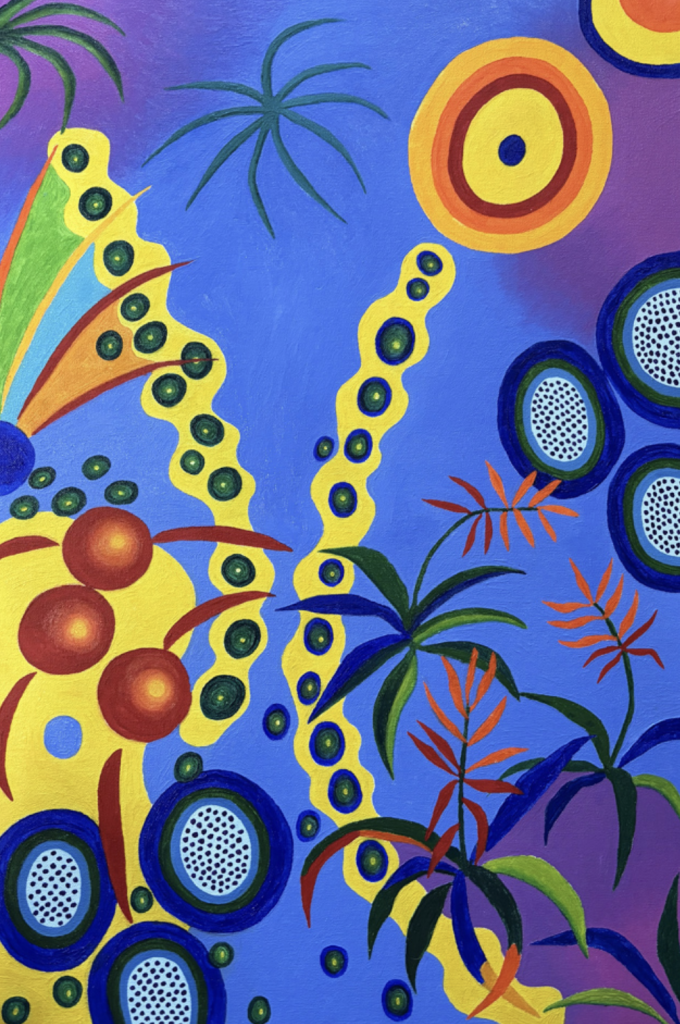
In Falling Seeds, Hammersley pulls from botanical imagery without reducing it to straightforward depiction. The title hints at beginnings—tiny starting points that carry future growth. The painting matches that feeling through floating, seed-like forms and fragments that suggest pods, petals, and drifting organic matter. It doesn’t describe one plant; it gathers the gestures of plant life—curves, clusters, drops, and bursts—and builds a field of vitality.
Here, color isn’t decoration; it’s architecture. The palette is fearless, yet disciplined, with areas that throb with energy set against passages that let the eye rest. The surface holds different kinds of motion at once: deliberate hand-painted sections, pours that bloom into unexpected transitions, and the resin layer that unifies everything into a luminous skin. As you move, the reflections shift and reorder what you notice, making the act of viewing part of the meaning. Nature changes. Light changes. Attention changes.
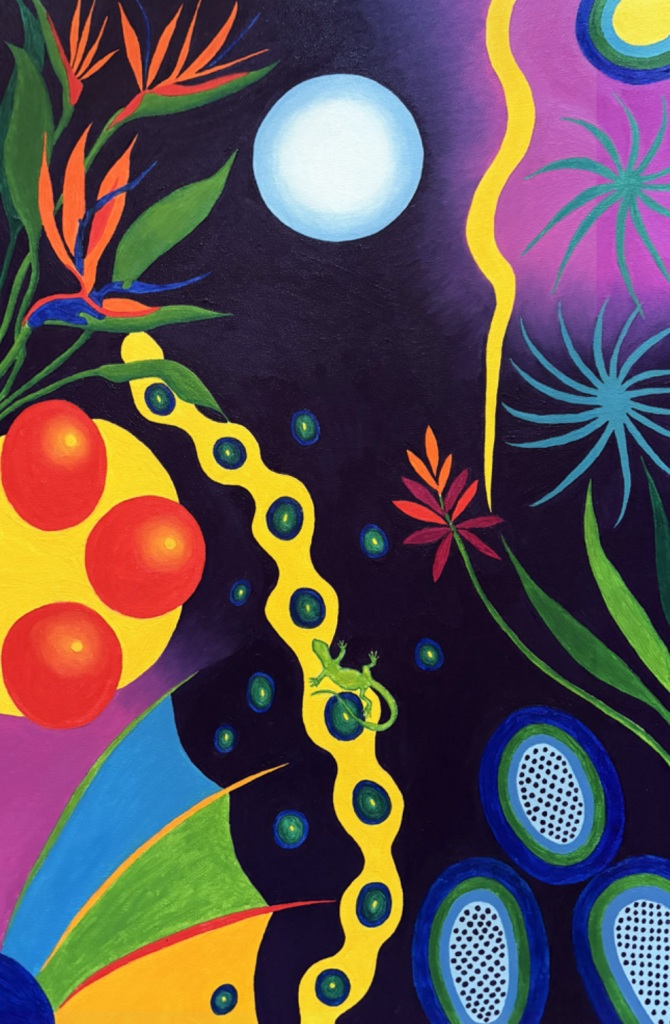
Midnight in the Garden turns toward a deeper, quieter intensity. Where Falling Seeds feels airy and open, Midnight in the Garden feels like entering thick vegetation after dark—when shapes become mysterious and color becomes more concentrated. The title sets a mood, but Hammersley doesn’t narrate. She creates atmosphere: layered leaf-like forms, hidden patterning, and darker passages that pull you inward slowly.
“Midnight” here isn’t emptiness—it’s saturation. Against deeper grounds, color feels richer and more loaded. The glossy surface can make highlights read as liquid, as if the painting holds its own weather. Her blend of organic and geometric elements becomes especially resonant: a garden is both freedom and design, both growth and control. The work holds that duality without resolving it.
Together, these two paintings show what Hammersley does best: she builds images that reward patience. They don’t give up everything in the first glance. They ask you to look longer, to track relationships between color and shape, to notice what sits beneath what. And underneath the surface beauty is a steady, grounded reminder—what she’s painting isn’t just scenery. It’s a living world, and it needs care.
You can see her Tropical Garden oil paintings in person at the Palm Beach Modern & Contemporary Art Fair (PB Convention Center), March 19–26, at the Walter Wickiser Gallery Booth.
For more information, visit: www.oenonehammersley.com
