

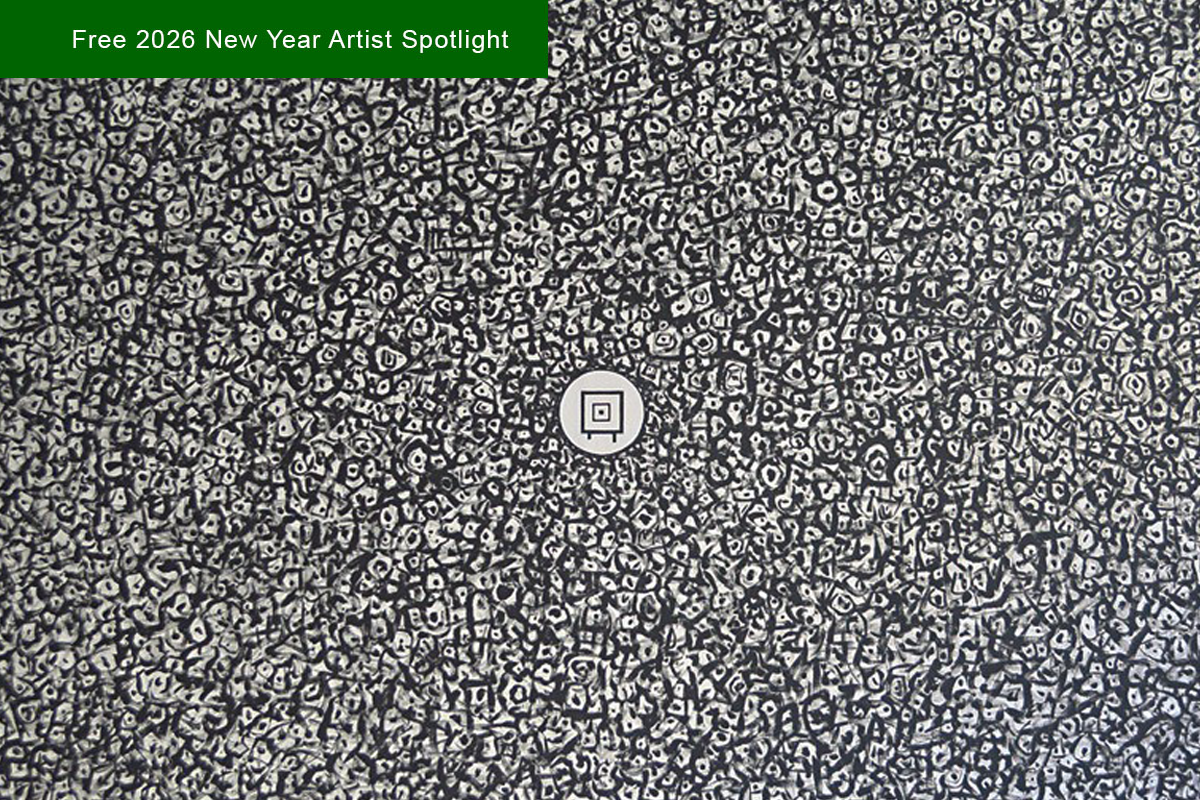
Nicola Mastroserio isn’t working on the clock of popularity. The studio isn’t a place where he reacts to demand or adjusts his direction to fit what buyers might want. He moves at a different pace—drawn to questions that don’t age out. For him, art is a way of digging beneath appearances, a method for getting closer to what things are, not just what they look like. Again and again, he returns to essence: how reality takes shape, how it’s felt in the body and mind, and how it can be approached beyond the constant distraction of the everyday.
That commitment gives his work a particular atmosphere. It’s thoughtful without becoming remote, and it carries philosophical weight without turning into a lecture. In Mastroserio’s paintings, life seems guided by underlying structures—currents of perception, intelligence, and thought that we can sense even when we can’t name them. The image doesn’t claim to settle anything. It holds attention. His work stays with the central human questions: what it means to be here, to perceive the world, to think, and to keep looking for the deeper order moving quietly through experience.
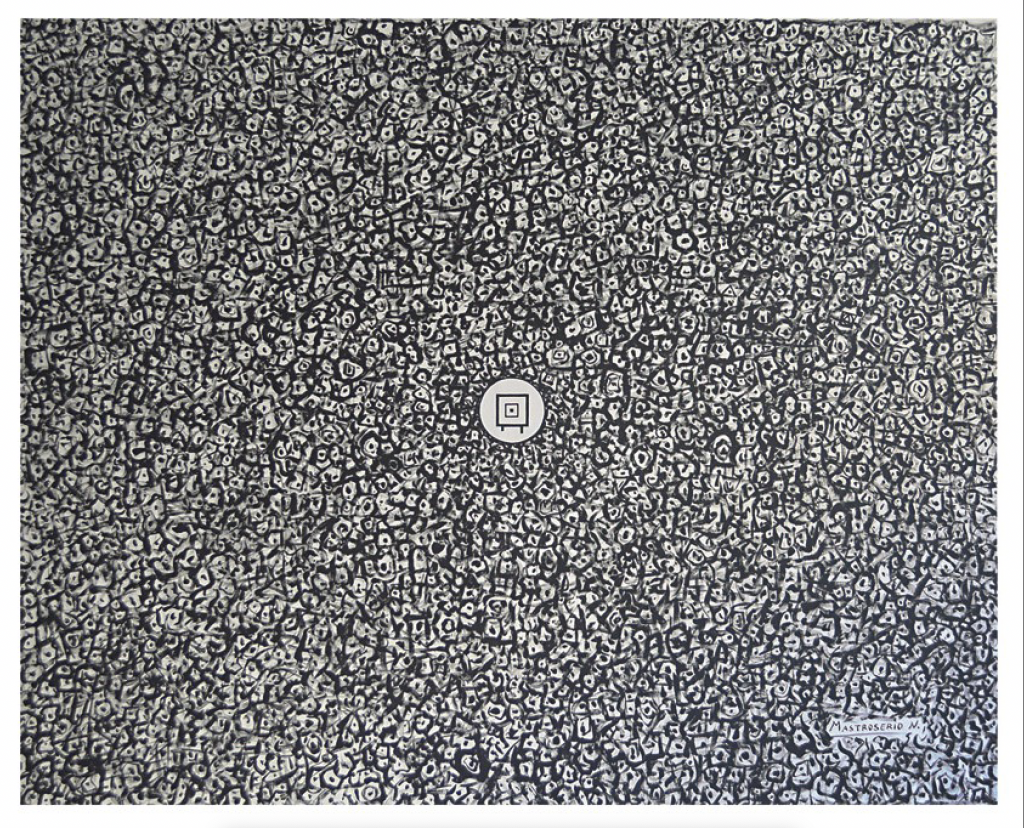
Esse Thesis (146 x 182 cm)
In Esse Thesis, Mastroserio takes on an idea that is both wide in scope and deeply personal: a visual attempt to describe life’s originating design. He presents the painting as a representation of Cellulism (Cellulismo)—an existentialist theory shaped through research, observation, and intuition, meant to investigate what generates life and how life, in turn, generates worlds. Rather than seeing life as mere biology or a chain of mechanical causes, Cellulism proposes something more foundational: life as an initiating intelligence—one that can shape matter and non-matter through the same governing thought.
This is the premise the painting asks the viewer to hold. If the visible world and what lies beyond it arise from one living principle, then the boundary between “material” and “spiritual” begins to soften. Reality becomes a single continuum—different layers, different conditions, but one source. In that sense, Esse Thesis doesn’t read like a depiction of a place. It reads like a structure being proposed. The canvas becomes a conceptual field where physical intelligence, ultra-physical intelligence, and spiritual intelligence can be understood as variations of one generative force.
At the center of the work is what Mastroserio identifies as the Universal Symbol of Life, positioned as the starting point of all created things. It functions like a core—visually concentrated, conceptually charged. It suggests a beginning that isn’t vague, but specific: a single organizing principle from which the rest can radiate. Even without stepping fully into the language of Cellulism, the composition communicates an insistence on origin—on the possibility that creation has an underlying pattern, a kind of syntax that can be sensed and explored.
Because the work calls itself a thesis, it also behaves like a doorway. It asks the viewer to see reality as something living, something that can be understood—and potentially shaped—through consciousness and attention. Mastroserio makes the intention clear in his own words: the aim isn’t only to understand created things, but to use that understanding “for the benefit of all human beings.” That shift is important. The painting becomes more than personal inquiry made visible; it’s presented as shared knowledge, something meant to move outward into the world.
One of the core tensions in his thinking is the relationship between separation and unity. He speaks about the limits life imposes and the strategies human beings can develop to live well—longevity, happiness, and the fuller expression of individual potential within a complex social organism. In this framework, society resembles something biological: many parts functioning as one system. Individual wellbeing and collective wellbeing are linked. The implication is that understanding the principles of life isn’t abstract—it changes how we relate to others, how we organize our lives, and how we care for the structure we all live inside.
Mastroserio’s writing also points toward ethics, not just theory. He describes his research as an offering toward “a prosperous and wonderful future,” and he connects it to the possibility of world peace—rooted in love and fraternity among human beings and evolved cosmic entities. Whether one reads that as literal cosmology or symbolic ambition, the direction is consistent: toward unity, toward expanded empathy, toward a future where conflict is not treated as permanent.
The scale of Esse Thesis supports that ambition. At 146 x 182 cm, it has the presence of something you encounter physically, not just visually. It’s immersive enough to feel like a proposition you step into. That bodily confrontation reinforces what the work is trying to do: function as more than an image—more like a model, a diagram, a blueprint. It suggests that the universe may be vast and mysterious, but not without structure; and that structure can invite understanding rather than shut it down.
Cellulism continues to unfold through symbols that mark time and progress. From this framework, Mastroserio identifies two emblems: the Universal Symbol of Life (2012) and the Universal Symbol of Love (2025). The dates imply sustained development across years—patient refinement rather than quick statements. In this system, love isn’t separate from life; it’s what follows from understanding life correctly. If life is the originating intelligence, then love becomes the intelligence of relation—the force that makes coexistence possible.
Approached this way, Esse Thesis becomes a painted philosophy: a proposal that there is a living order beneath the ordinary, and a bridge from insight to ethics. It asks what life is made of, what intelligence might be beyond the brain, and how deeper understanding could reshape how we live together. Mastroserio isn’t offering a decorative motif or a market-oriented symbol. He’s building a system through visual form—and treating art as a tool for approaching life with greater clarity, purpose, and care.
