

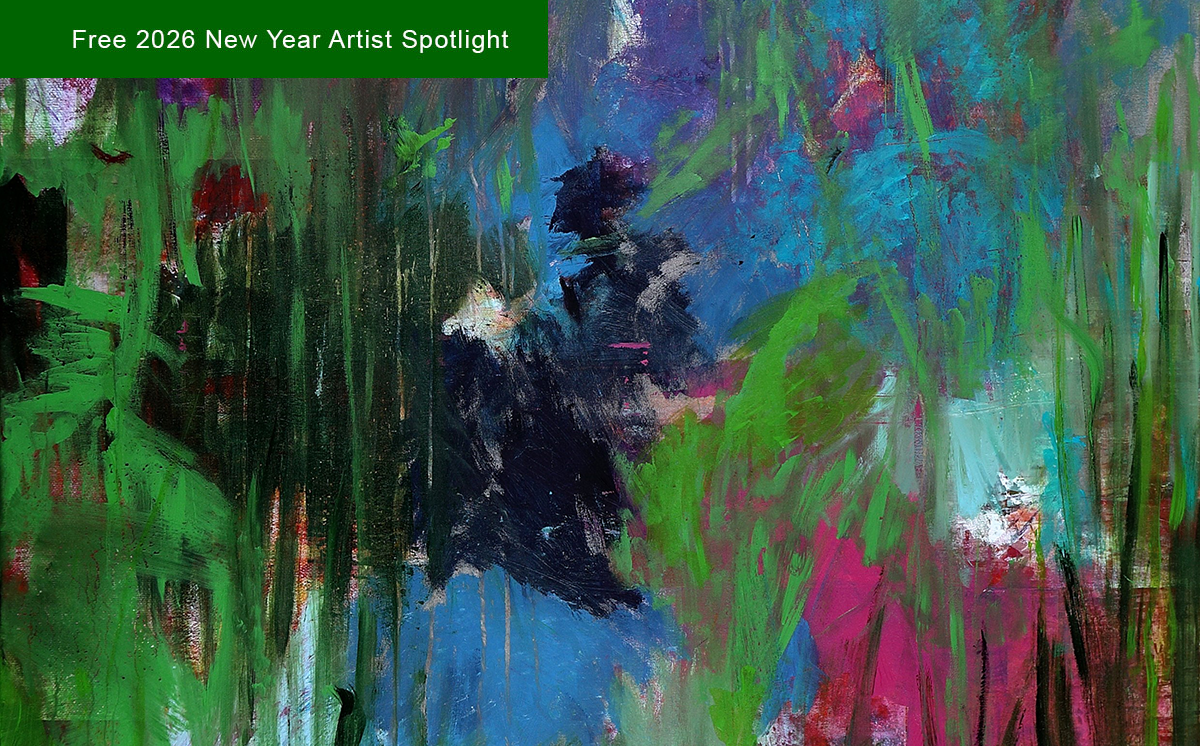
Sonja Kalb arrives at painting from a place most artists don’t start: engineering. Born in Stuttgart, Germany, she trained in textile and design engineering—work that depends on accuracy, systems thinking, and an intimate understanding of how materials behave. That early education doesn’t show up in her paintings as rigidity. It shows up as steadiness. She knows how to build a surface, how to hold a composition together, how to use restraint without draining the work of feeling.
What keeps her practice alive is the way she treats that discipline as a launchpad, not a limit. Her abstractions live in the tension between intention and surprise. You can sense decisions—how space is arranged, how color is weighted, how movement is guided—yet nothing feels overly controlled. The paintings stay porous. They shift as you look. They don’t invite decoding so much as participation. Give them time, and your own way of seeing starts to recalibrate.
Nature Pure I–III: A Series That Starts Moving Back
At first glance, Nature Pure I–III reads fast: saturated color, layered marks, a surface alive with motion. But the trilogy isn’t meant to be consumed in passing. It asks for a slower pace—one where the first impression is only the threshold. Stay with these works and they begin to function less like pictures and more like locations. Openings appear where you didn’t notice them before. Edges stop feeling fixed. Suggestions of presence arrive—then retreat—like something half-seen at the edge of a path.
A key strength of the series is that it refuses to romanticize nature. Kalb doesn’t offer a neat, decorative version of the natural world. This is nature as experience: abundant, complex, sometimes generous, sometimes withholding. Even as the work remains abstract, it carries a sense of the organic—growth, pressure, weather, concealment. The paintings never declare “forest” or “river” or “creature.” They simply make space for those associations to surface on their own. That’s why the trilogy can feel like landscape and interior state at the same time—outer terrain that mirrors a psychological one.
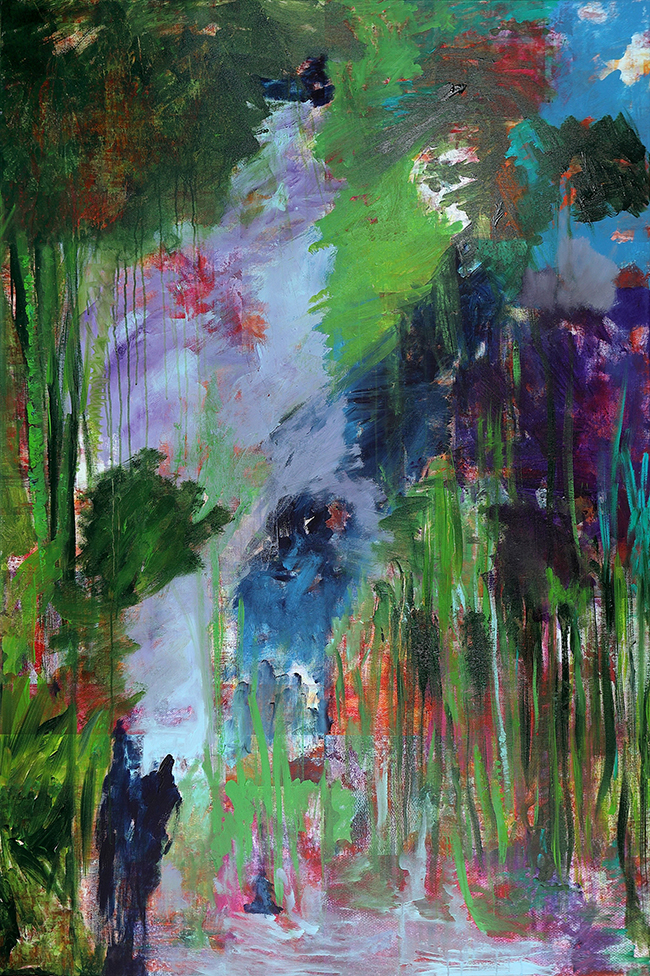
Nature Pure I: The Clearing You Only Notice When You Stop
In the first painting, a lighter zone opens near the center—like a break in density, a strip of air, a route forward. It could read as light through leaves, a stream cutting through growth, or just a breath of space inside a crowded field. Around it, deeper areas push inward: heavy greens, pockets of purple, and brief red flashes that land like signals—life, warning, bloom, pulse.
The drips change the temperature of the work. They keep it from becoming too clean, too finished, too carefully “composed.” They feel like gravity had a say. Like weather passed through. The surface carries evidence of something happening, not simply being arranged.
And beneath the brightness, shadow gathers. Forms may suggest themselves—figures, animal hints, silhouettes—or you may only feel thickness and depth. That ambiguity is part of the experience. The painting lets recognition hover without forcing a conclusion, holding you in that honest space between seeing and imagining.
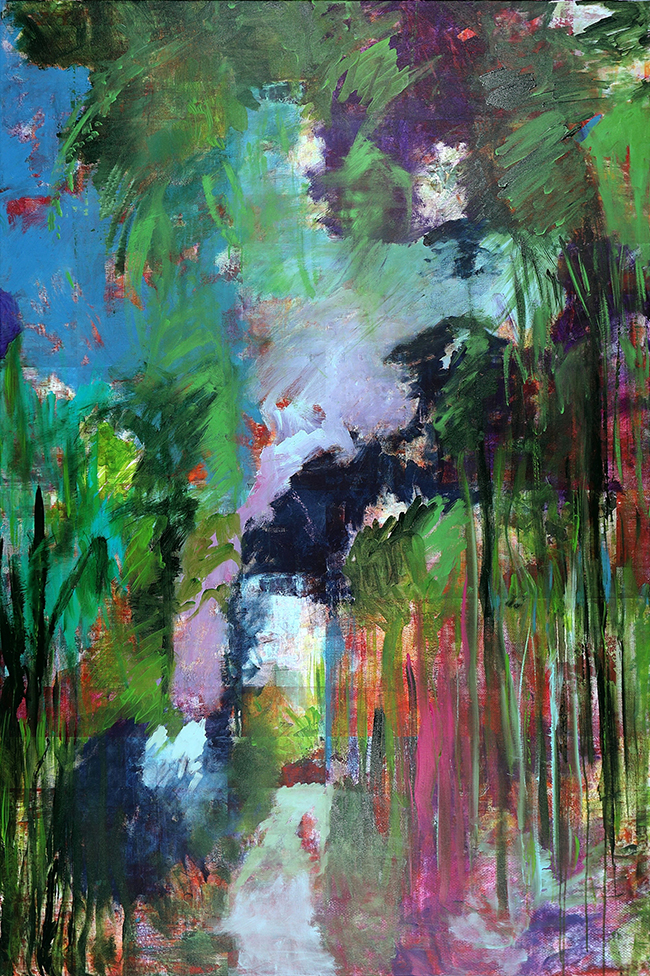
Nature Pure II: An Invitation With Limits
The second work feels closer, denser, more immediate. Color hits with more insistence, as if the painting has stepped forward. On the left, turquoise-blue reads like cooled air after rain. On the right, magenta carries the feel of a curtain or boundary—something that might part, conceal, or frame whatever comes next. Between them, a pale, milky band sits like fog or an opening—unclear in the best way.
This is where the sense of “presence” becomes strongest. In darker zones, face-like glimmers can appear—not as literal portraits, but as felt moments. It can seem as if the work is looking back. There’s welcome here, but also a reminder: you can enter, but you can’t run the room.
That push and pull is what gives the painting its charge. It doesn’t try to relax you. It wakes you up. It asks you to notice what you’re bringing into the encounter, what you’re projecting, and what the painting might be returning.
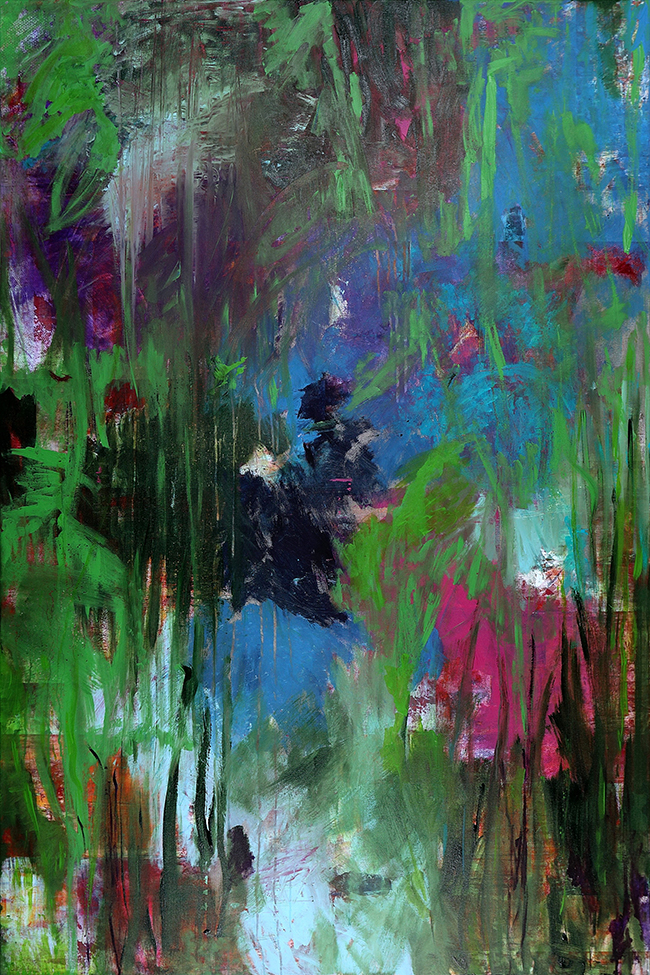
Nature Pure III: Depth, Weight, and the Moment You Belong
The third piece turns inward. It’s darker, more layered, and more quietly intense. A cool blue anchors one side while green presses over it like a living veil, as if growth is covering something older beneath. At the center is a dense, dark knot—core, pool, thought, gravity. Near the bottom, a lighter passage appears—an opening that could be exit or entry, depending on how you read it. The uncertainty stays intact, and that’s why it works.
This painting carries a particular emotional shift: when nature stops being backdrop and becomes a system you’re inside of. Not as a visitor. As something folded into it. The work doesn’t perform. It takes you in. And in that absorption, it lands with depth—without needing to announce anything.
A Practical Way to Look
If you want a straightforward way into the trilogy, resist naming too fast. Give each painting twenty seconds before you try to “recognize” anything. First, look for paths—clearings, breaks, openings, passages. Then look for beings—presences, silhouettes, face-hints, animal suggestions, whatever your perception offers.
What comes isn’t certainty. It’s expansion. These paintings don’t behave like statements. They behave like places—and the longer you stay, the more they reveal.
