

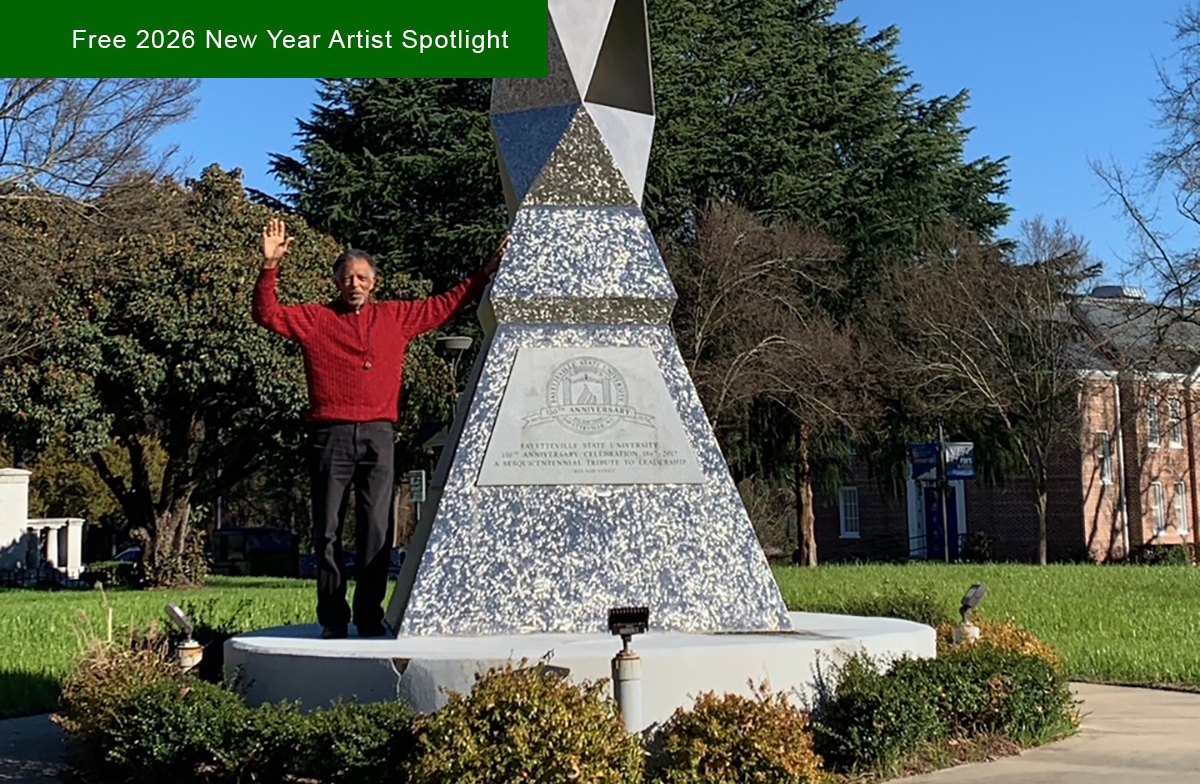
Born in Greensboro, North Carolina, in 1953, Vandorn Hinnant has spent decades shaping a practice where craft and inquiry move side by side. For him, art is never only about technique—it’s a way to test ideas about identity, values, and the forces that shape a life. He earned a B.A. in Art Design from North Carolina A&T State University, then strengthened his understanding of volume and scale through sculpture studies at the University of North Carolina at Greensboro. That dual foundation—design training with sculptural rigor—runs through everything he builds. His forms feel deliberate and resolved, yet they stay open to interpretation, allowing symbolism and intuition to sit comfortably alongside structure. Now based in Durham, Hinnant is widely associated with public commissions that turn everyday walkways and campuses into places for pause—works that ask people to look again at leadership, dignity, and the weight of shared history.
Work 1: “A Monument to Leadership at FSU” — ascent as a language
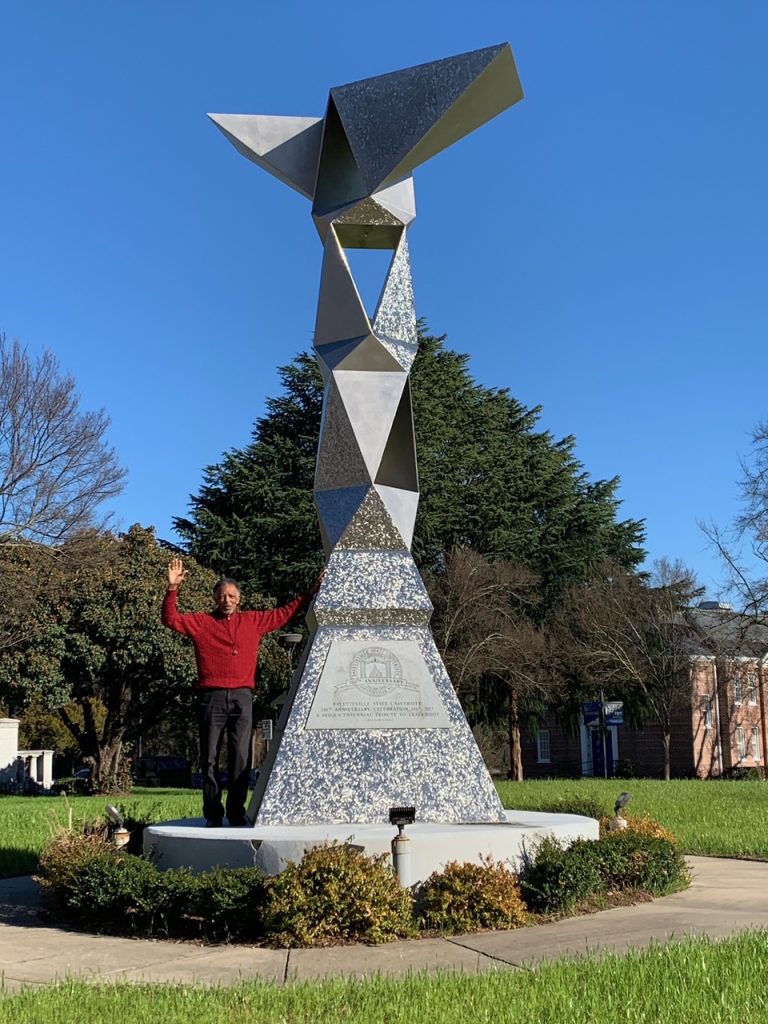
At Fayetteville State University, A Monument to Leadership rises as a focused vertical presence—part civic marker, part spiritual signpost. It reads less like an object placed in space and more like a form in motion, with an implied spiral that encourages the eye to climb. The sculpture’s logic centers on the number four: a four-part balance that echoes the Four Directions and suggests leadership as something assembled from multiple strengths rather than a single trait.
Hinnant has described the piece as a sequence of sections, like a stacked diagram of development. Near the top, the shape hints at a headdress—an abstract sign of responsibility—while also resembling wings, shifting the idea from status to uplift. Below, the work moves through supportive forces: feeling, insight, will, and grounded stability. The openings in the upper structure act like intentional silences—spaces that appear empty but imply what can’t be seen directly: spirit, breath, the invisible. At the base, inscribed historical elements do more than provide context; they function as metaphor, turning the foundation into “roots,” and the upward rise into growth that comes from what’s already there.
Work 2: “A Monument to Dignity and Respect” — a dialogue in steel
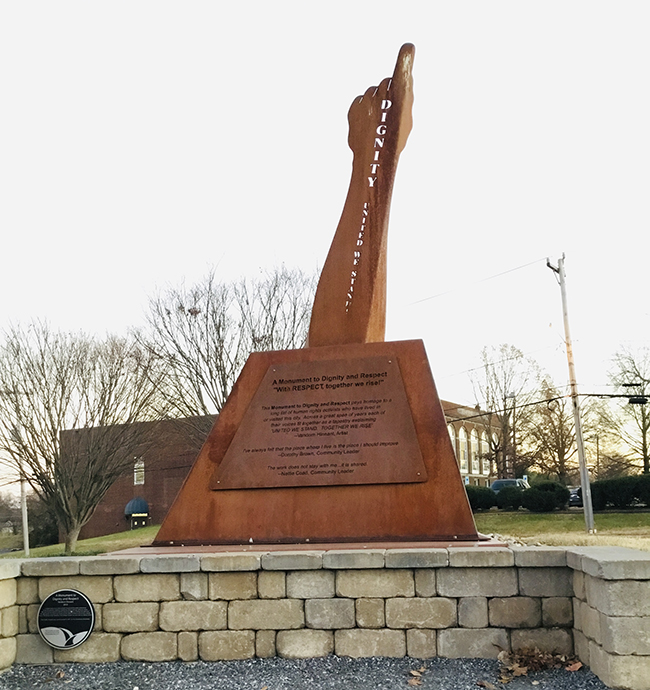
If the FSU work speaks through a single upward trajectory, A Monument to Dignity and Respect speaks through placement and exchange. Made for Greensboro’s Downtown Greenway and tied to Ole Asheboro—the neighborhood where Hinnant grew up—the installation is composed of two matching works set a block apart, facing each other across the path like a conversation held at a distance. Each element is a 14-foot Corten steel hand, index finger pointed upward, mounted on a steel base. One reads, “Dignity — United We Stand.” The other responds, “Respect — Together We Rise.”
The gesture is immediate: a finger raised to call attention, to mark importance, to ask for presence. The pairing shifts the meaning. Instead of one monument delivering one message, the two hands create a relationship in space, and the greenway becomes the bridge between them. The work doesn’t posture as an order; it feels like a shared insistence—values stated plainly and kept in view.
Text at the bases deepens the piece. Quotes from Dorothy Brown and Nettie Coad, alongside Hinnant’s words, are cut into steel panels, bringing community voices into the sculpture itself. That choice keeps the work anchored in lived experience and local memory, rather than letting it float as a generic statement.
Conclusion
Together, these projects show Hinnant’s approach: build the structure, then let meaning move through it. Symmetry, proportion, and clear direction aren’t just visual decisions—they’re how the work carries its message. His public sculptures don’t shout. They hold their ground, invite reflection, and give shared space something steady to return to—rooted in history, shaped by place, and oriented toward what we choose to honor.
