

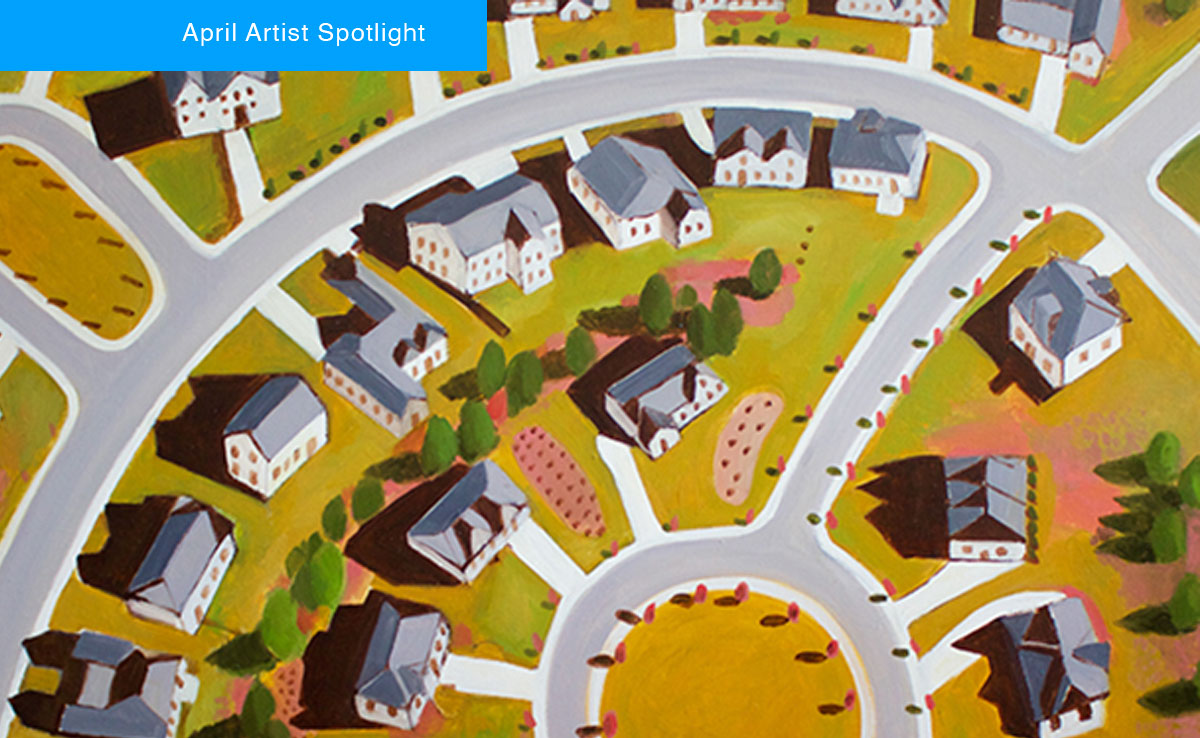
Toni Silber-Delerive’s work begins with a foundation shaped by both formal training and a wide-ranging curiosity about materials. She earned a BFA in painting from the Philadelphia College of Art, followed by an MA in art education from Kean College in New Jersey. Her path did not stay confined to a single discipline. Time spent at the School of Visual Arts in New York expanded her approach, introducing graphic design and silkscreen printing into her practice. These experiences continue to inform how she builds images today. Rather than treating painting as separate from design, Silber-Delerive allows structure, repetition, and clarity to move between mediums. The result is a body of work that feels considered but not rigid, where composition becomes a way of thinking through space, memory, and the environments people inhabit.
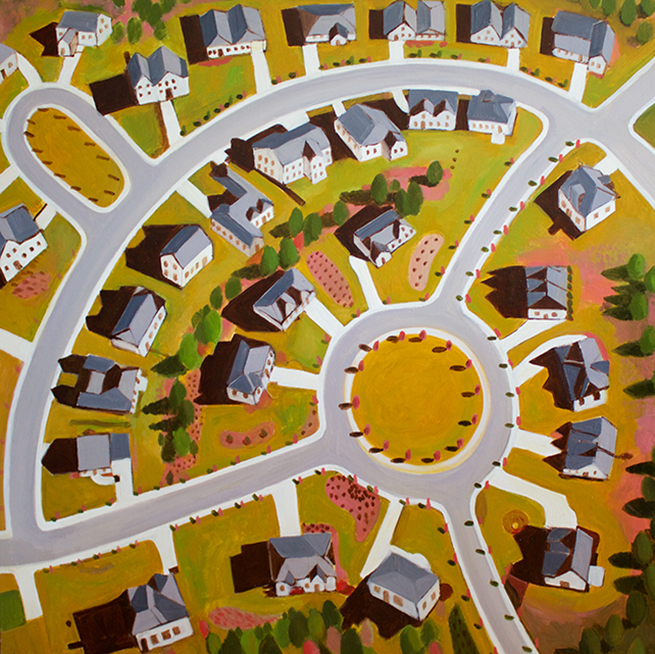
In Circular Development, Silber-Delerive turns her attention to a suburban cul-de-sac, viewed from above. The shift in perspective is immediate and deliberate. By removing the ground-level viewpoint, she strips away the familiarity of everyday experience and replaces it with something more analytical. The neighborhood is no longer a place to move through but a form to be read. Streets, driveways, and rooftops are reorganized into a circular structure that anchors the entire composition. This aerial vantage point transforms what might otherwise feel ordinary into something measured and intentional.
The painting operates within a flattened picture plane, where depth is reduced and detail is distilled. Architectural elements are simplified into geometric shapes, allowing pattern to take precedence over realism. Houses become blocks of color and form, arranged in a way that emphasizes repetition without becoming mechanical. Each structure holds its own presence, yet none dominate the composition. Instead, the eye moves across the surface in a steady rhythm, guided by the circular arrangement.
There is a quiet discipline in how Silber-Delerive handles space. The cul-de-sac, often understood as a symbol of closure or containment, becomes a compositional device that organizes the painting. The circle does not feel restrictive. It creates cohesion. Roads curve gently, connecting each home while reinforcing the sense of continuity. This arrangement suggests a shared structure beneath individual lives, where private spaces exist within a larger, interconnected system.
Color plays a steady role in maintaining balance across the surface. The palette is controlled, avoiding extremes while allowing subtle variations to emerge. These shifts in tone help distinguish one form from another without disrupting the unity of the composition. Rather than using color to dramatize, Silber-Delerive uses it to stabilize. The result is an image that feels calm but not static, where small changes carry weight.
Soft-edged shapes contribute to this atmosphere. Edges are not sharply defined, which softens the geometry and prevents the composition from becoming overly rigid. This choice introduces a sense of quiet movement, as if the forms are still settling into place. The painting resists precision for its own sake. Instead, it allows slight irregularities to remain, giving the surface a more human quality.
Shadows are handled with restraint but serve an important function. They suggest a specific time of day without anchoring the image to a fixed moment. These subtle shifts in light introduce depth while maintaining the overall flatness of the picture plane. The balance between surface and space remains intact. Nothing breaks the cohesion of the composition, yet there is enough variation to keep the image active.
What emerges from Circular Development is a careful study of how environments are constructed and perceived. The suburban layout, often associated with routine and repetition, is reexamined through structure and form. Silber-Delerive does not critique or idealize the setting. Instead, she presents it as something to observe closely. By reducing detail and emphasizing pattern, she reveals an underlying order that might otherwise go unnoticed.
There is also a sense of distance in the work. The aerial perspective creates separation between the viewer and the subject. This distance allows the composition to be read more objectively, as a system rather than a lived space. At the same time, the familiarity of the forms keeps the image grounded. The viewer recognizes the environment, even as it is transformed.
Silber-Delerive’s background in graphic design and silkscreen printing can be felt throughout the painting. The clarity of form, the emphasis on repetition, and the controlled use of color all point to a sensibility shaped by multiple disciplines. These influences are not layered on top of the work. They are integrated into how the image is constructed from the start.
In the end, Circular Development holds its focus on structure without losing its connection to lived experience. It is a painting that asks the viewer to slow down and consider how familiar spaces are organized. Through simplification and careful arrangement, Silber-Delerive creates an image that feels both distant and recognizable, analytical and grounded. The cul-de-sac becomes more than a setting. It becomes a way of understanding how individual lives sit within a shared design.
